4th Queen's Own Hussars: A History of Valor and Evolution
The story of the 4th Queen's Own Hussars is a sweeping chronicle of British military history, spanning nearly three centuries of service. From its origins as a response to internal rebellion in the 17th century to its role as a mechanized force in the 20th century, the regiment evolved through various designations and roles, consistently placing itself at the center of Europe's and the world's most pivotal conflicts.
Key Facts
- Founded: 1685 by the Hon. John Berkeley.
- Original Name: The Princess Anne of Denmark's Regiment of Dragoons.
- Notable Conflicts: Nine Years' War, War of the Spanish Succession, Peninsular War, Crimean War, WWI, and WWII.
- Famous Association: Winston Churchill served as a cornet and later as Honorary Colonel.
- Final Amalgamation: Merged with the 8th King's Royal Irish Hussars in 1958 to form the Queen's Royal Irish Hussars.
Formation and Early Engagements (1685–1788)
The regiment was raised in 1685 as The Princess Anne of Denmark's Regiment of Dragoons, formed from independent troops to counter the Monmouth Rebellion. Initially ranked as the 4th Dragoons, the unit shifted its allegiance to King William III in 1689, subsequently fighting James II's forces in Scotland.
Throughout the late 17th and early 18th centuries, the regiment faced grueling campaigns. It suffered heavy losses during the Nine Years' War at the Battle of Steenkerque (1692) and the Siege of Namur (1695), and again during the War of the Spanish Succession at the Battle of Almansa (1707). They also played a role in the Jacobite rising at the Battle of Sheriffmuir in 1715.
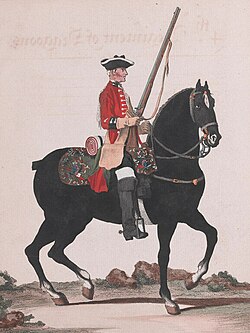
During the War of the Austrian Succession, the regiment's bravery was highlighted at the Battle of Dettingen (1743), where Trooper George Daraugh recovered the regimental standard from a French officer. Despite a disastrous ambush leading to the Fall of Ghent in 1745, the regiment fought valiantly at the Battle of Lauffeld in 1747. By 1751, it was formally titled the 4th Regiment of Dragoons, and after helping suppress the Gordon Riots in 1780, it was renamed the 4th (Queen's Own) Regiment of Dragoons in 1788.
The Napoleonic Era and the 19th Century
Under the command of Sir Arthur Wellesley, the regiment distinguished itself during the Peninsular War. Key actions included the Battle of Talavera (1809), a successful ambush at the Battle of Usagre (1811), and a charge at the Battle of Salamanca (1812), where they seized silver belonging to Joseph Bonaparte. They concluded this era with engagements at Vitoria (1813) and Toulouse (1814).
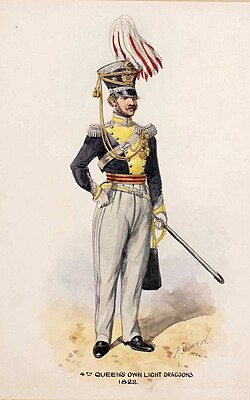
In 1818, the unit was designated as light dragoons, becoming the 4th (The Queen's Own) Regiment of (Light) Dragoons. This new role took them to the First Anglo-Afghan War, where they fought at the Battle of Ghazni in 1839.
The Crimean War and the Charge of the Light Brigade
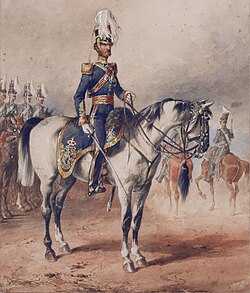
One of the most famous chapters in the regiment's history occurred during the Crimean War. After fighting at the Battle of Alma in September 1854, the regiment served in the second line of cavalry during the legendary Charge of the Light Brigade at the Battle of Balaclava. While the brigade successfully broke through Russian artillery and cavalry, they were unable to hold their position and suffered heavy casualties during the withdrawal. The regiment lost 55 men and four officers; however, Private Samuel Parkes was awarded the Victoria Cross for saving Trumpeter Hugh Crawford.
Transition to the Modern Era
In 1861, the unit became the 4th (Queen's Own) Hussars. A notable addition to its ranks occurred in February 1895, when Winston Churchill was commissioned as a cornet.
The First World War
Deploying to France in August 1914 as part of the 3rd Cavalry Brigade, the regiment endured the Great Retreat and the First and Second Battles of Ypres. In March 1918, they helped halt the German advance at the Battle of Moreuil Wood, a battle that claimed the life of their commanding officer, Lieutenant-Colonel John Darley.
Inter-war Period and Mechanization
Retitled as the 4th Queen's Own Hussars in 1921, the regiment spent a decade in India. The mid-1930s marked a technological shift as the regiment mechanised in 1936 and officially transferred to the Royal Armoured Corps—the branch of the British Army responsible for armored warfare—in 1939.
The Second World War and Final Years
The regiment's experience in WWII was marked by extreme hardship and resilience. After arriving in the Middle East in 1940, they fought in the Greek Campaign. While defending the Corinth Canal bridge, the regiment was overrun, resulting in the capture of over 400 men and all senior officers.
Reconstituted in Cairo in 1941, the regiment fought at the Battle of Gazala in 1942. Due to heavy losses, they were temporarily amalgamated with the 8th King's Royal Irish Hussars to form the 4th/8th Hussars for the battles of Alam el Halfa and the Second Battle of El Alamein. They later fought with distinction during the Italian campaign. During this period, Winston Churchill served as the Honorary Colonel of the Regiment.
Post-War and Amalgamation
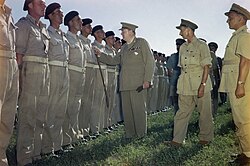
Following the war, the 4th Hussars served in Lübeck, Germany, and the Federation of Malaya. After returning to the UK and later posting to Hohne, Germany, the regiment was slated for reduction under the 1957 Defence White Paper. In 1958, it amalgamated with the 8th King's Royal Irish Hussars to form the Queen's Royal Irish Hussars.
| Year/Period | Regimental Title | Key Role/Event |
|---|---|---|
| 1685 | Princess Anne of Denmark's Regiment of Dragoons | Formation (Monmouth Rebellion) |
| 1751 | 4th Regiment of Dragoons | Formal titling |
| 1788 | 4th (Queen's Own) Regiment of Dragoons | Named for Queen Charlotte |
| 1818 | 4th (The Queen's Own) Regiment of (Light) Dragoons | Transition to Light Dragoons |
| 1861 | 4th (Queen's Own) Hussars | Redesignation as Hussars |
| 1939 | 4th Queen's Own Hussars | Transfer to Royal Armoured Corps |
| 1958 | Queen's Royal Irish Hussars | Amalgamation with 8th Hussars |
Frequently Asked Questions
Who founded the regiment?
The regiment was first raised in 1685 by the Hon. John Berkeley as The Princess Anne of Denmark's Regiment of Dragoons.
What was the regiment's role in the Charge of the Light Brigade?
The regiment served in the second line of cavalry on the right flank. They successfully broke through Russian artillery and cavalry but were forced to withdraw due to insufficient forces, losing 55 men and four officers.
How was Winston Churchill connected to the regiment?
Winston Churchill was commissioned as a cornet in the 4th Hussars in February 1895 and later served as the regiment's Honorary Colonel from 1941 until its amalgamation.
What happened to the regiment during the Greek Campaign of WWII?
While acting as the rearguard at the Corinth Canal bridge, the regiment was overrun and surrendered en masse, with over 400 men and all senior officers becoming prisoners of war.
When did the regiment stop existing as a separate entity?
The regiment ceased to be a separate entity in 1958 when it amalgamated with the 8th King's Royal Irish Hussars to form the Queen's Royal Irish Hussars.