Zygote Formation and Development Across Species
The beginning of a new life, whether in a human, a plant, or a fungus, starts with a single, specialized cell known as a zygote. Derived from the Ancient Greek word zygōtós, meaning "joined" or "yoked," a zygote is a eukaryotic cell created through the fertilization of two gametes. This single cell holds the complete genetic blueprint required to build an entire organism.
At its most basic level, a zygote is the result of karyogamy—the sexual fusion of two haploid cells (cells containing a single set of chromosomes). This process transforms two separate genetic contributions into one diploid cell, containing a combined genome from both parents.
Key Facts
- Definition: A diploid cell resulting from the fusion of two haploid gametes.
- Genetic Makeup: Contains a combination of DNA from both parents, forming the genome of a new individual.
- Totipotency: In multicellular organisms, the zygote is totipotent, meaning it has the potential to produce every cell type in the body.
- Human Timeline: The transition from a single-celled zygote to a multi-celled blastocyst occurs over approximately five days.
- Discovery: German zoologist Oscar Hertwig first proved the fusion of pronuclei in sea urchins in 1875.
The Zygote in Humans
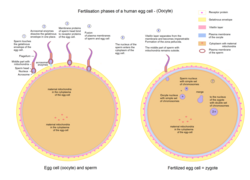
In human reproduction, fertilization occurs when a haploid sperm cell combines with a released ovum (a secondary oocyte). Once the sperm fuses with the oocyte, the oocyte completes its second meiotic division, resulting in a haploid daughter cell and a second polar body, which cannot survive or replicate.
From Fertilization to Blastomeres
Following fusion, DNA replicates within two separate pronuclei derived from the sperm and ovum. This temporarily creates a 4n diploid state. Approximately 30 hours after fertilization, these pronuclei fuse, and the cell undergoes its first mitotic division. This produces two 2n diploid daughter cells called blastomeres.
The Journey to Implantation
The developing conceptus travels through the fallopian tube toward the uterus. During this journey, it undergoes cleavage—a process of rapid cell division that does not increase the overall size of the organism. The developmental stages progress as follows:
- Morula: After four divisions, the conceptus consists of 16 blastomeres.
- Blastocyst: By the fifth day, through compaction and blastulation, the embryo becomes a blastocyst.
- Implantation: The blastocyst hatches from the zona pellucida (the protective outer layer) and implants into the endometrial lining of the uterus to begin gastrulation.
In medical and legal contexts, the stage between fertilization and implantation is sometimes referred to as a preimplantation embryo or pre-embryo.
Biological Mechanisms and Diversity
Epigenetic Reprogramming
For a zygote to be totipotent, it must undergo epigenetic reprogramming. This involves DNA demethylation—the removal of methyl groups from the DNA, particularly in the paternal genome. In mice, this process is linked to base excision repair and other DNA-repair mechanisms, which are essential for establishing the cell's ability to produce a whole organism.
Zygotes in Other Organisms
The behavior of the zygote varies significantly across different kingdoms of life:
- Plants: In land plants, the zygote forms within a flask-shaped chamber called the archegonium. Some plants may produce polyploid zygotes if fertilization occurs between unreduced gametes.
- Fungi: Depending on the species' life cycle, the zygote may enter either mitosis or meiosis.
- Single-Celled Organisms: Some can divide asexually via mitosis to create identical offspring. In Chlamydomonas, rare biparental zygotes containing chloroplast DNA from both parents have allowed scientists to map chloroplast genes.
| Organism Group | Key Feature/Location | Primary Process |
|---|---|---|
| Humans | Fallopian tube to Uterus | Cleavage $\rightarrow$ Morula $\rightarrow$ Blastocyst |
| Land Plants | Archegonium | Growth within the archegonium |
| Fungi | Species-dependent | Mitosis or Meiosis |
| Single-Celled | Cytoplasm | Asexual mitosis or recombination |
Frequently Asked Questions
What is the difference between a gamete and a zygote?
A gamete is a haploid reproductive cell (like a sperm or egg) containing half the genetic material of an organism. A zygote is the diploid cell formed when two gametes fuse, containing a full set of genetic information.
What is totipotency in a zygote?
Totipotency is the ability of a single cell to divide and produce all the differentiated cells in an organism, including extra-embryonic tissues like the placenta.
How long does it take for a human zygote to become a blastocyst?
It takes approximately five days for the zygote to undergo cleavage and blastulation to reach the blastocyst stage before implanting in the uterus.
What is the role of the zona pellucida?
The zona pellucida is a protective layer surrounding the embryo. The blastocyst must "hatch" from this layer before it can successfully implant into the uterine lining.
What is karyogamy?
Karyogamy is the specific biological process where the nuclei of two haploid cells fuse to form a single diploid nucleus, resulting in the creation of a zygote.