Zollverein: The Economic Engine of German Unification
The Zollverein, or German Customs Union, was a landmark coalition of German states designed to manage tariffs and synchronize economic policies. Formally established on January 1, 1834, through the Zollverein treaties, it represented a revolutionary step in international relations: it was the first time in history that independent states formed a full economic union without simultaneously creating a political federation.
Driven primarily by Prussia, the union sought to dismantle the suffocating web of internal trade barriers that had long hindered Central European commerce. While it operated independently of the German Confederation (1815–1866), the Zollverein eventually encompassed most German states, creating a massive internal market that paved the way for the eventual political unification of the German Empire.
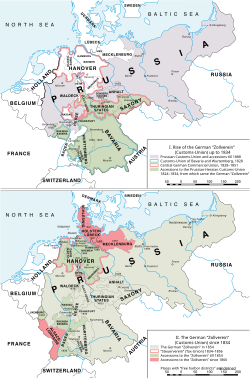
Key Facts
- Start Date: January 1, 1834.
- Primary Driver: The Kingdom of Prussia.
- Core Purpose: To eliminate internal customs barriers and establish a unified external tariff.
- Scale: By 1867, it covered approximately 425,000 square kilometers.
- Notable Exclusion: Austria was excluded due to protectionist policies and political opposition from Prince von Metternich.
- End Date: The union was effectively ended by the Treaty of Versailles in 1919 (specifically for remaining members like Luxembourg).
The Chaos of Early German Trade
To understand the necessity of the Zollverein, one must look at the fragmented state of the Holy Roman Empire in the 1790s. Central Europe was a patchwork of tiny territories, resulting in approximately 1,800 customs barriers. Even within Prussia, there were over 67 local customs zones. A shipment traveling from Königsberg to Cologne could be inspected and taxed roughly 80 times, drastically increasing prices and stifling profit.
The Napoleonic Era brought some consolidation. The Mediatization of 1803 (the Reichsdeputationshauptschluss) reorganized the map by annexing smaller imperial cities and ecclesiastical territories into larger states. However, Napoleon's Continental System—a trade embargo against Britain—proved disastrous. While it attempted to create a domestic European market, its primary goal was military. The resulting isolation from British raw materials and markets nearly ruined the economies of the Rhineland and Lowlands.
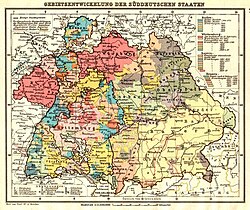
The Path to Economic Unity
Following the Congress of Vienna (1814–1815), the German states remained autonomous under the German Confederation. While diplomats focused on political spheres of influence, economic standardization was ignored. Prussia took the lead in 1818 by abolishing its own internal tariffs, creating a simple system where goods moved freely within the state but faced high tariffs at the external border.
The push for a broader union was championed by the economist Friedrich List. List argued that without protection from superior English industrial exports, German tradesmen would be reduced to "drawers of water and hewers of wood for Britain." This sentiment drove the demand for a unified trade front.
Early Attempts and the South German Union
Not all states trusted Prussia. In 1820, the "Third Germany"—middle-sized states including Württemberg, Baden, and Bavaria—attempted to form their own union to avoid Prussian dominance. This effort largely failed due to conflicting interests, such as Bavaria's strict protective tariffs. However, a 1825 agreement between Württemberg and Bavaria did establish the South German Customs Union.
The Expansion of the Zollverein
The tide turned in 1834 when Baden and Württemberg joined the Prussian-led system, officially renaming it the German Customs Union. By 1835, the majority of the German Confederation's states had joined, including Saxony and Bavaria. This removed internal barriers while maintaining a protectionist stance toward foreign trade partners.
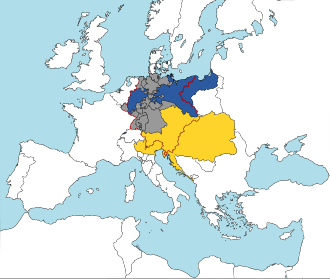
Timeline of Key Events
| Date | Event |
|---|---|
| 1818 | Prussia establishes an internal customs union. |
| 1826 | Bavaria and Württemberg form the South German Customs Union. |
| 1828 | Prussia and Hesse-Darmstadt form the Prussian-Hessian Customs Union. |
| 1834 | Formal start of the Zollverein (German Customs Union). |
| 1852 | Vienna Monetary Treaty standardizes currencies among member states and Austria. |
| 1871 | The German Empire assumes control of the customs union. |
| 1888 | Hamburg joins the Zollverein (with specific port exemptions). |
| 1919 | Treaty of Versailles ends the union for remaining members like Luxembourg. |
Impact and Legacy
The Zollverein's impact is a subject of historical debate. Some historians, such as Helmut Böhme and H.-U. Wehler, argue that the union laid the essential groundwork for German political unification under Prussian leadership. By tying the smaller states to Prussia economically, Berlin gained significant leverage.
Conversely, historians like Hans-Joachim Voth suggest that the union may have actually helped smaller states maintain their independence. Increased revenues from the customs union allowed some governments to consolidate their own power, and membership did not always translate into political loyalty to Prussia.
Frequently Asked Questions
Why was Austria excluded from the Zollverein?
Austria was excluded due to its highly protectionist trade policies, its refusal to divide its customs territory into separate regions (Austrian, Hungarian, and Galician-Lodomerian), and the direct opposition of Prince von Metternich.
What was the primary goal of Friedrich List?
Friedrich List sought to protect German industry from British competition. He advocated for a unified customs union to foster domestic industrialization and prevent Germany from becoming a mere provider of raw materials to Britain.
Did the Zollverein lead directly to the German Empire?
While it created economic unity and increased Prussian influence, it was not a political union. Some historians believe it paved the way for unification, while others argue it was a purely fiscal arrangement that didn't guarantee political commitment.
Which states joined the Zollverein late?
Hamburg is a notable example of a late addition, joining in 1888. Hamburg negotiated a specific exemption for a 4-square-mile area at the center of its port to remain outside the union's regulations.
How did the Zollverein end?
After the founding of the German Empire in 1871, the Empire took control of the union. The final remnants of the original arrangement, such as Luxembourg's membership, were ended by the Treaty of Versailles in 1919.