German Confederation: The Bridge to a Unified Germany
The German Confederation (German: Deutscher Bund) was a complex association of 39 predominantly German-speaking sovereign states in Central Europe. Established in 1815, it served as a loose political entity that filled the power vacuum left by the dissolution of the Holy Roman Empire in 1806. For five decades, it acted as a buffer and a diplomatic arena where the competing interests of the Austrian Empire and the Kingdom of Prussia clashed.
Created by the Congress of Vienna following the Napoleonic Wars, the Confederation was not a single nation-state but a league of independent princes and free cities. Its primary purpose was to maintain stability in Central Europe while preventing any single power from dominating the region entirely.
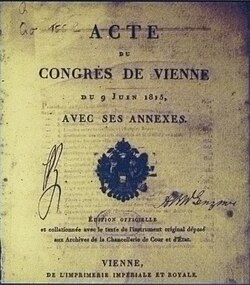
Key Facts
- Duration: 1815–1848 and 1850–1866.
- Capital: Frankfurt.
- Membership: Started with 39 sovereign states, fluctuating over time.
- Leadership: Dominated by the Präsidialmacht (presidency) of Austria.
- Legislature: The Federal Convention (Bundestag).
- Dissolution: Ended following the Austro-Prussian War of 1866.
The Structure and Governance of the Bund
The Confederation operated through the Federal Convention, a representative body based in Frankfurt. Unlike modern parliaments, this was a gathering of diplomats representing the sovereign states. Austria held a privileged position as the presiding power, with figures like Chancellor Klemens von Metternich exerting significant influence over the Confederation's policies from 1815 until 1848.
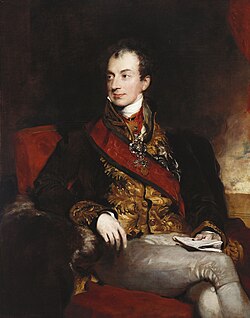
The member states varied wildly in size and status, ranging from powerful empires and kingdoms to tiny principalities and free cities. This diversity created a fragile balance of power, often resulting in political deadlock between the two largest members: Austria and Prussia.
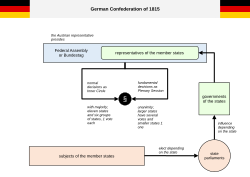
Member State Categories
- Empire: Austria.
- Kingdoms: Prussia, Bavaria, Saxony, Württemberg, and Hanover.
- Grand Duchies: Including Baden, Hesse, and Luxembourg.
- Duchies and Principalities: Numerous smaller territories such as Anhalt and Liechtenstein.
- Free Cities: Frankfurt, Hamburg, Bremen, and Lübeck.
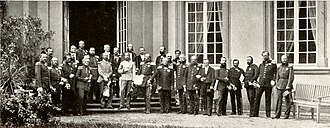
Military and Economic Integration
The Confederation maintained a collective defense system known as the German Federal Army. Military interventions were categorized into three types: the federal war (against external enemies), the federal execution (against member states violating federal law), and other internal security measures. The only true federal war occurred during the First Schleswig War against Denmark in 1848.
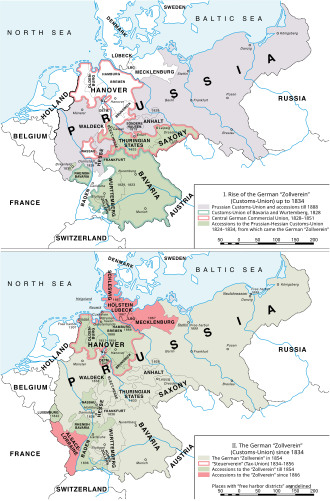
While political unity remained elusive, economic integration progressed through the Zollverein (Customs Union). This agreement eliminated internal tariffs and created a common external trade policy, effectively strengthening Prussia's economic lead over Austria and laying the groundwork for future political unification.
Federal Army Strength (1860 Projection)
| State | Population | Troop Totals | Annual Expenditure (Austrian Gulden) |
|---|---|---|---|
| Austrian Empire | 10,086,900 | 158,037 | 9,432,000 |
| Kingdom of Prussia | 9,957,000 | 133,769 | 7,956,000 |
| Kingdom of Bavaria | 4,120,000 | 59,334 | 3,540,000 |
| Kingdom of Württemberg | 1,547,400 | 23,259 | 1,389,000 |
| Kingdom of Saxony | 1,480,000 | 20,000 | 1,194,000 |
The Path to Dissolution
The stability of the Confederation was shattered by the German Revolutions of 1848–1849. Driven by liberal, democratic, and nationalist desires, revolutionaries attempted to replace the loose association with a unified federal state under a liberal constitution (the Frankfurt Constitution). Although the Federal Convention dissolved in July 1848, it was reestablished in 1850 after the revolutions were suppressed.
The final collapse came not from internal revolution, but from the rivalry between Austria and Prussia. The Austro-Prussian War of 1866 decided which power would lead the German states. Prussia's victory led to the Peace of Prague and the formal dissolution of the German Confederation.
In the aftermath, Prussia established the North German Confederation in 1867, a true state that excluded Austria. Following the Franco-Prussian War, this entity expanded to include the southern German states, culminating in the proclamation of the German Empire in 1871, with the Prussian king as Emperor (Kaiser).
Frequently Asked Questions
What was the primary purpose of the German Confederation?
It was created by the Congress of Vienna in 1815 to replace the Holy Roman Empire and provide a stable association of sovereign German states that could defend against external threats without becoming a single, centralized nation-state.
How did the Zollverein influence German unification?
The Zollverein was a customs union that integrated the economies of the German states. By excluding Austria and centering trade around Prussia, it shifted the economic balance of power toward Berlin, making political unification under Prussian leadership more feasible.
What happened during the Revolutions of 1848?
Liberal and nationalist movements attempted to transform the Confederation into a unified federal state with a liberal constitution. While the Frankfurt Parliament sought to create a democratic Germany, the movement was eventually crushed by the conservative forces of Austria and Prussia.
Why did the German Confederation eventually dissolve?
The Confederation dissolved due to the irreconcilable rivalry between Austria and Prussia. This culminated in the Austro-Prussian War of 1866, where Prussia's victory allowed it to dismantle the old system and create the North German Confederation.
Which territories were part of the Confederation but are not in modern Germany?
The Confederation included territories that now belong to Austria, the Czech Republic, Slovenia, Luxembourg, Liechtenstein, and parts of Poland and Croatia.