Federal Fortresses of the German Confederation: A 19th Century Defensive Line
Following the Napoleonic Wars, the 1815 Peace of Paris established a rigorous security framework for Central Europe. Under these terms, France was required to fund a strategic line of fortresses designed to protect the German Confederation from future French aggression. These fortifications were strategically placed outside the territories of Austria and Prussia—the two dominant and often competing powers of the Confederation—to ensure a collective defense mechanism.
The resulting system, known as the Bundesfestungen (Federal Fortresses), served as the primary visible manifestation of the central federal authorities' competence. Every piece of artillery within these strongholds was embossed with the double-headed eagle, the official symbol of the Confederation.
Key Facts
- Funding: Constructed largely using French indemnity payments, including 60 million francs for maintenance.
- Primary Goal: To secure the western border against France and provide operational bases for the Federal Army (Bundesheer).
- Core Fortresses: Mainz, Luxembourg, and Landau were the original designated sites, later joined by Rastatt and Ulm.
- Strategic Design: Many utilized the polygonal system, a Prussian-developed fortification style.
- Scale: The Fortress of Ulm was one of Europe's largest, capable of accommodating up to 100,000 men.
The Evolution of the Defensive System
The protocol of November 3, 1815, initially designated Mainz, Luxembourg, and Landau as federal fortresses, with a fourth to be built on the Upper Rhine. Funding was allocated specifically: £200,000 for Mainz, £800,000 for Prussian works on the Lower Rhine, £800,000 for a new Upper Rhine fortress, and £600,000 for Bavaria to establish a stronghold at Germersheim.
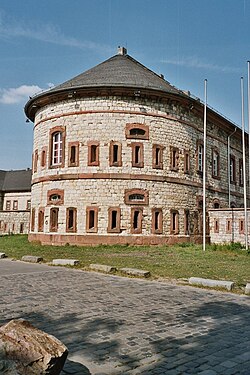
While the legal framework was set in 1815 and reinforced by the Federal War Constitution (Bundeskriegsverfassung) in 1822, the actual takeover of these sites was delayed. Mainz was acquired in 1825, Luxembourg in 1826, and Landau in 1831. By 1842, the system was expanded with the addition of the new federal fortresses at Rastatt and Ulm.
Administration and Governance
Each fortress was managed by two key figures: the Fortress Governor (responsible for general administration) and the Fortress Commandant (responsible for military administration). Both were appointed by the head of state who provided the majority of the garrison and were required to swear an oath to act solely in the interests of the Confederation's defense.
Major Federal Fortresses
Mainz
Mainz served as a joint venture between the two great powers. In peacetime, the garrison was split equally between Prussian and Austrian troops, with the command rotating every five years. To accommodate a wartime strength of 21,000 men, the city expanded beyond its walls into four cordons of detached forts on surrounding hills.
Luxembourg
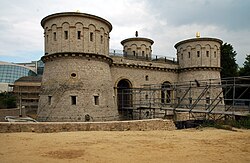
Known as the "Gibraltar of the North," Luxembourg was a massive complex of 22 forts and 22 kilometers of underground tunnels and casemates (fortified gun positions). The garrison was primarily Prussian (three-quarters) and Dutch (one-quarter). Following the Luxembourg Crisis, the Treaty of London (1867) mandated the demolition of these works.
Landau
Originally designed in 1688 by the famous engineer Sébastien le Prestre de Vauban, Landau was an older polygonal fortress. During the Confederation era, it was updated with detached forts and primarily garrisoned by Bavarian troops, with support from Baden during wartime.
Rastatt and Ulm
The creation of these two fortresses was a political compromise. Austria favored Ulm to protect southern Germany, while south German states preferred Rastatt to secure the Upper Rhine. The Federal Assembly eventually approved both in 1841.
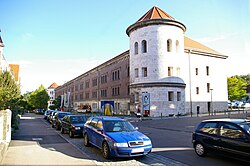
Rastatt, managed by the Grand Duchy of Baden, focused its defenses to the west, south, and east. Ulm, however, became a strategic titan. Designed by Prussian Major Moritz Karl Ernst von Prittwitz, it spanned both sides of the Danube, encompassing the cities of Ulm and Neu-Ulm. With 16 detached forts and a massive moat system, it was designed to hold 20,000 to 100,000 men.
Strategic Planning and Military Utility
The overarching strategy was to prevent a coup de main—a sudden, surprise attack—by France. The Confederation feared that French forces might use rail transport to rapidly concentrate an army in Strasbourg and invade south-west Germany.
The defensive line was anchored by a series of strongholds. Rastatt commanded the roads from Basel to the Main, while Ulm and Ingolstadt formed a secondary line of defense. Military analysts of the time suggested that as long as 150,000 to 200,000 men held the Rhine-line from Germersheim to Coblenz, no French army smaller than 300,000 could successfully cross the river.
| Fortress | Primary Garrison | Key Feature | Strategic Role |
|---|---|---|---|
| Mainz | Prussia & Austria | Four cordons of detached forts | Joint power stronghold |
| Luxembourg | Prussia & Netherlands | 22km of tunnels/casemates | "Gibraltar of the North" |
| Landau | Bavaria & Baden | Vauban-style polygonal system | Upper Rhine security |
| Rastatt | Baden & Austria | New Prussian Fortress System | Frontier defense against Alsace |
| Ulm | Federal Army | 16 detached forts; 100k capacity | Southern Germany training/defense |
Frequently Asked Questions
Who paid for the construction of these fortresses?
The construction was funded primarily by indemnity payments forced upon France following the Peace of Paris in 1815, with additional maintenance provided by the Federal Matriculation Fund financed by member states.
What was the "Gibraltar of the North"?
This was the nickname for the Fortress of Luxembourg, earned due to its formidable defenses, which included 22 forts and an extensive network of tunnels and casemates carved into the rock.
Why was the Fortress of Ulm not destroyed after World War I?
Because it was never fully armed during wartime, it was not designated for destruction. Many of its works survived and were later used as emergency shelters during World War II.
What was the purpose of the polygonal system?
The polygonal system was a Prussian-developed method of fortification that moved away from older bastioned designs to create more efficient defensive works adapted to the surrounding terrain.
How did the fortresses prevent a French invasion?
They were designed to force an invading army into time-consuming sieges, covering the concentration of the Federal Army and serving as operational bases for defensive counter-attacks.