Zenith and Nadir: Defining the Highest Points in Astronomy
In everyday conversation, people often use the word zenith to describe the highest point or peak of a career or a celestial body's path. However, in the precise world of astronomy, the term has a very specific geometric meaning. Rather than referring to a peak in a journey, the zenith is a fixed point of reference in the sky directly above an observer.
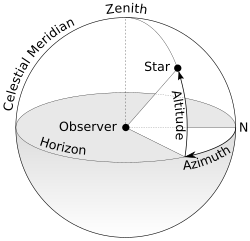
To understand the zenith, one must imagine the celestial sphere, an imaginary sphere of infinite radius surrounding the Earth. In this system, the zenith is the point exactly 90 degrees above the observer's horizon. Its opposite point, located directly below the observer on the other side of the Earth, is known as the nadir.
Key Facts
- The zenith is the point directly overhead; the nadir is the point directly below.
- The zenith angle is the angular distance between the zenith and a specific celestial object.
- The Sun only reaches the zenith for observers located between the Tropic of Cancer and the Tropic of Capricorn.
- Zenith stars are stars whose declination matches the observer's latitude.
- On the International Space Station (ISS), zenith and nadir are used instead of "up" and "down" relative to Earth.
The Geometry of the Sky
In a scientific context, the zenith serves as a primary reference for measuring the zenith angle (or zenith angular distance). This is the angle between the local zenith and a direction of interest, such as a specific star. The zenith angle is the complement of the altitude angle (also called the elevation angle), which measures the height of an object above the horizon.
The zenith also helps define the astronomical meridian. This is a great circle on the celestial sphere that passes through the zenith, the nadir, and the celestial poles.
The Sun and the Subsolar Point
While many say "the sun reached its zenith" to mean it reached its highest point of the day, astronomers only use this term if the Sun is exactly 90° above the horizon. This occurrence only happens at the subsolar point—the specific location on Earth where the Sun is directly overhead. This phenomenon is restricted to the tropics, between the Tropic of Cancer and the Tropic of Capricorn.

This astronomical alignment has practical applications. In Islamic astronomy, the Sun passing over the zenith of Mecca is used to determine the qibla (the direction of prayer) via shadow observations twice a year, specifically on May 27/28 and July 15/16.
Zenith Telescopes and Space Navigation
Because the zenith is a fixed point of reference, some instruments are designed specifically to look straight up. A zenith telescope is built to point at or near the zenith to simplify construction or achieve high-precision measurements of star positions. Examples include the Large Zenith Telescope and the NASA Orbital Debris Observatory, both of which utilize liquid mirrors that require the telescope to point exclusively upward.
This terminology extends beyond Earth. On the International Space Station, where traditional gravity-based directions are absent, astronauts use zenith and nadir to describe directions relative to the Earth below them.
Zenith Stars and Celestial Navigation
A zenith star (also known as a latitude star or overhead star) is a star whose declination—its angular distance north or south of the celestial equator—is equal to the observer's latitude. Because of this equality, the star will pass exactly through the zenith at some point during the day or night.
This relationship is vital for celestial navigation. By identifying a zenith star, a navigator can determine their latitude. Furthermore, if the current time at Greenwich is known, the observer's longitude can be calculated using the star's right ascension (its celestial longitude) at the moment it culminates at the zenith.
| Term | Definition | Relative Position |
|---|---|---|
| Zenith | The point directly above the observer | 90° from the horizon |
| Nadir | The point directly below the observer | Opposite the zenith |
| Subsolar Point | The spot on Earth where the Sun is at the zenith | Within the tropics |
| Zenith Star | A star with declination equal to observer's latitude | Passes through the zenith |
Frequently Asked Questions
Does the Sun reach the zenith every day?
No. The Sun only reaches the zenith for observers located between the Tropic of Cancer and the Tropic of Capricorn, and even then, only on specific days of the year.
What is the difference between the zenith angle and the altitude angle?
They are complementary angles. The altitude angle measures the height from the horizon up to the object, while the zenith angle measures the distance from the point directly overhead down to the object.
How do zenith stars help with navigation?
Since a zenith star's declination equals the observer's latitude, identifying one allows a navigator to determine their latitude. Longitude can then be found if the time at Greenwich is known.
Why do some telescopes only point at the zenith?
Some telescopes, like the Large Zenith Telescope, use liquid mirrors. Because these mirrors rely on gravity to maintain their shape, they must remain perfectly horizontal, meaning the telescope can only point straight up.
How is the zenith used on the International Space Station?
In the microgravity environment of the ISS, "up" and "down" are not intuitive. Instead, zenith and nadir are used to describe directions relative to the Earth.