International Space StationISSmicrogravity researchorbital laboratoryNASA

International Space Station: A Marvel of Global Cooperation and Science

International Space Station: A Marvel of Global Cooperation and Science The International Space Station (ISS) represents the pinnacle of human engineering and international diplomacy. Orb...

International Space Station: A Marvel of Global Cooperation and Science

The International Space Station (ISS) represents the pinnacle of human engineering and international diplomacy. Orbiting high above the Earth, this massive modular laboratory serves as a permanent human outpost in space, allowing scientists and astronauts to conduct research that would be impossible under the influence of Earth's gravity.

Since its first module launched on November 20, 1998, the ISS has evolved from a few connected cylinders into a sprawling complex that spans the length of a football field. It is a joint venture between several space agencies, including NASA (United States), Roscosmos (Russia), ESA (Europe), and JAXA (Japan).
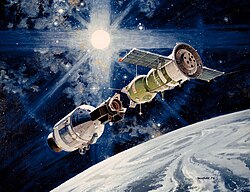
A painting of Apollo–Soyuz, a first milestone in international spaceflight

Key Facts

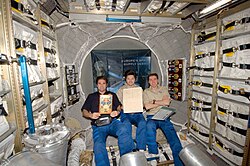
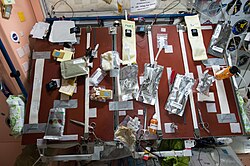
Original Jules Verne manuscripts displayed by crew inside the Jules Verne ATV (Automated Transfer Vehicle)
  • Mass: Approximately 450,000 kg (990,000 lb).
  • Dimensions: 109 meters in length and 73 meters in width (solar arrays).
  • Orbital Speed: 7.67 km/s (approximately 27,600 km/h).
  • Orbital Period: Completes one orbit of Earth every 92.9 minutes.
  • Altitude: Maintains a perigee of 413 km and an apogee of 422 km.
  • Atmosphere: 1 atm of pressure, consisting of 79% nitrogen and 21% oxygen.

The Architecture of the Station
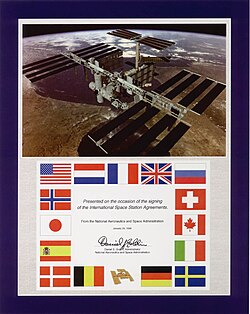
A Commemorative Plaque honouring Space Station Intergovernmental Agreement signed on 28 January 1998

The ISS is composed of various pressurized modules—areas where the crew can live and work without spacesuits—and unpressurized elements like the Integrated Truss Structure, which supports the solar arrays and radiators.

Foundational Modules

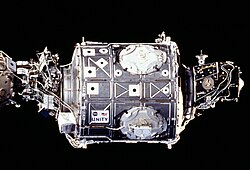
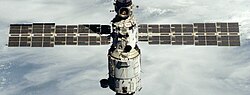
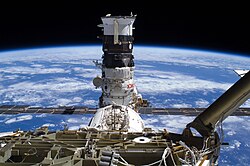
The station began with Zarya, the first module, followed quickly by Unity. These provided the initial structural backbone and power. Later, the Zvezda service module added essential living quarters and life support systems.
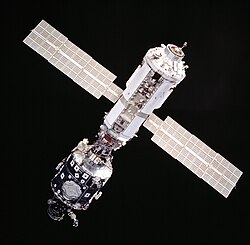
Zarya and Unity, the first two modules of the ISS, pictured in May 2000

Specialized Laboratories and Facilities

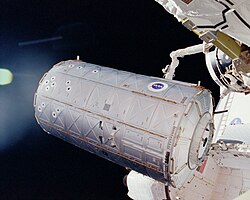
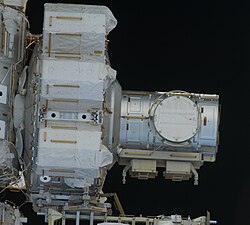
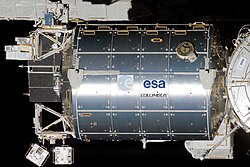
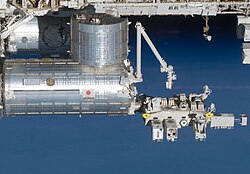
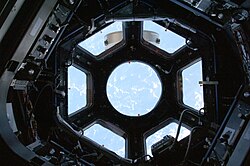
To facilitate diverse scientific goals, the station includes several dedicated labs. The Destiny module serves as the primary US laboratory, while Columbus (ESA) and Kibō (JAXA) provide additional research capabilities. The Cupola offers a panoramic view of Earth, serving as both a psychological refuge for the crew and a vital observation post.
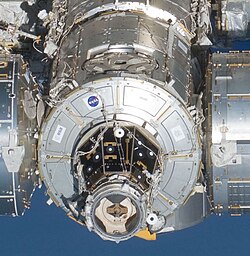
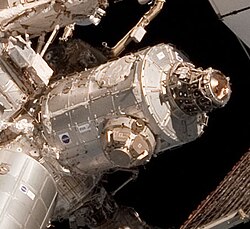
Harmony (center) shown connected to Columbus, Kibo, and Destiny. The dark PMA-2 faces the camera. The nadir and zenith locations are open.

Expansion and Modernization

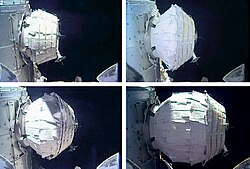
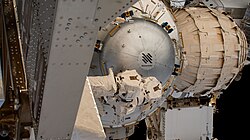
The station continues to evolve with additions like the Nauka multipurpose laboratory and the Prichal docking module. Innovative additions such as the Bigelow Expandable Activity Module (BEAM) have tested inflatable habitat technology to increase usable volume.
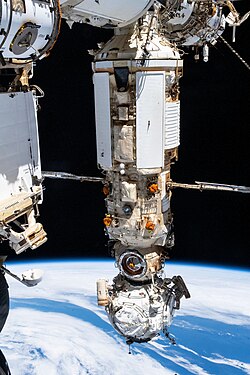
Nauka and Prichal docked to ISS

Science in Microgravity

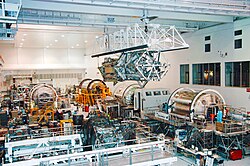
S3-S4 Truss being hoist to the payload transfer container inside the Space Station Processing Facility next to several other ISS modules (2007)

The primary purpose of the ISS is to serve as a microgravity environment. Microgravity is the condition in which people or objects appear to be weightless, allowing researchers to study physical and biological processes without the interference of gravity.

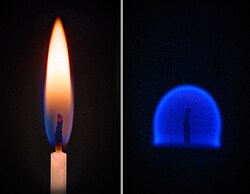
Research ranges from botany—such as the XROOTS experiment testing soilless hydroponic and aeroponic growth—to fundamental physics. For example, combustion behaves differently in space; a candle flame on the ISS is spherical and behaves differently than the teardrop shape seen on Earth.
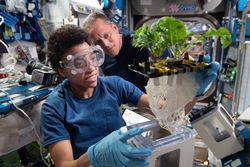
Jessica Watkins and Bob Hines working on XROOTS, an experiment using the Veggie facility of the station testing soilless hydroponic and aeroponic plant growth

A comparison between the combustion of a candle on Earth (left) and in a free fall environment, such as that found on the ISS (right)

Life Aboard the Station

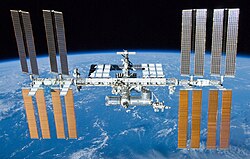
The ISS as seen from Space Shuttle Atlantis during STS-132, pictured in May 2010

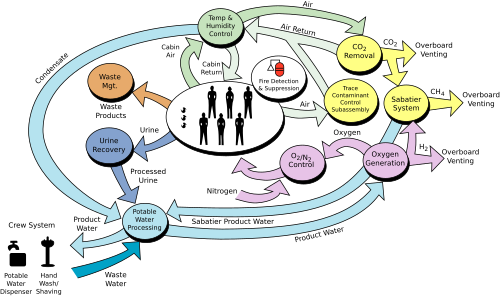
Living in space requires complex Environmental Control and Life-Support Systems (ECLSS) to recycle air and water. Crew members must follow strict health regimens to combat the effects of weightlessness, including using specialized equipment like the TVIS treadmill with bungee cords to maintain muscle and bone density.

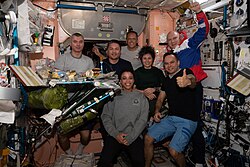
Daily life involves a mix of rigorous scientific work, station maintenance, and shared meals. The crew typically resides in the Unity and Zvezda modules, where they eat and sleep in a confined but highly efficient environment.
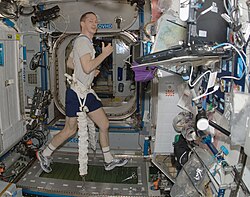
A man running on a treadmill, smiling at the camera, with bungee cords stretching down from his waistband to the sides of the treadmill
Astronaut Frank De Winne, attached to the TVIS treadmill with bungee cords aboard the ISS

The Expedition 67 crew during a group dinner in Unity

Station Operations and Maintenance

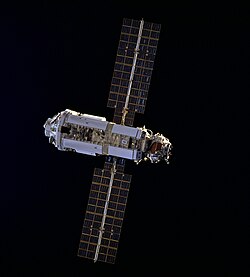
Zarya as seen by Space Shuttle Endeavour during STS-88

Maintaining a structure in the harsh environment of space requires constant vigilance. The station uses robotic arms, such as Canadarm2 and Dextre, to move payloads and assist astronauts during Extravehicular Activities (EVAs), commonly known as spacewalks.

Resupply is handled by various uncrewed spacecraft, including the Russian Progress vehicles and Japan's Kounotori, which deliver food, water, and scientific equipment.
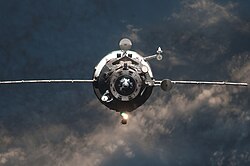
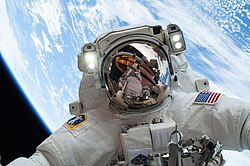
The Progress M-14M resupply vehicle approaching the ISS in 2012. Nearly 100 unpiloted Progress spacecraft have delivered supplies during the lifetime of the station.

Mike Hopkins during a spacewalk

ISS Summary Specifications

Unity as seen by Space Shuttle Endeavour during STS-88
International Space Station Technical Overview
Feature Specification
Launch Date November 20, 1998
Pressurized Volume 1,005.0 m³
Orbits per Day 15.5
Orbital Inclination 51.64°
Average Speed 27,600 km/h

Frequently Asked Questions
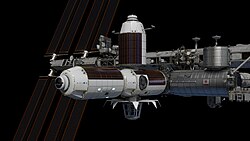
Zvezda as seen by Space Shuttle Atlantis during STS-106
The Destiny module being installed on the ISS
Quest Joint Airlock Module
Poisk with its own propulsion module (soon to be jettisoned)
Tranquility in 2011
Tranquility in 2011
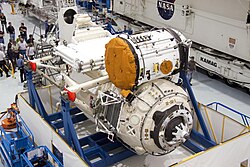
The Columbus module on the ISS
Kibō with its exposed facility on the right
The Cupola's windows with shutters open
Rassvet module with MLM-outfitting equipment (consisting of experiment airlock, RTOd radiators, and ERA workpost) at KSC
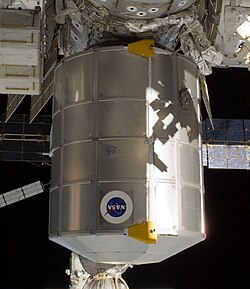
The Leonardo module hours after berthing
Progression of the expansion of BEAM
NanoRacks Bishop airlock module installed on the ISS
Early rendering of the Axiom Orbital Segment, made prior to assembly plan changes, with now only one module, the Payload Power Thermal Module (PPTM), being planned to dock with the ISS
A flowchart diagram showing the components of the ISS life-support system.
The interactions between the components of the ISS Environmental Control and Life-Support System (ECLSS)
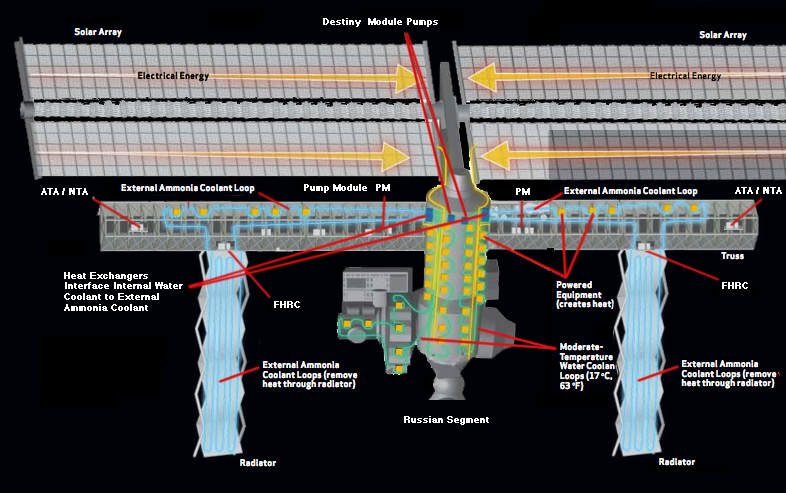
ISS External Active Thermal Control System (EATCS) diagram
Chart of the number of ISS missions longer than 90 days, until 2020
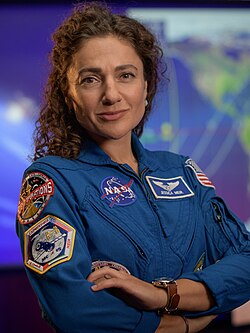
Jessica Meir, current commander
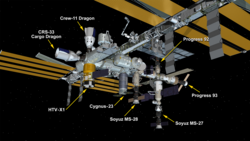
Rendering of the ISS and visiting vehicles as of 1 December 2025. Live link at nasa.gov.
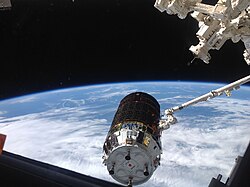
Japan's Kounotori 4 berthing
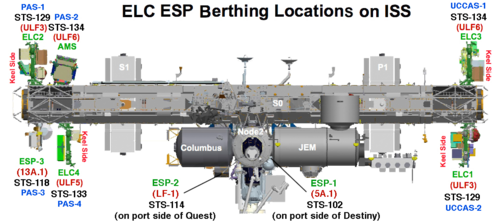
Spare parts are called ORUs; some are externally stored on pallets called ELCs and ESPs.
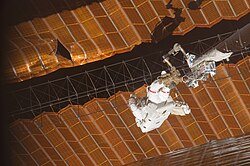
Two black and orange solar arrays, shown uneven and with a large tear visible. A crew member in a spacesuit, attached to the end of a robotic arm, holds a latticework between two solar sails.
While anchored on the end of the Orbiter Boom Sensor System during STS-120, astronaut Scott Parazynski performs makeshift repairs to a US solar array that was damaged during unfolding
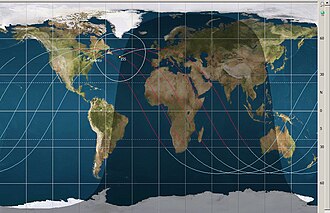
Orbits of the ISS, shown in April 2013
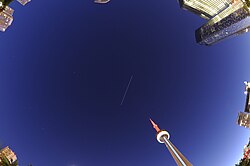
The ISS visible as a skytrack line drawn in the sky nearly overhead shortly after sunset by a long exposure photo
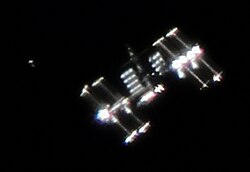
The ISS and HTV photographed from Earth by Ralf Vandebergh
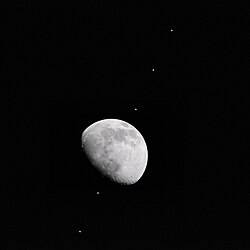
Composite of six photos of the ISS transiting the gibbous Moon
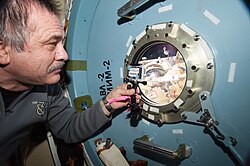
Pavel Vinogradov looks out of a Poisk hatch window at Alexander Misurkin on EVA.
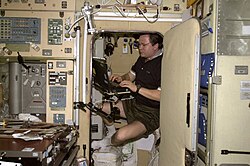
Cosmonaut Nikolai Budarin at work inside the Zvezda service module crew quarters
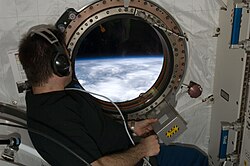
Engineer Gregory Chamitoff looking out of a window
Main dining desk in Unity
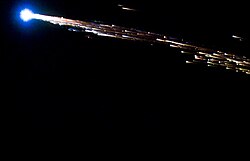
Many ISS resupply spacecraft have already undergone atmospheric re-entry, such as Jules Verne ATV.

How fast does the ISS travel?

The ISS travels at an orbital speed of approximately 7.67 km/s, which is roughly 27,600 kilometers per hour (17,100 mph).

Who manages the International Space Station?

The station is a collaborative effort managed by NASA (USA), Roscosmos (Russia), ESA (Europe), and JAXA (Japan), governed by the Space Station Intergovernmental Agreement signed in 1998.

What is the purpose of the Cupola?

The Cupola is a specialized module with large windows that allows the crew to observe Earth, monitor the docking of spacecraft, and conduct robotic operations.

How do astronauts stay healthy in microgravity?

Astronauts use specialized exercise equipment, such as the TVIS treadmill and weight-lifting devices, to prevent the loss of bone density and muscle mass caused by the lack of gravity.

What happens to the ISS at the end of its mission?

Plans include the use of a US Deorbit Vehicle to safely guide the station back into the atmosphere for a controlled re-entry.

References

  1. standard;[2] past min. 2; past max. 13[3]
  2. With the launch of the first module: Zarya
  3. Russian: Междунаро́дная косми́ческая ста́нция (МКС), romanized: Mezhdunaródnaya kosmícheskaya stántsiya, French: Station Spatiale Internationale (SSI), German: Internationale Raumstation, Japanese: 国際宇宙ステーション, romanized: Kokusaiuchū sutēshon
  4. Boeing Starliner, designed for crew transport, made one crewed mission to the station in 2024, and one uncrewed in 2022, both experiencing malfunctions. One cargo flight is planned with the future of the craft unclear.
  5. Pirs was connected to the nadir port of Zvezda now occupied by Nauka.