What Is a Blue Moon? Uncovering the Science and Folklore
Most of us have used the phrase "once in a blue moon" to describe an event that happens very rarely. While the expression is common, the actual phenomenon of a blue moon is more complex than it seems. Depending on who you ask—an astronomer, a historian, or a meteorologist—you will receive a different answer. In reality, a blue moon refers to three distinct occurrences: a rare atmospheric event, a seasonal lunar pattern, and a monthly calendar quirk.
The Visual Blue Moon: When the Sky Changes Color
While most blue moons are defined by dates, the moon can occasionally appear physically blue. This is a rare and unpredictable phenomenon caused by atmospheric emissions. When large amounts of particles—such as ash from volcanic eruptions or smoke from massive forest fires—are suspended in the air, they can scatter red and yellow light. If these particles are approximately one micrometre in diameter, they allow blue light to pass through, giving the moon a blue or indigo hue.
Historical records highlight several such events. The 1883 eruption of Krakatoa caused the moon to appear blue and green in various parts of the world for months. Similar effects were reported after the eruption of El Chichón in Mexico (1983), Mount St. Helens (1980), and Mount Pinatubo (1991). In 1950 and 1951, forest fires in Canada and Sweden produced similar results; in Alberta, Canada, oily smoke droplets scattered light so effectively that observers in Britain reported seeing an indigo sun and a blue moon.
Even ice particles can create this effect. In July 1911, explorer Robert Falcon Scott noted in his Antarctic diary that the moon appeared a "vague blue" through air thick with snow.
![An ESA radio telescope located at the New Norcia Station, Western Australia, tracking the "super blue moon" of August 30, 2023. The blue colour is an effect of the camera.[25]](/images/eb/bd/ebbdb2372a61ec23cea3aaad542051377431a526ba8b47637f42dcd38cd9d113.gif)
The Calendrical Blue Moon: Two Different Rules
The most common use of "blue moon" today refers to the calendar rather than the color. However, there are two competing definitions for what constitutes a calendrical blue moon.
The Monthly Blue Moon (The Pruett Rule)
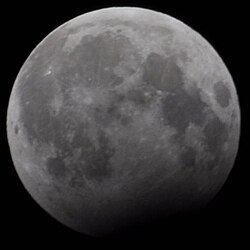
In modern popular culture, a blue moon is most often defined as the second full moon to occur within a single calendar month. This definition was popularized by amateur astronomer James Hugh Pruett in a 1946 article for Sky & Telescope. Because the time between full moons is shorter than the average calendar month, this happens relatively frequently—approximately seven times every 19 years, or once every two to three years.
The Seasonal Blue Moon (The Maine Rule)
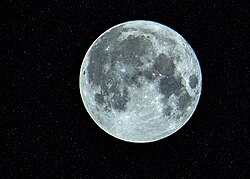
A more "traditional" (though still modern) definition is the third full moon in an astronomical season that contains four full moons. This is known as the "Maine rule" because it originated in the 1937 Maine Farmers' Almanac, edited by H.P. Trefethen. While this version is sometimes called the "true" blue moon, it is essentially a modern invention and not based on ancient lunisolar timekeeping.
The History and Origin of the Phrase
Contrary to popular belief, the calendrical blue moon did not originate from Native American traditions. In fact, the metaphorical use of the phrase "blue moon" to mean a long period of time predates the calendar definitions by over a century.
The Oxford English Dictionary (OED) traces the metaphorical use back to the 1810s. Pierce Egan's Real Life in London (1821) uses the phrase to describe a long absence, and a revision of Francis Grose's Classical Dictionary of the Vulgar Tongue (1823) explicitly defines it as an allusion to a long time. The specific phrase "once in a blue moon" was recorded by 1833.
The shift toward a specific date occurred in 1937 with the Maine Farmers' Almanac. This was later misinterpreted by James Hugh Pruett in 1946, leading to the "second full moon in a month" definition. This version gained massive popularity in the 1980s through the radio program StarDate and the board game Trivial Pursuit.
The Science Behind the Cycle
To understand why blue moons happen, we have to look at the lunation—the average time between two identical phases of the moon (such as full moon to full moon), which is approximately 29.53 days. This is known as a synodic orbit.
A tropical year (the time it takes Earth to orbit the sun) is about 365.24 days. When you divide the year by the length of a lunation, you get roughly 12.37 lunations per year. Because of that extra 0.37, the date of the full moon shifts backward by nearly one day each month. Every two or three years, these "extra" days accumulate to create a 13th full moon in a single year, resulting in either a monthly or seasonal blue moon.
This cycle is part of the Metonic cycle, a period of approximately 19 years after which the phases of the moon recur on the same days of the year.
Summary of Blue Moon Types
The following table summarizes the differences between the three types of blue moons discussed.
| Type | Definition | Cause/Frequency | Origin |
|---|---|---|---|
| Visual | Moon physically appears blue | Atmospheric particles (volcanoes/fires) | Natural phenomenon |
| Monthly | Second full moon in a calendar month | Lunar cycle vs. calendar month | James Hugh Pruett (1946) |
| Seasonal | Third full moon in a season of four | Lunar cycle vs. astronomical season | Maine Farmers' Almanac (1937) |