X-38 Crew Return Vehicle: NASA's Experimental Lifeboat for the ISS
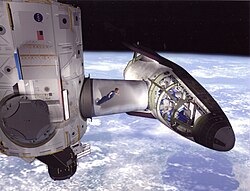
In the high-stakes environment of orbital living, safety is the primary concern. Between 1995 and 2002, NASA spearheaded the X-38 program, an ambitious effort to develop a Crew Return Vehicle (CRV). Designed as an emergency "lifeboat" for the International Space Station (ISS), the X-38 was intended to ensure that a full complement of astronauts could return safely to Earth in the event of a catastrophic failure or medical emergency.
The project combined cutting-edge parachute technology with a wingless aerodynamic design, aiming to create a vehicle that was both autonomous and reliable. While the program was ultimately canceled, its contributions to lifting body research and docking systems left a lasting mark on aerospace engineering.
Key Facts
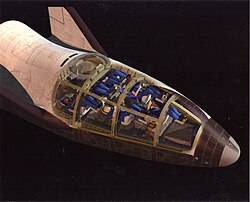
- Purpose: Emergency evacuation vehicle for up to seven ISS crew members.
- Design: A wingless lifting body (a spacecraft that generates lift from its hull shape rather than wings).
- Landing System: Utilized the largest parafoil ever constructed for a controlled descent.
- Status: Canceled on April 29, 2002, due to budget cuts.
- Prototypes: Two atmospheric test vehicles and one orbital prototype (90% complete).
The Need for a Space Lifeboat
During the early planning of the ISS, NASA recognized several critical scenarios that necessitated a dedicated rescue craft. These included serious illness or injury to an astronaut, onboard fires, collisions with space debris, or the grounding of the Space Shuttle, which would have cut off life-sustaining supplies.
Initially, the goal was to support a crew of seven. However, early ISS operations were limited by the capacity of the Russian Soyuz TMA vehicles, which could only transport three people. The X-38 was designed to bridge this gap, providing a high-capacity escape route that could be semi-permanently docked to the station.
Development and Engineering
The X-38 was not a completely new concept; it was developed from the Martin-Marietta X-24, a lifting body project from the 1960s. R. Dale Reed, known as the Father of the Lifting Body Programs, provided the foundational X-24A designs that were scaled up to accommodate a seven-person crew.
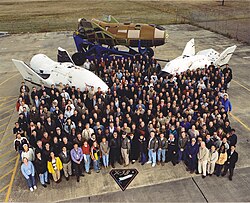
The program was an international collaboration involving the European Space Agency (ESA) and the German Space Agency (DLR), with the physical prototypes built by Scaled Composites. The development progressed through several iterations:
- V-131 and V-132: Atmospheric prototypes based on the X-24A shape.
- V-131-R: A reworked prototype at 80% scale of the final CRV.
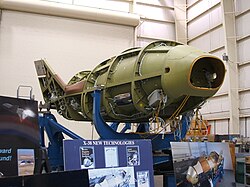
- V-201: The orbital test vehicle, which reached 90% completion before the project's end.
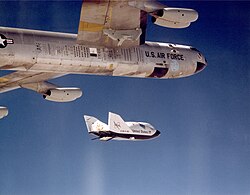
To test these vehicles, NASA used a B-52 mothership to drop the prototypes from altitudes up to 45,000 feet. The vehicles would glide at near-transonic speeds before deploying a drogue parachute and then a massive 7,500-square-foot parafoil wing for a gentle landing.
Technical Design and Re-entry Process
The X-38 was designed for a fully automated return to Earth, ensuring safety even if the crew were incapacitated. The process involved several sophisticated stages:
Deorbit and Descent
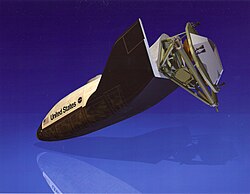
Once undocked from the ISS, the vehicle would use a Deorbital Propulsion System (DPS). This module, featuring eight thrusters, would fire to slow the spacecraft below orbital velocity, allowing gravity to pull it back into the atmosphere.
Landing and Recovery
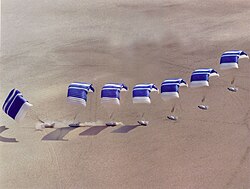
After jettisoning the DPS, the X-38 would glide through the atmosphere. To solve the difficulty of landing a high-speed lifting body, NASA employed a five-stage deploying parafoil derived from U.S. Army technology. This staging process took 45 seconds and prevented high-speed winds from destroying the chute.
The vehicle lacked traditional wheels, instead using skids to slide to a stop on the ground. For extreme emergencies, the cabin included seven High-Altitude Low-Opening (HALO) parachute packs for crew bailout.
Cancellation and Legacy
Despite the technical success of the flight tests, the X-38 fell victim to the "American Core Complete" cost-cutting initiative. In 2001, NASA Administrator Sean O'Keefe implemented recommendations from the International Space Station Management and Cost Evaluation (IMCE) Task Force to reduce U.S. contributions to the ISS. This led to the official cancellation of the X-38 on April 29, 2002.
Although the vehicle never flew in orbit, its development led to the creation of the Low Impact Docking System used in later NASA projects. Today, the prototypes serve as museum pieces, preserving the history of lifting body research.
X-38 Technical Specifications
| Feature | Specification |
|---|---|
| Crew Capacity | 7 Astronauts |
| Length | 30 ft (9.1 m) |
| Wingspan | 14 ft 6 in (4.42 m) |
| Height | 7 ft 3 in (2.22 m) |
| Empty Weight | 23,500 lb (10,659 kg) |
| Gross Weight | 25,000 lb (11,340 kg) |
| Power/Life Support | 9-hour battery system |
Frequently Asked Questions
Why was the X-38 designed without wings?
The X-38 used a lifting body design, which allows the shape of the vehicle's fuselage to generate lift during atmospheric re-entry. This reduces the need for heavy wings that would be unnecessary in space and could be a liability during the extreme heat of re-entry.
How did the X-38 plan to land on Earth?
The vehicle used a combination of a drag chute for stabilization and a massive, steerable parafoil for the final descent. Instead of landing gear with wheels, it used skids to slide to a stop on the ground.
What happened to the X-38 prototypes after cancellation?
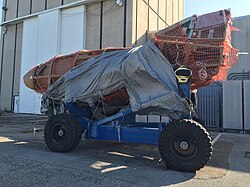
The V-132 is on loan to the Strategic Air Command & Aerospace Museum in Nebraska, the V-131R is at the Evergreen Aviation Museum in Oregon, and the V-201 orbital prototype is held at the NASA Johnson Space Center in Houston, Texas.
Could the crew manually fly the X-38?
While the vehicle was designed to be completely automated to assist injured or incapacitated crew, it included backup systems that allowed the crew to operate the vehicle manually if necessary.