John A. Manke: The Pioneer of Wingless Supersonic Flight
In the history of aviation, few achievements are as daring as flying a vehicle without wings. While traditional aircraft rely on wings to generate lift, a select group of engineers and pilots explored the possibility of lifting bodies—aircraft designed so that the shape of the fuselage itself generates the lift necessary for flight. Among these pioneers, John A. Manke stood out as a visionary test pilot and aerospace engineer whose courage and precision fundamentally changed how humans return from space.
Understanding the Lifting Body
To appreciate Manke's contributions, one must first understand the concept of a lifting body. Unlike a standard airplane, a lifting body is a wingless vehicle that uses its entire hull to create lift as it moves through the air. This design is particularly valuable for spaceflight, as it allows a vehicle to survive the intense heat of atmospheric reentry while remaining maneuverable enough to be steered toward a specific landing site.
From the Marine Corps to NASA
John Manke's journey to the frontiers of flight began in Selby, South Dakota. After attending the University of South Dakota and serving in the U.S. Navy starting in 1951, he pursued a degree in electrical engineering at Marquette University. Graduating in 1956, Manke served as a fighter pilot in the United States Marine Corps before transitioning to the private sector as a test engineer at Honeywell Aerospace.
On May 25, 1962, Manke joined NASA's Flight Research Center at Edwards Air Force Base. His early years at NASA were spent as both a flight research engineer and a research pilot, operating a diverse array of aircraft including the Lockheed F-104 Starfighter, the General Dynamics F-16 Fighting Falcon, and the Douglas C-47 Skytrain. He also served as a flight planner for the X-15 program, where he worked closely with Michael J. Adams on the Reaction Motors XLR99 engine.
Breaking Barriers in Wingless Flight
In 1968, Manke began piloting rocket-powered lifting bodies optimized for the rigors of spaceflight. He quickly achieved a historic milestone on May 9, 1969, when he became the first person to reach supersonic speed—exceeding the speed of sound—while piloting a Northrop HL-10.
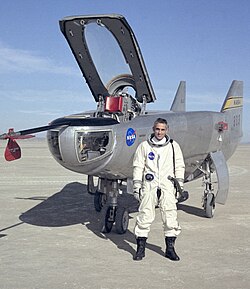
Manke's expertise extended to several different experimental vehicles, including the Martin Marietta X-24 and the Northrop M2-F3, the latter of which he flew a record 42 times. His most significant contribution to aerospace design occurred on August 5, 1975, during a test flight of the X-24B. Manke executed a precision unpowered landing on a runway at Edwards Air Force Base, proving that wingless vehicles could be landed safely and accurately without the aid of parachutes or water splashes.
Shaping the Space Shuttle
Manke's successful runway landing had a direct and lasting impact on the development of the Space Shuttle. Prior to his X-24B flight, design engineers had considered adding jet engines to the shuttle to assist with landing approaches. Manke's demonstration proved that a lifting body could be glided to a precise stop on a runway, leading NASA to forego the additional weight and complexity of landing engines.
Furthermore, Manke conducted exploratory flights in the Vought F-8 Crusader to refine fly-by-wire systems. Fly-by-wire is a system that replaces traditional manual flight control cables with an electronic interface, allowing a computer to process pilot inputs for smoother and more stable flight—a critical technology for the Space Shuttle's control systems.
A Legacy of Aerospace Leadership
Beyond his time in the cockpit, Manke was a distinguished administrator. He served as the facility manager and chief of flight operations at the Dryden and Ames Research Centers, eventually becoming the Director of NASA's Dryden Flight Research Center from 1981 to 1984.
Throughout his career, Manke flew 4,500 hours in 56 different aircraft. His versatility was highlighted by his time in the Lockheed YF-12 Blackbird, where he earned his Mach 3+ pin for flying at more than three times the speed of sound. He also contributed to the development of the Boeing 747 Shuttle Carrier, the Northrop B-2 Spirit, and the Grumman X-29.
Notable Test Flight Milestones
The following table summarizes some of the most significant flights conducted by John Manke during his tenure as a test pilot.
| Date | Vehicle | Max Speed (kph) | Mach | Max Altitude (km) | Significance |
|---|---|---|---|---|---|
| May 9, 1969 | HL-10 | 1,197 | 1.00 | 16.25 | First supersonic flight of a lifting body |
| October 22, 1969 | X-24A | 623 | 0.51 | 12.19 | First glide flight |
| March 29, 1971 | X-24A | 1,667 | 1.36 | 21.49 | Fastest X-24A flight |
| November 21, 1972 | M2-F3 | 1,524 | 1.24 | 20.33 | Fastest M2-F3 flight |
| November 15, 1974 | X-24B | 1,722 | 1.41 | 21.96 | Fastest X-24B flight |
| August 5, 1975 | X-24B | 1,381 | 1.13 | 18.29 | First controlled runway landing of a lifting body |
Personal Life and Final Years
Outside of his professional achievements, John Manke was a devoted family man. He and his wife, Marilyn, were married for 65 years and raised five children in Lancaster, California. A man of faith, he served as a eucharistic minister for the Sacred Heart Parish. Even in retirement, his passion for aviation remained; he spent his time building and flying his own lightweight aircraft and gliders.
John Manke passed away on January 31, 2019, at the age of 87. He left behind a legacy of bravery and engineering excellence, honored by awards such as the NASA Exceptional Service Medal and induction into the Aerospace Walk of Honor.