Low Earth Orbit: Characteristics, Uses, and the Challenges of Space Congestion
Low Earth orbit, commonly known as LEO, is the immediate frontier of outer space. It is the region where most human activity in space occurs, hosting everything from massive space stations to the vast constellations of satellites that power our modern communication networks. Because of its proximity to Earth, LEO offers unique advantages for technology, but it also presents significant physical and environmental challenges.
Key Facts
- Altitude Range: Generally defined as the region below 2,000 km (1,200 mi).
- Orbital Period: Typically 128 minutes or less.
- Orbital Velocity: Approximately 7.8 km/s (17,000 mph).
- Primary Uses: Satellite communications, Earth observation, and human spaceflight.
- Main Risk: Increasing congestion from space debris and potential collisions.
Defining the LEO Region
While definitions can vary among scientific sources, a Low Earth orbit is technically characterized by an orbital period of 128 minutes or less—meaning an object completes at least 11.25 orbits per day—and an eccentricity (a measure of how much an orbit deviates from a perfect circle) of less than 0.25.
The term "LEO region" is often used more broadly to describe the area of space below an altitude of 2,000 km (1,200 mi). This distinction is vital for safety; even objects that are not in a permanent LEO orbit, such as sub-orbital craft or highly elliptical orbits that only pass through this zone at their perigee (the closest point to Earth), must be carefully tracked to prevent collisions with established satellites.
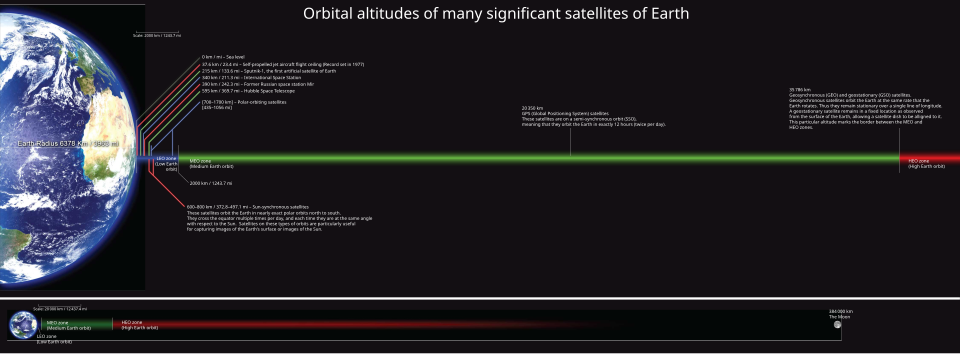
Altitude and Orbital Mechanics
The altitude of an object in orbit can fluctuate. Even in a circular orbit, the distance from the ground can vary by up to 30 km due to the Earth's oblateness (the slight bulge at the equator) and local topography. Most artificial objects in LEO peak in number at an altitude of approximately 800 km (500 mi).
To maintain a stable orbit, a spacecraft must travel at a high mean orbital velocity. For a circular orbit at 200 km, this is about 7.79 km/s, whereas at a higher altitude of 1,500 km, the required velocity drops to 7.12 km/s. Interestingly, while gravity in LEO is only slightly weaker than on the surface, astronauts experience weightlessness because they are in a state of permanent free fall, where the pull of gravity and centrifugal force are balanced.
Applications and Advantages of LEO
LEO is a highly efficient region for several types of space missions due to its proximity to the planet:
- Communication: Because the satellites are closer to Earth, they require less energy for placement and less powerful amplifiers for signal transmission. This results in high bandwidth and low latency (the delay in data transfer).
- Earth Observation: Remote sensing satellites, such as spy satellites or imaging platforms like Envisat, use LEO to capture high-resolution images of the Earth's surface.
- Human Spaceflight: All space stations operating as of 2026, including the International Space Station (ISS) and the Chinese Tiangong station, utilize geocentric orbits within LEO.
Types of LEO Orbits
Different mission requirements dictate different orbital paths:
- Equatorial Low Earth Orbits (ELEO): These have low inclination and allow for rapid revisits to low-latitude locations. They also benefit from the Earth's rotation, requiring less delta-v (the change in velocity needed to perform maneuvers).
- Polar and Sun-synchronous Orbits: These have higher inclinations and provide coverage for higher latitudes. Sun-synchronous orbits are particularly useful for Earth observation because they provide consistent lighting conditions.
- Very Low Earth Orbits (VLEO): A newer concept involving altitudes below 450 km, which requires advanced technology to combat rapid orbital decay.
Challenges: Decay and Debris
Operating in LEO is not without difficulty. Satellites at lower altitudes encounter atmospheric drag from the thermosphere and exosphere. This drag causes orbital decay, where the satellite gradually loses altitude. To combat this, satellites like the ISS must be periodically re-boosted to maintain their position.
The most pressing concern in LEO is the growing density of space debris. As launch frequencies increase, the risk of collisions grows. A collision at orbital velocities can be catastrophic, potentially triggering the Kessler syndrome—a domino effect where one collision creates more debris, leading to further collisions.
| Orbit Type / Altitude | Key Characteristics | Notable Examples |
|---|---|---|
| Very Low Earth Orbit (< 450 km) | High drag, requires frequent boosting | Tiangong Space Station, ISS |
| Standard LEO (approx. 500–800 km) | Ideal for observation and internet | Hubble Space Telescope, Starlink |
| Upper LEO (up to 2,000 km) | Boundary of MEO; higher radiation | Iridium telecom satellites |
Frequently Asked Questions
Why do satellites in LEO need to be re-boosted?
Satellites in lower LEO altitudes experience atmospheric drag from gases in the thermosphere and exosphere. This drag slows them down, causing their orbits to decay, which necessitates periodic engine burns to raise their altitude again.
What is the difference between a LEO orbit and the LEO region?
A LEO orbit refers to a specific path with a period of 128 minutes or less. The LEO region is a broader spatial area (up to 2,000 km) that includes any object passing through it, even if that object is in a much larger or sub-orbital trajectory.
How much debris is currently in Low Earth Orbit?
NASA's Orbital Debris Program tracks over 25,000 objects larger than 10 cm. However, there are an estimated 500,000 objects between 1 and 10 cm, and over 100 million particles larger than 1 mm.
What is the Kessler syndrome?
The Kessler syndrome is a theoretical scenario where the density of objects in LEO is high enough that a single collision creates a cascade of debris, leading to a chain reaction of further collisions that could make certain orbits unusable.
Why is LEO preferred for internet constellations like Starlink?
LEO provides much lower latency compared to higher orbits like Geostationary Orbit (GEO). Because the satellites are closer to the ground, the time it takes for a signal to travel from Earth to the satellite and back is significantly reduced.