Vulcan Centaur: ULA's Next-Generation Heavy-Lift Launch Vehicle
The Vulcan Centaur is a heavy-lift launch vehicle developed by the United Launch Alliance (ULA). Designed to provide a versatile and cost-effective means of transporting payloads into various orbits, it serves as the successor to the Atlas V and Delta IV rocket families. With a starting cost of US$110 million per launch, the Vulcan Centaur is engineered to support a wide array of missions, from commercial satellite deployments to critical national security launches for the U.S. Space Force.
The vehicle is a two-stage rocket that can be augmented with multiple solid rocket boosters to tailor its lift capacity to specific mission requirements. Since its maiden flight on January 8, 2024, it has entered operational status, launching from Space Launch Complex 41 (SLC-41) at Cape Canaveral, with plans for future operations at SLC-3 in Vandenberg.
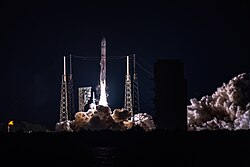
Key Facts
- Manufacturer: United Launch Alliance (USA).
- Status: Operational, with 4 successful launches as of February 2026.
- Configuration: Two-stage rocket with optional GEM-63XL solid rocket boosters.
- First Stage: Powered by two BE-4 engines using liquid oxygen (LOX) and liquid methane (CH4).
- Second Stage: Centaur V, powered by RL10 engines using LOX and liquid hydrogen (LH2).
- Max Payload (LEO): Up to 27,200 kg (60,000 lb) in the VC6 configuration.
Technical Specifications and Design
Vehicle Dimensions and Mass
The Vulcan Centaur varies in size depending on its configuration. The standard height is 61.6 meters (202 ft), extending up to 67.3 meters (221 ft) in its longest form. It features a diameter of 5.4 meters (18 ft) and a maximum gross mass of 546,700 kg (1,205,300 lb).
The First Stage: Vulcan
The first stage, known as Vulcan, stands 33.3 meters (109 ft) tall. It is powered by two BE-4 engines, which provide a maximum thrust of 4,893 kN (1,100,000 lb f). These engines utilize a propellant combination of liquid oxygen and liquid methane, offering a sea-level specific impulse of 320 seconds and a vacuum specific impulse of 340 seconds over a burn time of 299 seconds.
The Second Stage: Centaur V
The Centaur V upper stage is available in two heights: the CV-L (10.66 m) and the CV-HE (12.6 m). It is currently powered by two RL10C engines, with planned upgrades to RL10E engines to increase thrust and efficiency. The stage uses liquid oxygen and liquid hydrogen, with the CV-HE version boasting a burn time of 1,077 seconds.
Boosters: GEM-63XL
To increase lift capacity, the Vulcan can be equipped with 0, 2, 4, or 6 GEM-63XL solid rocket boosters. Each booster provides 2,061 kN of maximum thrust and burns for 87.3 seconds. When all six boosters are utilized, they contribute a total thrust of 12,364 kN.
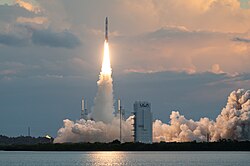
Payload Capabilities by Configuration
The Vulcan Centaur is highly modular, allowing ULA to adjust the number of solid rocket boosters (SRBs) based on the payload mass and target destination. The following table outlines the capacity for different versions:
| Version | SRBs | ISS (kg) | GTO (kg) | GEO (kg) | TLI (kg) |
|---|---|---|---|---|---|
| VC0 | 0 | 8,800 | 3,300 | N/A | 2,100 |
| VC2 | 2 | 16,300 | 8,300 | 2,500 | 3,600 |
| VC4 | 4 | 21,400 | 11,600 | 4,800 | 9,100 |
| VC6 | 6 | 25,600 | 14,400 | 6,300 | 11,300 |
| VC6 (Upgrade) | 6 | 26,900 | 15,300 | 7,000 | 12,100 |
Operational History and Future
The Vulcan Centaur's inaugural flight took place on January 8, 2024, successfully launching the Peregrine lunar lander. Since then, the vehicle has completed a total of four launches. While the rocket has demonstrated strong performance, some flights have encountered anomalies, including a booster issue during the second certification flight and a glitch during a Space Force mission in February 2026, which led to a temporary pause in national security launches.
Looking forward, ULA is exploring several potential upgrades to enhance the vehicle's utility. These include SMART reuse (a method for recovering engines), long-endurance upper stages, a LEO-optimized Centaur, and a more powerful "Vulcan Heavy" variant.
Frequently Asked Questions
What is the difference between the VC0 and VC6 configurations?
The primary difference is the number of GEM-63XL solid rocket boosters. The VC0 configuration uses no boosters, while the VC6 uses six, significantly increasing the payload capacity to Low Earth Orbit (LEO) from 8,800 kg to 25,600 kg.
What propellants does the Vulcan Centaur use?
The first stage uses a combination of liquid oxygen (LOX) and liquid methane (CH4). The Centaur V second stage uses liquid oxygen (LOX) and liquid hydrogen (LH2). The solid boosters use AP/HTPB/Al.
Who manufactures the engines for the Vulcan rocket?
The first-stage BE-4 engines are manufactured by Blue Origin, while the second-stage RL10 engines are produced by Aerojet Rocketdyne (now part of L3Harris).
Where does the Vulcan Centaur launch from?
It currently launches from Space Launch Complex 41 (SLC-41) at Cape Canaveral, Florida, with planned future launches from Space Launch Complex 3 (SLC-3) at Vandenberg Space Force Base.
What is the purpose of the Centaur V upgrade?
The upgrade involves replacing the RL10C engines with RL10E engines, which increases the maximum thrust from 203.6 kN to 214.6 kN and improves the specific impulse, thereby increasing the rocket's overall payload capacity.