Württemberg-Baden: The Post-War State of West Germany
In the immediate aftermath of World War II, the geopolitical landscape of Germany was radically reshaped by Allied occupation. One of the most unique administrative creations of this era was Württemberg-Baden, a state that existed from 1945 to 1952. Established by United States occupation forces, this entity served as a critical stepping stone toward the modern administrative structure of southwestern Germany.
The state was formed because the previous states of Baden and Württemberg had been split between the US and French occupation zones. Württemberg-Baden comprised the northern halves of these two territories, with its capital located in Stuttgart.
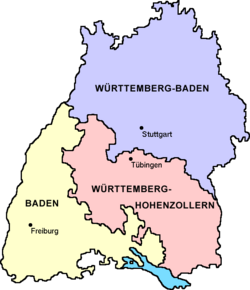
Key Facts
- Established: September 19, 1945, by US occupation forces.
- Capital: Stuttgart.
- Population (1950): Approximately 3,908,000.
- Area (1950): 15,700 square kilometers.
- Duration: Existed as a state of the Federal Republic of Germany from May 23, 1949, until April 25, 1952.
- Successor: Merged to form the modern state of Baden-Württemberg.
The Formation and History of Württemberg-Baden
The creation of Württemberg-Baden was driven by strategic logistics. The southern border of the US-administered zone was specifically drawn to ensure that the autobahn (highway) connecting Karlsruhe and Munich—known today as the A8—remained entirely within American control. On September 19, 1945, the US zone was divided into three major subdivisions: Greater Hesse, Bavaria, and Württemberg-Baden.
The state quickly moved toward self-governance. A new constitution was enacted on November 24, 1946, which led to the election of the state's first parliament. By May 23, 1949, Württemberg-Baden became a founding member of the Federal Republic of Germany (West Germany).
The Path to Merger
The existence of Württemberg-Baden was always seen as a transitional phase. To consolidate the region, a straw poll was conducted on September 24, 1950, involving Württemberg-Baden, Württemberg-Hohenzollern, and Baden. This was followed by a formal public referendum on December 9, 1951. Voters in Württemberg-Baden showed a clear majority in favor of unification. Consequently, on April 25, 1952, the three states merged to create the modern state of Baden-Württemberg.
Politics and Administration
The political leadership of the state was remarkably stable, with Reinhold Maier serving as the sole minister-president from 1946 to 1952. Maier, who transitioned from the DVP to the FDP, continued his leadership role as the first minister-president of the unified Baden-Württemberg in 1952.
Administratively, the state was divided into two Landesbezirke (administrative districts). These boundaries were based on the original state sections of Baden and Württemberg. These divisions were so effective that they persist today as the Regierungsbezirke (government districts) of Stuttgart and Karlsruhe.
Symbols of Statehood
The state's identity was reflected in its official symbols. In 1947, Württemberg-Baden adopted the black-red-gold tricolour flag, a symbol later used by the Federal Republic of Germany and the German Democratic Republic.
The coat of arms was a hybrid design, blending the heritage of its predecessors. It featured the red stripe on a golden field from the Baden coat of arms and the three deer antlers from the Württemberg coat of arms.
State Overview Summary
| Attribute | Details |
|---|---|
| Capital | Stuttgart |
| Area (1950) | 15,700 km² |
| Population (1950) | 3,908,000 |
| Minister-President | Reinhold Maier |
| Preceding Entities | Free People's State of Württemberg, Republic of Baden |
| Successor Entity | Baden-Württemberg |
Frequently Asked Questions
Why was Württemberg-Baden created?
It was created by US occupation forces in 1945 because the previous states of Baden and Württemberg had been split between the US and French occupation zones.
What influenced the state's southern border?
The border was set to ensure that the autobahn connecting Karlsruhe and Munich (the current A8) was located entirely within the US-administered zone.
Who was the leader of Württemberg-Baden?
Reinhold Maier was the only minister-president of the state from 1946 until its merger in 1952.
How did the state eventually disappear?
Following a straw poll in 1950 and a public referendum in 1951, Württemberg-Baden merged with Baden and Württemberg-Hohenzollern on April 25, 1952, to form the modern state of Baden-Württemberg.
What happened to its administrative districts?
The two administrative districts (Landesbezirke) remained largely unchanged and continue to exist as the Regierungsbezirke of Stuttgart and Karlsruhe within the current state of Baden-Württemberg.