Kingdom of Württemberg
The Kingdom of Württemberg (German: Königreich Württemberg) was a sovereign German state that existed from 1806 to 1918. Located in what is now the southern German federal state of Baden-Württemberg, the kingdom emerged during a period of intense territorial reorganization following the dissolution of the Holy Roman Empire. It was established when the Electorate of Württemberg was elevated to royal status as part of Napoleon Bonaparte's restructuring of German lands.
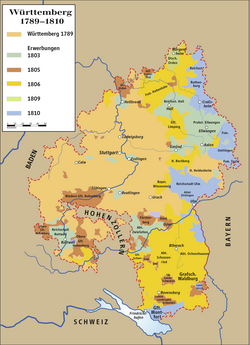
The kingdom's origins lie in the process of mediatization (Reichsdeputationshauptschluss), a political restructuring where ecclesiastical territories and free imperial cities were secularized and absorbed into larger states. Through this process, Duke Frederick II was raised to the rank of Elector in 1803, significantly expanding his holdings before the state eventually became a kingdom.
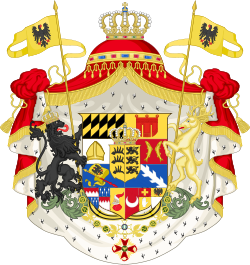
Key Facts
- Existence: 1806–1918
- Capital: Stuttgart
- Government: Constitutional Monarchy
- State Religion: Lutheranism
- Total Area (1813): 19,508 km² (7,532 sq mi)
- Population (1910): 2,437,574
- Motto: "Furchtlos und treu" (Fearless and loyal)
Historical Evolution
The Reign of Frederick I (1806–1816)
Frederick III, Duke of Württemberg, became King Frederick I on January 1, 1806. His early reign was marked by the abrogation of the constitution and the unification of Old and New Württemberg. He brought church property under government control and expanded the kingdom's borders through mediatization.
Frederick aligned himself with Napoleon, joining the Confederation of the Rhine and gaining territory in exchange for supporting French campaigns against Prussia, Austria, and Russia. However, following the Battle of Leipzig in 1813, he deserted Napoleon and secured his royal title and lands through a treaty with Metternich. He died in 1816 after his proposed new constitution was rejected by his people.
William I and the Constitutional Era (1816–1864)
King William I granted a new constitution in September 1819, which remained the legal foundation of the state until 1918. His reign saw periods of unrest, particularly during the revolutionary movements of 1848. While William briefly appointed liberal ministers to appease proponents of a united Germany, he eventually restored the 1819 constitution and returned power to bureaucratic hands by 1851.
Charles I and the German Empire (1864–1891)
Under Charles I, Württemberg initially sided with Austria during the competition for German supremacy. This led to the Austro-Prussian War of 1866, resulting in a defeat at the Battle of Tauberbischofsheim and a subsequent indemnity payment of 8,000,000 gulden to Prussia.
In 1871, Württemberg joined the German Empire. Despite this, it maintained significant autonomy, retaining control over its own railways, telegraphs, and post office, as well as autonomous management of its army within the Imperial German Army.
William II and the End of the Monarchy (1891–1918)
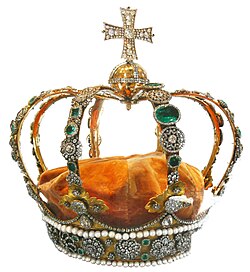
The final king, William II, continued the policies of his predecessor. His reign was marked by ongoing constitutional debates and the rise of democratic parties. Because William II had no sons, the succession was complicated by the transition of power to a Roman Catholic branch of the family.
Following Germany's defeat in World War I, King William II abdicated on November 30, 1918. This ended a dynasty that had lasted 837 years, and the kingdom was succeeded by the Free People's State of Württemberg.
Governance and Administration
The Kingdom of Württemberg operated as a constitutional monarchy. Its legislature, the Landtag, consisted of two chambers:
- Herrenhaus (Upper Chamber): Comprised of princes of the blood, heads of noble families (counts and above), royal nominees, knightly members, ecclesiastical dignitaries, and representatives from universities and industry.
- Abgeordnetenhaus (Lower Chamber): Consisted of 92 members representing administrative divisions, major provincial towns, and electoral divisions.
Notably, in 1906, Württemberg became the first German state to introduce a proportional system of election for its Second Chamber.
Economy and Infrastructure
The kingdom was primarily agricultural, with nearly 45% of its land dedicated to gardens and farming. Key products included spelt, rye, wheat, hops, and various fruits. However, the state also became a hub for industrial innovation.
Stuttgart became a center for the automotive industry, with Gottlieb Daimler incorporating the Daimler Motoren Gesellschaft in 1900. Additionally, Count Ferdinand von Zeppelin developed his famous airships in Friedrichshafen starting in 1897. The state's financial system transitioned from the gulden to the gold mark in 1873.
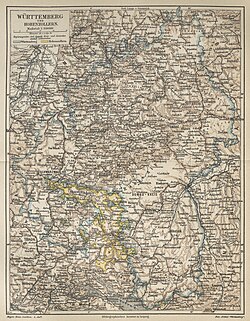
| District (Kreis) | Area (km²) | Population 1900 | Population 1905 | Density (pop/km²) 1905 |
|---|---|---|---|---|
| Neckarkreis | 3,330 | 745,669 | 811,478 | 244 |
| Schwarzwaldkreis | 4,780 | 509,258 | 541,662 | 113 |
| Jagstkreis | 5,140 | 400,126 | 407,059 | 79 |
| Donaukreis | 6,270 | 514,427 | 541,980 | 87 |
| Total | 19,520 | 2,169,480 | 2,302,179 | 118 |
Frequently Asked Questions
How was the Kingdom of Württemberg formed?
It was formed in 1806 when the Electorate of Württemberg was elevated to a kingdom by Napoleon Bonaparte during the restructuring of German territories following the collapse of the Holy Roman Empire.
What special privileges did Württemberg keep after joining the German Empire?
Unlike many other states, Württemberg retained control over its own postal services, telegraphs, and railways, and it maintained an autonomous army within the broader Imperial German Army.
Who were some of the most famous innovators from the kingdom?
The kingdom was home to Gottlieb Daimler, a pioneer of the automobile industry, and Count Ferdinand von Zeppelin, who constructed the first airships in Friedrichshafen.
What happened to the kingdom after World War I?
King William II abdicated in November 1918, and the monarchy was replaced by the Free People's State of Württemberg. Eventually, after World War II, the region became part of the modern state of Baden-Württemberg.
What was the religious composition of the population?
Around 1905, approximately 69% of the population was Protestant, 30% was Roman Catholic, and about 0.5% was Jewish.