World War IIAllied PowersAxis PowersHolocaustBattle of Stalingrad

World War II: A Global History of the Greatest Conflict

World War II: A Global History of the Greatest Conflict World War II was the most expansive and destructive conflict in human history, spanning from September 1, 1939, to September 2, 194...

World War II: A Global History of the Greatest Conflict

World War II was the most expansive and destructive conflict in human history, spanning from September 1, 1939, to September 2, 1945. This global struggle pitted the Allies—led primarily by the Soviet Union, the United States, the United Kingdom, and China—against the Axis powers, dominated by Nazi Germany, Imperial Japan, and Fascist Italy. The war fundamentally reshaped global borders, political ideologies, and the nature of modern warfare.

Key Facts
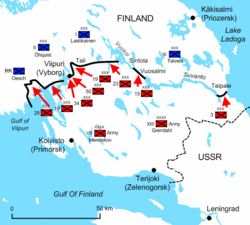
Mannerheim Line and Karelian Isthmus on the last day of the Winter War, 13 March 1940
  • Duration: 6 years and 1 day.
  • Total Casualties: Estimated 60 to 75 million deaths, including both military and civilian populations.
  • Outcome: Decisive Allied victory.
  • Major Theatres: The European Theatre (including the Eastern Front and Mediterranean) and the Pacific Theatre.
  • Defining Events: The Holocaust, the bombing of Pearl Harbor, the Battle of Stalingrad, and the atomic bombings of Hiroshima and Nagasaki.

The Road to Global Conflict
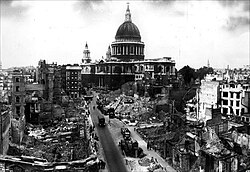
London's St Paul's Cathedral after the German Blitz on 29 December 1940

The seeds of World War II were sown in the aftermath of World War I. In Europe, economic instability and political unrest allowed for the rise of totalitarian regimes. In Germany, Adolf Hitler and the Nazi Party rose to power, while Benito Mussolini established a fascist state in Italy.
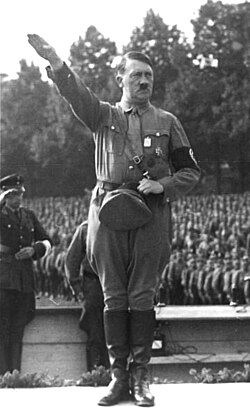
Adolf Hitler at a German Nazi political rally in Nuremberg, August 1933

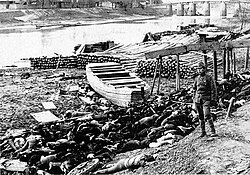
By the mid-1930s, Axis aggression became evident through several key events. Italy invaded Ethiopia in 1935, and Japan launched a full-scale invasion of China in 1937, marked by atrocities such as the Nanjing massacre.
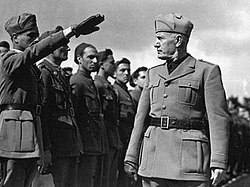
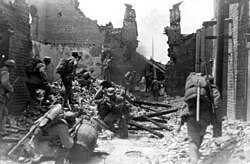
Benito Mussolini inspecting troops during the Italo-Ethiopian War, 1935

Chinese soldiers battle the Imperial Japanese Army in Taierzhuang, 1938

Bodies of Chinese civilians killed by the Imperial Japanese Army during the Nanjing massacre in December 1937

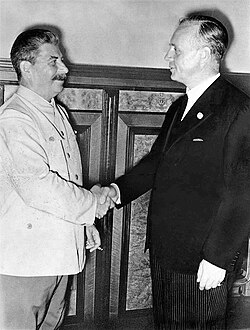
Diplomatic efforts to prevent a wider war, such as the Munich Agreement of 1938, failed to curb Hitler's expansionist ambitions. The tension culminated in the Molotov–Ribbentrop Pact, a non-aggression treaty between Germany and the Soviet Union, which cleared the way for the invasion of Poland.
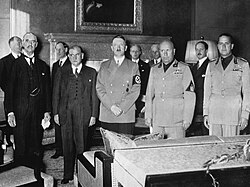
From left to right: Chamberlain, Daladier, Hitler, Mussolini, and Ciano pictured just before signing the Munich Agreement, 29 September 1938

German Foreign Minister Joachim von Ribbentrop (right) and the Soviet leader Joseph Stalin after signing the Molotov–Ribbentrop Pact, 23 August 1939

The Course of the War

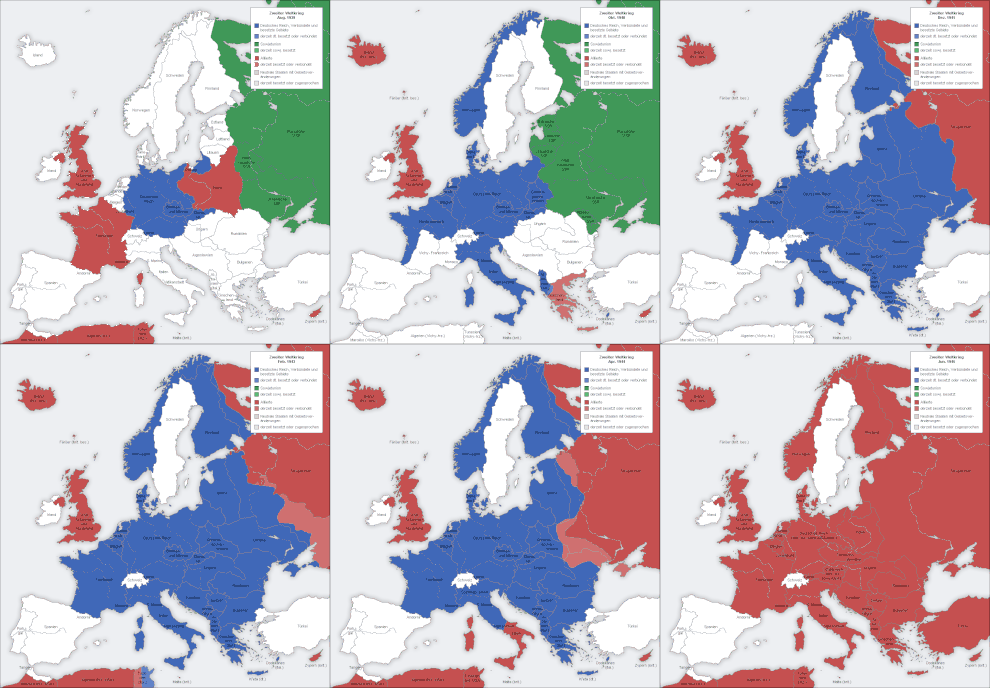
European theatre of World War II animation map, 1939–1945 – Red: Western Allies and the Soviet Union after 1941; Green: Soviet Union before 1941; Blue: Axis powers

The Outbreak and Axis Ascendancy (1939–1941)

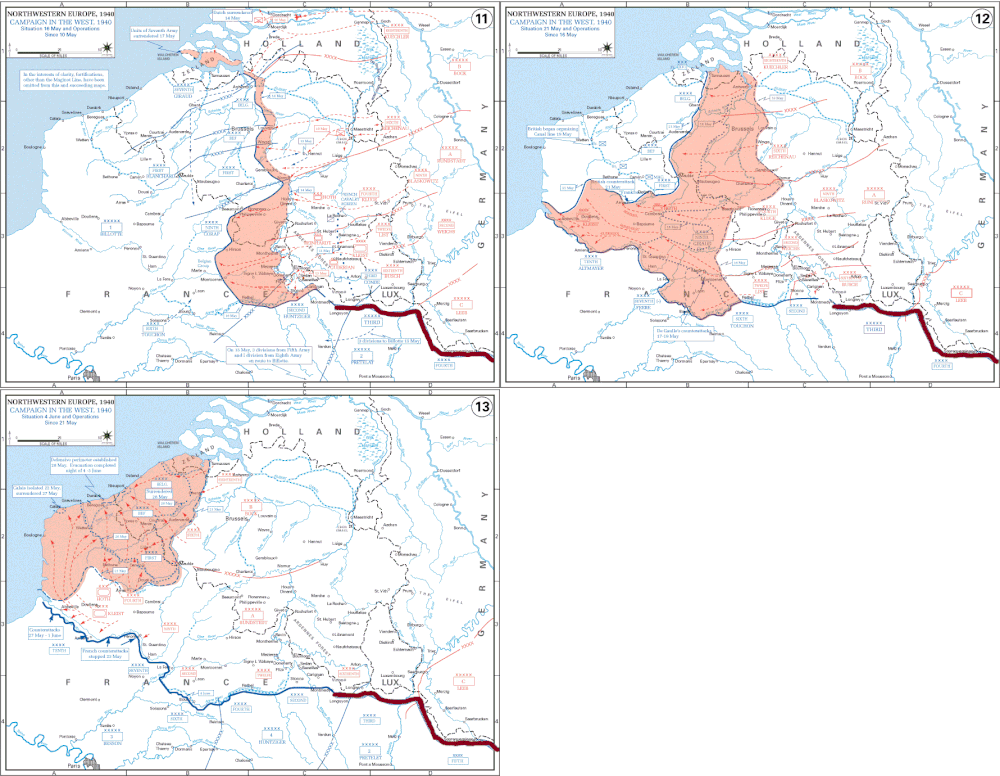
The war began in Europe on September 1, 1939, when Germany invaded Poland. This triggered declarations of war from Britain and France. Using Blitzkrieg (lightning war)—a tactic combining fast-moving armored divisions with air support—Germany quickly overran much of Western Europe, including Belgium and France, by June 1940.

A German propaganda photograph reenacting the removal of the Polish border crossing in Sopot[68]

German advance into Belgium and Northern France, 10 May – 4 June 1940, sweeping past the Maginot Line (shown in dark red)

The conflict expanded further when Germany launched a massive invasion of the Soviet Union in 1941. Simultaneously, the war became truly global on December 7, 1941, when Japan launched a surprise air attack on the U.S. Pacific Fleet at Pearl Harbor, bringing the United States into the war.
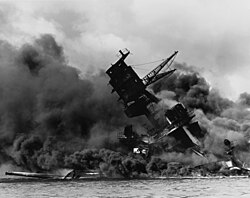
The USS Arizona was a total loss in the Japanese surprise air attack on the United States Pacific Fleet at Pearl Harbor, Sunday 7 December 1941

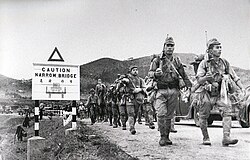
Japanese soldiers entering Hong Kong, 8 December 1941

The Turning Tide (1942–1943)

The momentum shifted as the Axis powers faced critical defeats. In the Pacific, the Battle of Midway in June 1942 dealt a severe blow to the Japanese Navy. On the Eastern Front, the Battle of Stalingrad became a pivotal turning point; the Soviet victory there halted the German advance into the USSR.
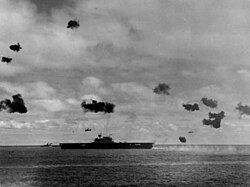
Japanese torpedo bombers fly past the USS Yorktown during the Battle of Midway, 4 June 1942

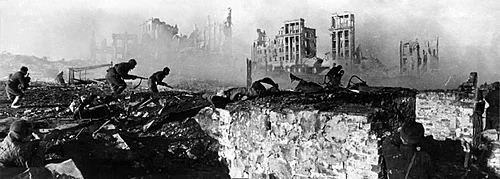
Red Army soldiers on the counterattack during the Battle of Stalingrad, February 1943

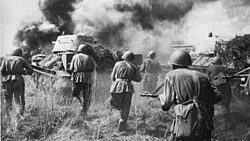
In North Africa, Allied forces pushed back the Afrika Korps, while the Soviet victory at the Battle of Kursk in July 1943 marked the final failure of the German offensive in the East.
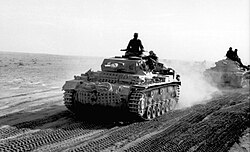
German Panzer III of the Afrika Korps advancing across the North African desert, April 1941

Red Army troops behind T34/76 (1942 variant) in a counter-offensive on German positions at the Battle of Kursk, July 1943

Allied Victory and Axis Collapse (1944–1945)

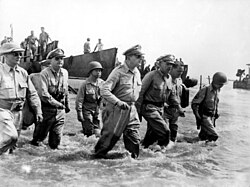
The Allies launched a series of massive offensives to reclaim occupied territories. On June 6, 1944, known as D-Day, Allied forces invaded Normandy, establishing a foothold in Western Europe. In the Pacific, U.S. forces engaged in an "island-hopping" campaign, eventually returning to the Philippines.
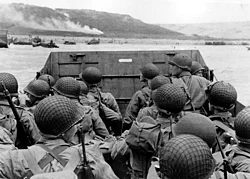
American troops approaching Omaha Beach during the invasion of Normandy on D-Day, 6 June 1944

General Douglas MacArthur returns to the Philippines during the Battle of Leyte, 20 October 1944

By 1945, the Axis powers were collapsing. Soviet troops captured Berlin, leading to Germany's unconditional surrender in May. In the Pacific, the war ended in August 1945 following the U.S. atomic bombings of Hiroshima and Nagasaki, leading to the formal Japanese surrender on September 2, 1945.
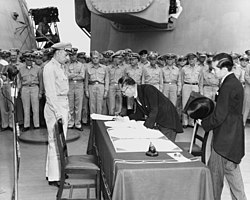
Japanese foreign affairs minister Mamoru Shigemitsu signs the Japanese Instrument of Surrender on board USS Missouri, 2 September 1945

The Human Cost and Aftermath

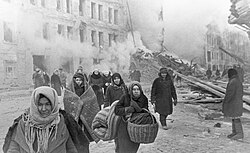
Russian civilians leaving destroyed houses after a German bombardment during the siege of Leningrad (Saint Petersburg), 10 December 1942

The war was characterized by unprecedented atrocities. The Holocaust saw the systematic, state-sponsored murder of millions of Jews and other persecuted groups by the Nazi regime in concentration and extermination camps.
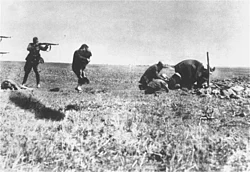
Members of the Einsatzgruppen prepares to shoot a Jewish mother holding her child, Ivangorod, Ukraine

Prisoner identity photograph of a Polish girl taken by the German SS in Auschwitz.[391] Approximately 230,000 children were held prisoner and used in forced labour and Nazi medical experiments.

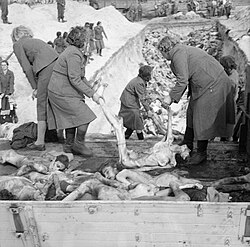
Schutzstaffel (SS) women camp guards removing prisoners' bodies from lorries and carrying them to a mass grave, inside the German Bergen-Belsen concentration camp, 1945

Beyond the Holocaust, the war saw widespread war crimes, including the massacre of civilians in occupied territories and the use of forced labor. Following the war, the Nuremberg trials were established to prosecute Nazi leaders for crimes against humanity.
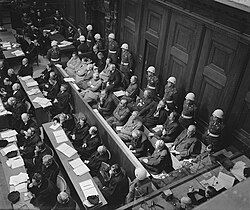
Defendants at the Nuremberg trials, where the Allied forces prosecuted prominent members of the political, military, judicial, and economic leadership of Nazi Germany for crimes against humanity

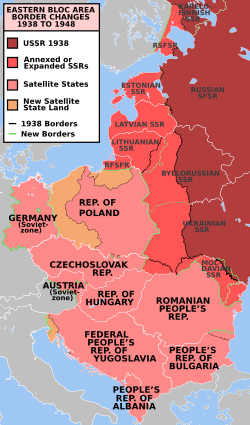
The geopolitical landscape was forever changed. The Yalta Conference helped determine the post-war order, leading to the creation of the communist Eastern Bloc and a new era of global tension known as the Cold War.
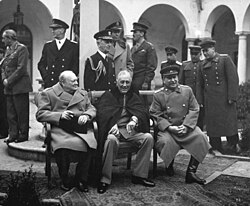
Yalta Conference held in February 1945, with Winston Churchill, Franklin D. Roosevelt, and Joseph Stalin

Post-war border changes in Central Europe and creation of the communist Eastern Bloc

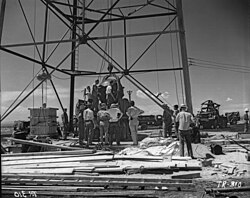
Technological advancements accelerated during the conflict, ranging from the development of the V-2 rocket to the creation of the first nuclear weapons.
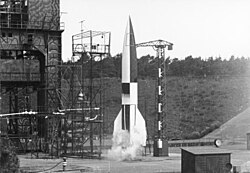
A V-2 rocket launched from a fixed site in Peenemünde, 21 June 1943

Nuclear Gadget being raised to the top of the detonation "shot tower", at Alamogordo Bombing Range; Trinity nuclear test, New Mexico, July 1945

Faction Primary Nations Key Leaders
Allies Soviet Union, USA, UK, China Joseph Stalin, Franklin D. Roosevelt, Winston Churchill, Chiang Kai-shek
Axis Germany, Japan, Italy Adolf Hitler, Hirohito, Benito Mussolini

Frequently Asked Questions

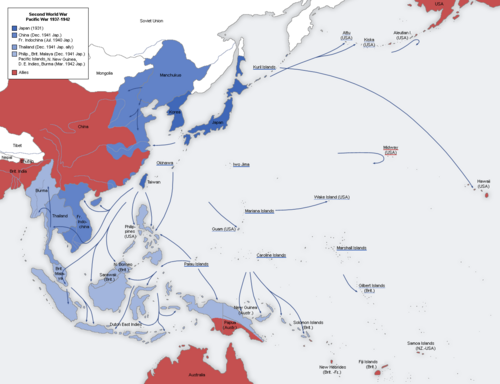
Map of Japanese military advances through mid-1942
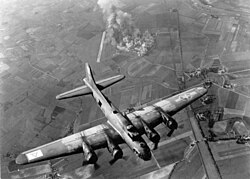
American Eighth Air Force Boeing B-17 Flying Fortress bombing raid on the Focke-Wulf factory in Germany, 9 October 1943
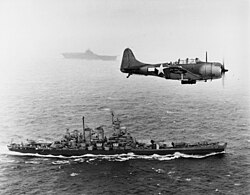
US Navy SBD-5 scout/dive bomber flying patrol over USS Washington and USS Lexington during the Gilbert and Marshall Islands campaign, 1943
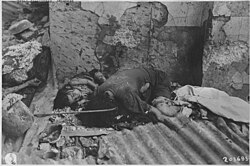
A Filipino woman and child killed by Japanese troops in Manila, 1945
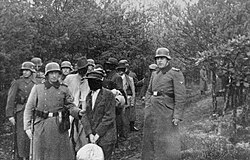
Polish civilians wearing blindfolds photographed just before being massacred by German soldiers in Palmiry forest, 1940
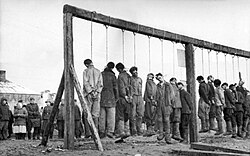
Soviet partisans hanged by the German army. The Russian Academy of Sciences reported in 1995 that civilian victims in the Soviet Union at German hands totalled 13.7 million dead, twenty per cent of the 68 million people in the occupied Soviet Union.
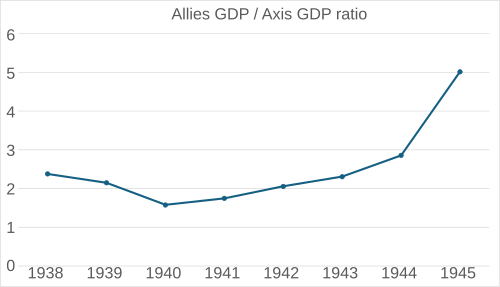
Allies to Axis GDP ratio throughout the war

When did World War II officially start and end?

The war began on September 1, 1939, with the German invasion of Poland, and officially ended on September 2, 1945, with the signing of the Japanese Instrument of Surrender.

What was the significance of the Battle of Stalingrad?

The Battle of Stalingrad is considered one of the most critical turning points of the war. The Soviet victory halted the German advance into the Soviet Union and shifted the momentum of the Eastern Front in favor of the Allies.

What were the primary causes of the war?

The war was caused by a combination of factors, including the unresolved tensions from World War I, the rise of totalitarianism in Germany and Italy, Japanese imperialism in Asia, and the failure of international diplomacy to stop Axis aggression.

What was the Holocaust?

The Holocaust was the systematic, state-sponsored persecution and murder of approximately six million Jews, along with millions of others, by the Nazi regime and its collaborators.

How did the war end in the Pacific?

The war in the Pacific ended after the United States dropped atomic bombs on the cities of Hiroshima and Nagasaki in August 1945, leading to the unconditional surrender of Japan.