Wilhelm IIGerman EmpireHohenzollern dynastyWorld War IKaiser

Wilhelm II: The Last German Emperor and the Fall of the Hohenzollerns

Wilhelm II: The Last German Emperor and the Fall of the Hohenzollerns Wilhelm II served as the final German Emperor and King of Prussia from 1888 until his abdication in 1918. His reign w...

Wilhelm II: The Last German Emperor and the Fall of the Hohenzollerns

Wilhelm II served as the final German Emperor and King of Prussia from 1888 until his abdication in 1918. His reign was a period of immense industrial growth and military expansion, but it was also characterized by diplomatic volatility that contributed to the outbreak of World War I. His departure from power signaled not only the end of the German Empire but also the conclusion of the Hohenzollern dynasty's 400-year rule over Prussia.

Born into the heart of Prussian royalty on January 27, 1859, Prince Friedrich Wilhelm Viktor Albert grew up in an era of transition. His early years were marked by a traumatic birth and a complex relationship with his parents, including his mother, Victoria, Princess Royal.
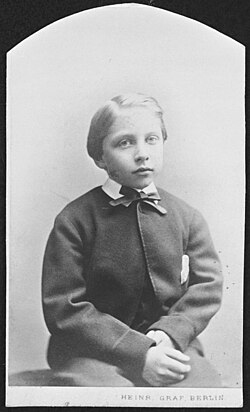
Wilhelm in 1867, aged 8

The Path to the Throne

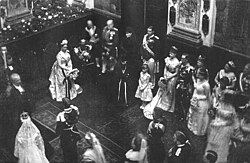
Wedding of Prince Henry of Prussia with Princess Irene of Hesse on 24 May 1888. The future emperor Wilhelm II is on the right. The emperor Frederick III is seated on the left and would have died just three weeks after.

The transition of power in 1888 was swift and tragic. Following the death of Kaiser Wilhelm I on March 9, Wilhelm's father, Frederick III, ascended the throne. However, Frederick III suffered from incurable throat cancer and reigned for only 99 days. Upon his father's death on June 15, 1888, the 29-year-old Wilhelm II became the German Emperor.
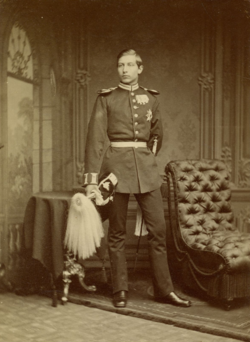
Prince Wilhelm as a student at the age of 18 in Kassel.

The Dismissal of Otto von Bismarck

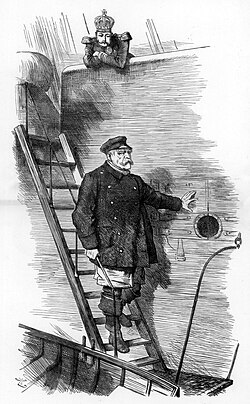
One of the most pivotal moments of Wilhelm's early reign was his conflict with Otto von Bismarck, the Chancellor who had architected the unification of Germany. While Bismarck had effectively dictated German policy for years, Wilhelm II sought personal control over the government. This tension culminated in Bismarck's forced resignation in March 1890, an event famously captured in contemporary political cartoons.
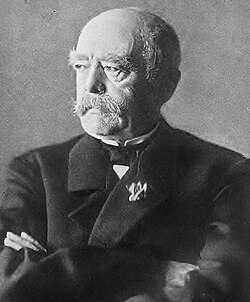
Otto von Bismarck, the Chancellor who effectively dictated German policy until Wilhelm II assumed the throne in 1888

"Dropping the Pilot" by John Tenniel, published in Punch on 29 March 1890, two weeks after Bismarck's forced resignation as Chancellor

Imperial Ambitions and Foreign Policy
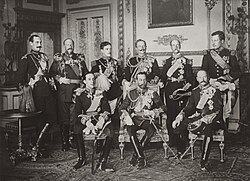
The Nine Sovereigns at Windsor for the funeral of King Edward VII, photographed on 20 May 1910. Standing, from left to right: King Haakon VII of Norway, Tsar Ferdinand I of Bulgaria, King Manuel II of Portugal, Kaiser Wilhelm II of Germany, kings George I of Greece and Albert I of Belgium. Seated, from left to right: kings Alfonso XIII of Spain, George V of the United Kingdom and Frederick VIII of Denmark.

Once in control, Wilhelm II embarked on a "New Course," promoting the arts and sciences while aggressively pursuing Weltpolitik (World Policy) to secure Germany's place as a global power. He was known for his flamboyant personality and a deep appreciation for military pageantry, often appearing in elaborate uniforms.
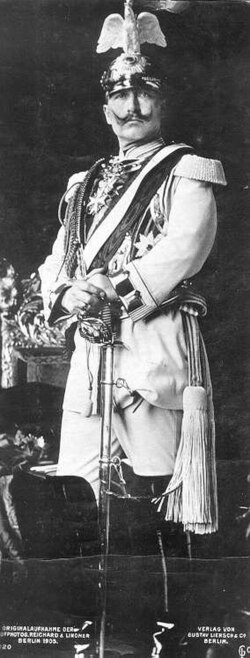
Wilhelm indulging in his famed appreciation of flamboyant uniforms

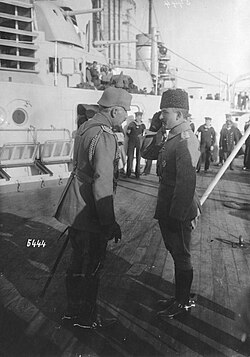
His foreign relations were a mixture of familial ties and diplomatic friction. Despite being related to many European monarchs, his erratic diplomacy often alienated allies. He developed a particular interest in the Ottoman Empire, conducting state visits to Jerusalem and Istanbul, and maintaining close ties with figures such as Enver Pasha.
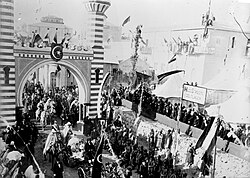
Wilhelm in Jerusalem during his state visit to the Ottoman Empire, 1898

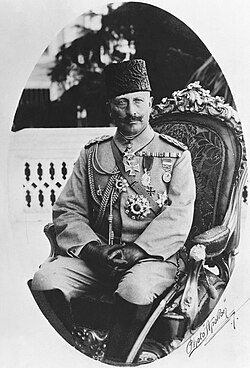
Wilhelm in Turkish field marshal uniform at Dolmabahçe Palace (15 October 1917)

Kaiser Wilhelm II with Enver Pasha, October 1917. Staunchly pro-German, Enver was one of the main perpetrators of the Armenian genocide.

The Naval Race and International Tension

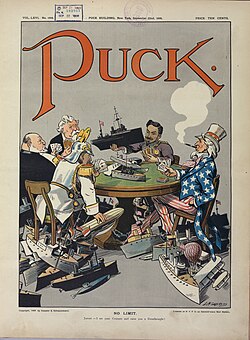
Wilhelm's desire for a powerful navy led to a costly and tense naval arms race with Great Britain. This strategic shift, combined with diplomatic blunders like the Daily Telegraph Affair and the Moroccan Crisis, pushed Britain closer to France and Russia, isolating Germany.
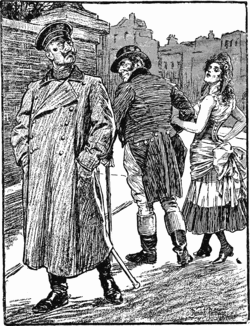
A 1904 British cartoon commenting on the Entente cordiale: John Bull walking off with Marianne, turning his back on Wilhelm II, whose sabre is shown extending from his coat

1909 cartoon in Puck shows five nations engaged in naval race; the Kaiser is in white.

World War I and the Collapse of Empire
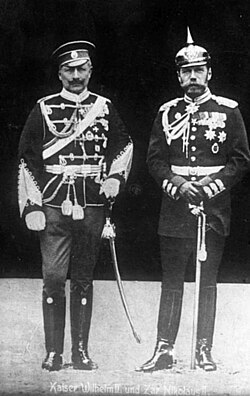
Wilhelm with Nicholas II of Russia in 1905, wearing the military uniforms of each other's army

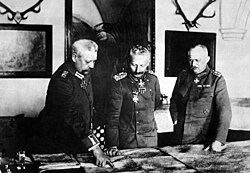
The Sarajevo crisis of 1914 acted as the catalyst for World War I. While Wilhelm II initially viewed the conflict through the lens of military maneuvers and dynastic loyalty, the war soon evolved into a global catastrophe. As the conflict progressed, the Kaiser's actual power waned, and he became a "Shadow-Kaiser," with military leaders like Paul von Hindenburg and Erich Ludendorff exercising primary control over the war effort.
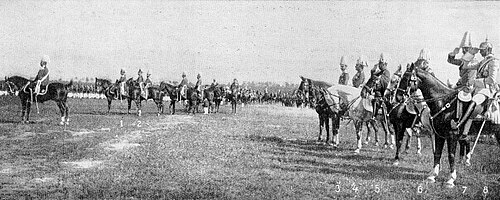
Wilhelm with the Grand Duke of Baden, Prince Oskar of Prussia, the Grand Duke of Hesse, the Grand Duke of Mecklenburg-Schwerin, Prince Louis of Bavaria, Prince Max of Baden and his son, Crown Prince Wilhelm, at pre-war military manoeuvres in autumn 1909

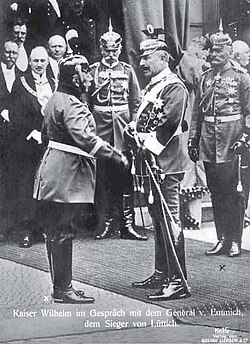
Wilhelm conversing with the victor of Liège, General Otto von Emmich; in the background the generals Hans von Plessen (middle) and Moriz von Lyncker (right)

Hindenburg, Wilhelm, and Ludendorff in January 1917

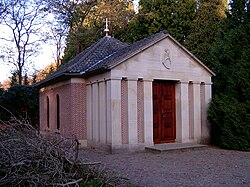
By November 1918, with Germany facing internal revolution and military defeat, Wilhelm II was forced to abdicate. He fled to the Netherlands, where he spent the remainder of his life in exile at Huis Doorn.
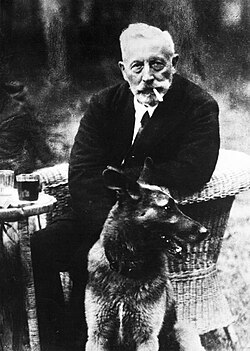
Kaiser Wilhelm II and his dog in exile. Doorn, 1938

Key Facts

ภาพประกอบบทความ
ภาพประกอบจากบทความต้นฉบับ
  • Reign: June 15, 1888 – November 9, 1918.
  • Dynasty: House of Hohenzollern.
  • Predecessor: Frederick III (reigned 99 days).
  • Successor: Monarchy abolished; succeeded by Friedrich Ebert as President of the Weimar Republic.
  • Exile: Lived at Huis Doorn in the Netherlands from 1918 until his death in 1941.
  • Death: June 4, 1941, at the age of 82.

Summary of Imperial Life

Overview of Wilhelm II's Life and Reign
Category Details
Full Name Friedrich Wilhelm Viktor Albert
Spouses Augusta Viktoria of Schleswig-Holstein (m. 1881); Hermine Reuss of Greiz (m. 1922)
Key Political Rival Otto von Bismarck
Major Conflict World War I
Final Residence Huis Doorn, Netherlands

Wilhelm's tomb at Huis Doorn

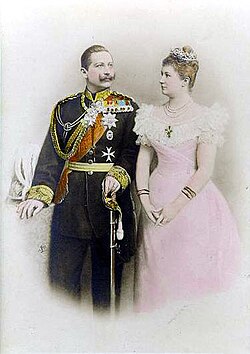
Wilhelm and his first wife, Augusta Victoria

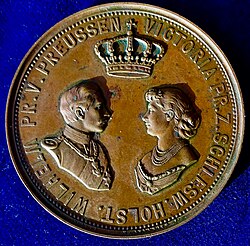
Wedding medal of Prince Wilhelm and Princess Augusta, obverse

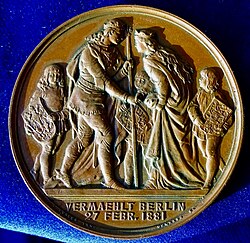
The reverse shows the couple in medieval costumes in front of 3 squires carrying the shields of Prussia, Germany, and Schleswig-Holstein.

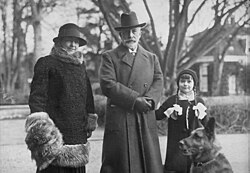
With second wife, Hermine, and her daughter, Princess Henriette

Frequently Asked Questions

Why did Wilhelm II dismiss Otto von Bismarck?

Wilhelm II wanted to exercise personal authority over the German government and move away from the cautious, calculated diplomacy of Bismarck in favor of a more aggressive global presence.

What was the "Hun Speech"?

The "Hun Speech" was an address given by the Kaiser in 1900 to the German Expeditionary Force heading to China, which became a point of contention and was used in later propaganda.

How did Wilhelm II's relationship with Britain affect the war?

His naval ambitions and erratic diplomatic behavior created deep mistrust with the British monarchy and government, contributing to the formation of the Triple Entente between Britain, France, and Russia.

Where did Wilhelm II spend his exile?

After abdicating in 1918, Wilhelm II lived in the Netherlands at Huis Doorn, where he remained until his death in 1941.

Who succeeded Wilhelm II as the head of state?

The German monarchy was abolished upon his abdication, and the country transitioned to the Weimar Republic, with Friedrich Ebert serving as the first President.

References

  1. Compared with other historical monarchs, the term "William II" is not commonly used in modern English, but many older sources used this name.[2][3][4]
  2. "Kaiser Wilheim II Birthday Invite". BBC. Retrieved 15 May 2026.
  3. "Kaiser Dies In Exile". YouTube. 21 July 2015.
  4. The Daily Life Of The Kaiser William: In Business as An Emperor Harmsworth London Magazine
  5. 1918 Sunday Pictorial Abdication of Kaiser William II. ALAMY