Whitehall: A History of London's Political Heart
Whitehall is more than just a street in central London; it is a corridor of power that has witnessed the rise and fall of monarchs, the execution of a king, and the evolution of the British government. Connecting Charing Cross to Westminster, this route has transitioned from a scenic suburb of gardens and orchards in the 12th century to the dense urban center of administration it is today.
In its early years, the area was not a single road. The name Whitehall originally referred only to the section between Charing Cross and Holbein Gate. Beyond that point, the route was known as "The Street" until it reached King Street Gate, after which it became King Street. By the 16th and 17th centuries, it had evolved into a prestigious residential area, attracting notable figures such as the poet Edmund Spenser and Lord Howard of Effingham.
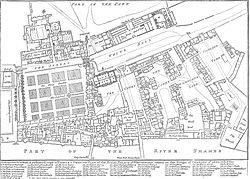
The Rise and Fall of the Palace of Whitehall
The centerpiece of the area was the Palace of Whitehall, originally known as York Palace. Renamed during the reign of Henry VIII, the palace underwent a major redesign between 1531 and 1532, eventually becoming the primary residence of the King. It served as the backdrop for pivotal royal events, including Henry VIII's marriages to Anne Boleyn in 1533 and Jane Seymour in 1536, and it was where the King ultimately died in 1547.
The palace was a hub of culture and art. Charles I maintained an extensive art collection there, and the venue hosted the first performances of several plays by William Shakespeare. However, the royal connection faded in 1689 when William III moved to Kensington Palace to escape the increasingly congested urban environment for the sake of his health.
Tragedy struck the palace twice by fire. After initial damage in 1691 led to a redesign of the front entrance by Sir Christopher Wren, a catastrophic accidental fire in 1698—started by a careless washerwoman—burned most of the vast structure to the ground.
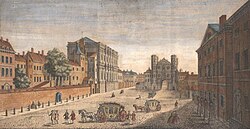
The Banqueting House
The only surviving remnant of the great palace is the Banqueting House. Built in 1622 by Inigo Jones as an extension to the palace, it holds the distinction of being London's first Renaissance building. After serving various roles, it became a museum for the Royal United Services Institute and has been open to the public since 1963.
Political Turmoil and the English Civil War
Whitehall's geography played a role in some of England's most dramatic political shifts. In 1647, Oliver Cromwell took up residence in Wallingford House, a property originally built in 1572 by Sir Francis Knollys and later used by Charles I. Two years later, the street became the site of a national tragedy when Charles I was transported through Whitehall to his trial at Westminster Hall.
Because Whitehall was a wide thoroughfare, there was sufficient space to erect a scaffold outside the Banqueting House. It was here that Charles I delivered a brief speech before being beheaded. In a poetic turn of history, Oliver Cromwell also died at the site of the Palace of Whitehall in 1658.
Urban Evolution and Modern History
Throughout the centuries, Whitehall adapted to the needs of a growing city. During the Great Plague of 1665, the street served as a departure point for those fleeing the city. Samuel Pepys recorded in his diary on June 29 that the area was "full of waggons and people ready to go out of town" as the King and his court temporarily relocated to Oxford.
As traffic increased in the 18th century, the narrow streets south of Holbein Gate became impassable. This led to the demolition of King Street Gate in 1723 and Holbein Gate in 1759. Parliament Street, once a side road, was widened to match Whitehall's breadth following the palace's destruction. The street's current layout was finalized in 1899 after the removal of houses between Downing Street and Great George Street.
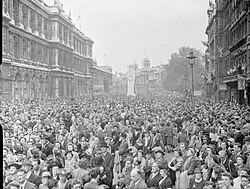
In more recent history, Whitehall has been the target of political violence. On March 8, 1973, an IRA bomb detonated in front of the Ministry of Agriculture, injuring bystanders. Later, on February 7, 1991, the IRA launched a mortar attack on 10 Downing Street in an attempt to assassinate Prime Minister John Major and his cabinet, though the attempt was unsuccessful.
Key Facts
- First Renaissance Building: The Banqueting House (1622) is the first of its kind in London.
- Royal Transitions: The Palace of Whitehall was the main royal residence until 1689.
- Historic Execution: King Charles I was beheaded on a scaffold at the Banqueting House.
- Urban Change: The street's modern appearance was established in 1899.
- Architectural Loss: Most of the Palace of Whitehall was destroyed by a fire in 1698.
| Landmark | Significance | Key Date/Period |
|---|---|---|
| Palace of Whitehall | Main royal residence; site of Henry VIII's marriages | 1530s – 1689 |
| Banqueting House | First Renaissance building in London; only palace survivor | Built 1622 |
| Wallingford House | Residence of Cromwell; site of Old Admiralty Buildings | Built 1572 |
| Holbein Gate | Former boundary marker between Whitehall and The Street | Demolished 1759 |
Frequently Asked Questions
What is the only remaining part of the Palace of Whitehall?
The Banqueting House, built by Inigo Jones in 1622, is the only surviving portion of the palace after the majority of the structure was destroyed by fire in 1698.
Why did the royal family stop living at Whitehall?
William III moved to Kensington Palace in 1689 to improve his health and escape the dense, crowded urban surroundings of central London.
Who was executed at Whitehall?
King Charles I was beheaded on a scaffold erected outside the Banqueting House following his trial at Westminster Hall.
How did the street's name change over time?
Originally, "Whitehall" only described the road from Charing Cross to Holbein Gate. The section beyond was called "The Street" until King Street Gate, and then "King Street." Over time, the name Whitehall came to encompass the wider area.
What happened to Wallingford House?
Originally built in 1572, it was later used by Charles I and Oliver Cromwell. It was eventually purchased for the Admiralty, and the Old Admiralty Buildings now occupy its site.