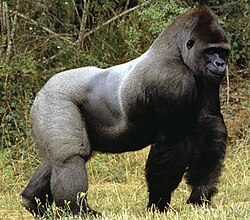
Western Lowland Gorilla
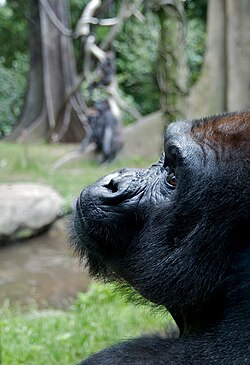
The Western lowland gorilla (Gorilla gorilla gorilla) is a powerful primate native to the tropical forests of Central Africa. Known for their immense strength and complex social structures, these great apes play a vital role in their ecosystem. However, they currently face severe threats that have pushed them toward the brink of extinction.
These primates are characterized by their significant sexual dimorphism, where males are considerably larger than females. While they can stand erect, they typically move in a hunched, quadrupedal fashion, walking on their knuckles. This unique locomotion means their arm span often exceeds their standing height.
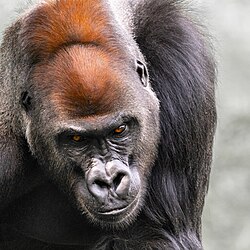
Key Facts
- Conservation Status: Critically Endangered (IUCN 3.1).
- Maximum Male Weight: Up to 227 kg (500 lb) in the wild; up to 275 kg (606 lb) in captivity.
- Primary Habitat: Rainforests and swamp forests of Central Africa, particularly the Republic of the Congo.
- Major Threats: Ebola virus, poaching for bushmeat, and deforestation.
- Genetic Profile: 23 pairs of chromosomes with a genome size of 3,035.66 Mb.
Physical Characteristics and Biology
Adult males, often referred to as silverbacks, can reach heights of 1.83 m (6 ft 0 in) and average weights of 140 kg (310 lb). Females are smaller, averaging 70 kg (150 lb) and standing approximately 1.5 m (4 ft 11 in) tall. The physical power of a silverback is legendary, though specific claims regarding their strength relative to Olympic athletes remain unverified.
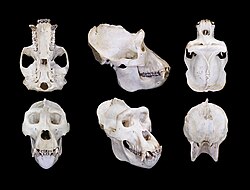
Genetics and Rare Variations
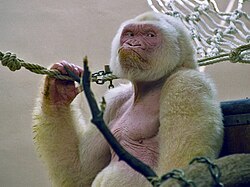
The genome of the western lowland gorilla was completed in 2012, revealing a diploid structure with 23 pairs of chromosomes. While most gorillas possess dark fur, rare instances of albinism (a genetic condition resulting in a lack of pigment) have been documented, providing scientists with unique opportunities to study inbreeding in wild populations.
Habitat and Ecology
Western lowland gorillas inhabit a variety of environments, including primary and secondary lowland tropical forests, swamp forests, brush, and riverine forests. They are found at elevations ranging from sea level up to 1,300 m (4,300 ft). These areas typically receive an average annual rainfall of 1,500 mm (60 in), peaking between August and November.
The Republic of the Congo currently hosts the majority of the population. Gorillas generally avoid human settlements, roads, and farms, favoring areas where edible plants are abundant. Swamp forests are particularly critical, as they provide essential food sources during both wet and dry seasons.
Behavior and Movement
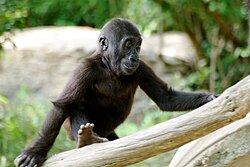
These gorillas travel within home ranges spanning 8 to 45 km (3 to 17 sq mi). They are not territorial and often overlap ranges with neighboring groups. Their daily travel typically covers 3–5 km (1.9–3.1 mi), though this distance increases for larger groups or those relying on high-energy foods that vary seasonally.
Intelligence and Tool Use
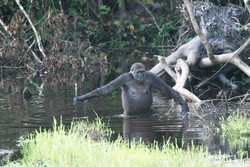
Western lowland gorillas exhibit high levels of intelligence and the ability to use tools to interact with their environment. Examples include using branches to measure the depth of water, as well as the use of buckets in captive settings to obtain food.
Reproduction and Population Dynamics
Female gorillas typically reach reproductive maturity between 10 and 12 years of age, though some may mature as early as 7 or 8. Males mature more slowly, rarely becoming dominant enough to reproduce before the age of 15 to 20. Fecundity—the capacity to produce offspring—generally declines in females by age 18.
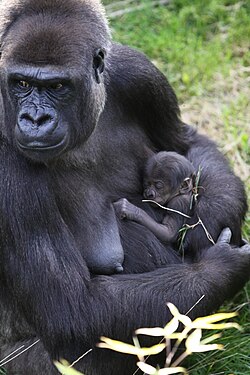
In captivity, reproduction can be challenging; approximately 30% of viable reproductive-age females have had only a single birth. To combat this and maintain genetic diversity, zoos often employ assisted reproductive techniques.
Threats and Conservation
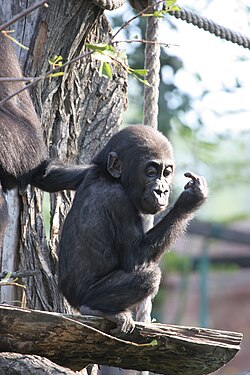
The western lowland gorilla is classified as Critically Endangered due to a combination of human-driven and biological threats. Deforestation, grazing, and expanding human settlements lead to habitat loss, which is closely linked to an increase in bushmeat hunting.
The Impact of Disease
Disease has had a devastating impact on wild populations. The Ebola virus has caused mortality rates exceeding 90% in some areas. Between 2003 and 2004, outbreaks in the Republic of the Congo significantly reduced populations in the Lossi sanctuary and Lokoué forest clearing. In the latter, the population plummeted from 377 individuals to just 38 within two years.
Additionally, malaria caused by Plasmodium parasites transmitted by Anopheles mosquitoes has been identified in wild populations, further stressing their survival.
Population Recovery
Despite these losses, there is hope. Surveys in 2006 and 2007 by the Wildlife Conservation Society discovered approximately 125,000 previously unreported gorillas in the swamp forests of the Lake Télé Community Reserve and neighboring Marantaceae forests in the Republic of the Congo.
| Feature | Male (Silverback) | Female |
|---|---|---|
| Average Weight | 140 kg (310 lb) | 70 kg (150 lb) |
| Max Weight (Wild) | 227 kg (500 lb) | Not specified |
| Standing Height | 1.67 m (5 ft 6 in) | 1.5 m (4 ft 11 in) |
| Sexual Maturity | 15–20 years | 10–12 years |
Frequently Asked Questions
Why are western lowland gorillas critically endangered?
They face a combination of habitat loss due to deforestation and farming, poaching for bushmeat, and devastating disease outbreaks, most notably the Ebola virus.
How do western lowland gorillas differ from other gorillas?
They are a specific subspecies (Gorilla gorilla gorilla) primarily found in the lowland tropical and swamp forests of Central Africa, distinct from the mountain gorilla.
Do gorillas use tools in the wild?
Yes, they have been observed using tools, such as using branches to test the depth of water in their natural habitat.
What is the role of the silverback in a gorilla group?
The silverback is the dominant adult male who leads the group, providing protection and stability for the females and juveniles.
How does Ebola affect gorilla populations?
Ebola is highly lethal to gorillas, with mortality rates over 90% in some outbreaks. It can disrupt the demographic structure of groups, often leaving a higher proportion of solitary males.