Bornean Orangutan: Biology, Evolution, and Conservation Challenges
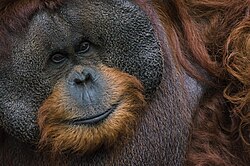
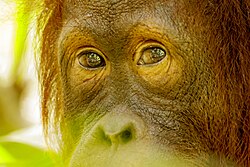
The Bornean orangutan (Pongo pygmaeus) is one of the world's most intelligent primates, known for its remarkable tool use and complex cultural patterns. As the largest truly arboreal (tree-dwelling) extant ape, it plays a critical role in the ecosystem of the Borneo lowland and montane rain forests, inhabiting elevations up to 1,500 meters (4,900 ft).
Despite their intelligence and ecological importance, these great apes face an uncertain future. Listed as Critically Endangered, their survival is threatened by the rapid expansion of palm oil plantations, deforestation, and illegal hunting.
Key Facts
- Conservation Status: Critically Endangered (IUCN 3.1) and CITES Appendix I.
- Habitat: Lowland and montane rain forests of Borneo.
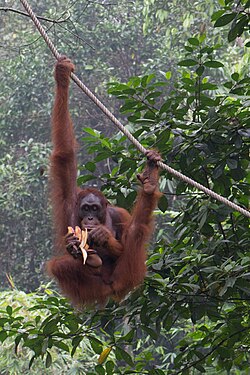
- Diet: Primarily frugivorous, eating fruits, seeds, flowers, sap, vines, and occasionally bird eggs.
- Size: Males average 75 kg (165 lb); females average 38.5 kg (85 lb).
- Intelligence: High cognitive ability characterized by tool use and distinct cultural behaviors.
Taxonomy and Evolution
The Bornean orangutan is classified within the family Hominidae. It is divided into three recognized subspecies:
- Northwest Bornean orangutan (P. p. pygmaeus): Found in Sarawak and northern West Kalimantan.
- Central Bornean orangutan (P. p. wurmbii): Found in Southern West Kalimantan and Central Kalimantan.
- P. p. morio.
Evolutionary history reveals that Bornean orangutans diverged from Tapanuli orangutans approximately 674,000 years ago. They diverged from Sumatran orangutans about 400,000 years ago, though a low level of gene flow has continued between the two. While they were considered subspecies until 1996, mitochondrial DNA sequencing led to their elevation to distinct species.
Physical Characteristics
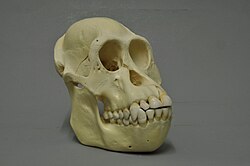
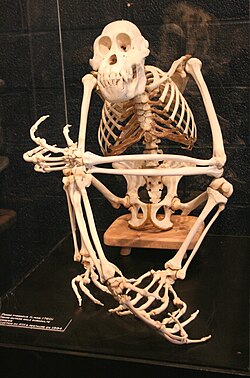
The Bornean orangutan is the third-largest ape globally, surpassed only by the western gorilla. While their body weights overlap with humans, they are specialized for life in the canopy. In the wild, males typically range from 50 to 100 kg (110 to 220 lb) and measure 1.2 to 1.7 meters in length. Females are smaller, generally ranging from 30 to 50 kg (66 to 110 lb).
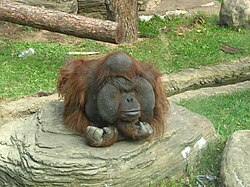
A notable physical trait in males is the development of face pads, which widen as the individual ages.
Behavior and Life Cycle
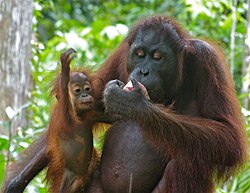
Orangutans exhibit a slow reproductive rate. Females reach sexual maturity between six and 11 years of age, typically giving birth for the first time around 14 to 15 years. The bond between mother and offspring is exceptionally strong; infants cling to their mother's abdomen for the first year and are not fully weaned until approximately four years of age.
Juveniles remain dependent on their mothers for guidance and protection, usually achieving complete independence around seven years of age. During this adolescent phase, they actively seek out other young orangutans for social play.
Diet and Daily Life
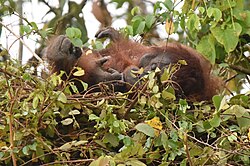
Their diet is diverse, consisting largely of forest produce. They are highly adept at manipulating their environment, often using both hands and feet to handle food.
Conservation Status and Threats
The population of Bornean orangutans is estimated at 104,700 individuals—significantly more than the Sumatran species, but still in sharp decline. It is estimated that current numbers are less than 14% of the population present from 10,000 years ago until the mid-20th century.
The primary drivers of this decline include:
- Habitat Loss: Deforestation for palm oil plantations has fragmented populations and reduced available nutrients, leading to lower birth rates.
- Illegal Trade: Young orangutans are often captured for the pet trade, a process that usually involves killing the mother.
- Poaching: Hunting for bushmeat remains a critical threat. A 2011 survey suggested killing rates between 750 and 1,800 individuals per year in Kalimantan.
Summary of Species Data
| Feature | Details |
|---|---|
| Scientific Name | Pongo pygmaeus |
| Average Male Weight | 75 kg (165 lb) |
| Average Female Weight | 38.5 kg (85 lb) |
| Conservation Status | Critically Endangered |
| Primary Habitat | Borneo Lowland/Montane Rain Forests |
| Estimated Population | ~104,700 (Wild) |
Frequently Asked Questions
How do Bornean and Sumatran orangutans differ?
While similar in size, they are distinct species that diverged about 400,000 years ago. Bornean orangutans generally have lower autosomal gene and nucleotide diversity due to a smaller historical population size.
What is the main threat to their survival?
The most significant threats are habitat destruction caused by deforestation and the expansion of palm oil plantations, alongside the illegal bushmeat trade and the capture of infants for pets.
How long do orangutans stay with their mothers?
Orangutans have one of the longest dependency periods of any mammal. They are typically weaned around four years of age and do not become fully independent until about seven years of age.
Does well-being affect their lifespan in captivity?
Yes. A seven-year longitudinal study indicated that zoo-housed orangutans with higher subjective well-being assessments were less likely to die during the follow-up period, suggesting that happiness is linked to longevity.
Are Bornean orangutans protected by law?
Yes, they are listed as a "totally protected animal" under the 1998 Wild Life Protection Ordinance in Sarawak and are protected by Indonesian law, although enforcement and prosecution of poachers can be inconsistent.