Kinkajou: The Arboreal 'Honey Bear' of the Tropical Rainforest
Deep within the dense, closed-canopy forests of Mexico, Central, and South America lives a fascinating nocturnal mammal known as the kinkajou. Often referred to by the nickname "honey bear," this creature is a master of the treetops, navigating the complex layers of the rainforest with remarkable agility. While its name might suggest a primate, the kinkajou is actually a member of the Procyonidae family, making it a relative of raccoons, coatis, and olingos.
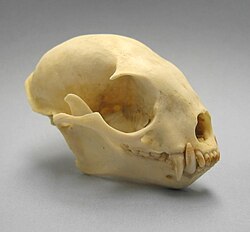
Key Facts
- Scientific Name: Potos flavus
- Conservation Status: Least Concern (IUCN 3.1)
- Primary Diet: Frugivorous (mostly fruit, especially figs)
- Activity Pattern: Strictly nocturnal
- Defining Feature: Fully prehensile tail used as a "fifth hand"
- Lifespan: Up to 40 years in captivity
Physical Characteristics and Adaptations
The kinkajou is perfectly engineered for an arboreal (tree-dwelling) lifestyle. They possess a round head, large eyes that reflect green or bright yellow in the light, and a short, pointed snout. Their limbs are relatively short, but they possess a unique anatomical advantage: the ability to rotate their ankles and feet 180 degrees. This allows them to run backward along branches and descend trees headfirst with ease.

One of their most striking features is the prehensile tail. Measuring between 39 and 57 cm, this thick, hairless-tipped tail acts as a stabilizer and a grasping tool while climbing. While they use it for balance and support, they do not use it to hold food. Additionally, their long, slender, and highly extrudable tongue—reaching up to 5 inches in length—is essential for scooping pulp from soft fruits and licking nectar from flowers.
Size and Weight
Adult kinkajous typically weigh between 1.4 and 4.6 kg. Their total head-and-body length, including the tail, ranges from 82 to 133 cm. Generally, females are smaller in stature than males.
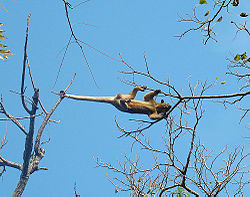
Habitat and Distribution
Kinkajous inhabit a wide variety of tropical environments, ranging from sea level to altitudes of 2,500 meters. Their preferred habitats include lowland rainforests, montane forests, dry forests, and secondary forests. Their range extends from the Sierra Madre in Mexico, through Central America, and into South America, reaching as far as Bolivia and the Atlantic Forest of southeastern Brazil.
| Feature | Details |
|---|---|
| Order | Carnivora |
| Family | Procyonidae |
| Dietary Type | Omnivorous (primarily frugivorous) |
| Primary Food Source | Fruit (approx. 90%) |
| Gestational Period | 112 to 118 days |
Behavior and Diet
As nocturnal animals, kinkajous are most active between 7:00 pm and midnight, and again shortly before dawn. During the day, they seek refuge in tree hollows or shaded leaf tangles to avoid direct sunlight. They are social sleepers, often forming family units and engaging in mutual grooming.
Though classified under the order Carnivora, their diet is overwhelmingly plant-based. Approximately 90% of what they consume consists of ripe fruit, particularly figs. This diet makes them vital players in their ecosystem, as they assist in seed dispersal and pollination. The remaining 10% of their diet includes leaves, flowers, nectar, insects (such as ants), and occasionally bird eggs or small vertebrates.
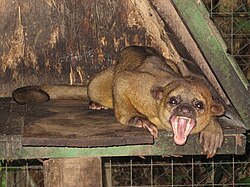
Evolutionary History and Taxonomy
Molecular evidence suggests that kinkajous are the sister group to all other lineages within the Procyonidae family. They diverged from other members of the family approximately 21.6 to 24 million years ago during the Late Oligocene or Early Miocene. It is believed they evolved in North America and migrated to South America during the Great American Interchange following the formation of the Isthmus of Panama.
The taxonomy of the kinkajou has historically been complex. Early naturalists occasionally confused them with other species, leading to various scientific names. Today, Potos flavus is the recognized binomial name. Recent phylogenetic studies have identified five distinct geographical clades, suggesting that some subspecies may eventually be classified as independent species.
Frequently Asked Questions
Are kinkajous related to monkeys?
No. While they share similar physical traits with some neotropical monkeys, such as a prehensile tail and large eyes, they are mammals in the order Carnivora and are not closely related to primates.
Why are they called "honey bears"?
The name comes from the fact that captive kinkajous often enjoy eating honey, though honey is not a widely reported staple in the diet of wild kinkajous.
Can kinkajous be kept as pets?
While some people keep them as exotic pets, there are significant risks. They can become aggressive if agitated, emitting screams and using their claws or teeth. Furthermore, the CDC has noted that pet kinkajous in the U.S. can carry the raccoon roundworm Baylisascaris procyonis, which can cause severe illness in humans.
What is the conservation status of the kinkajou?
The kinkajou is currently listed as Least Concern by the IUCN. However, they face potential threats from deforestation and are sometimes hunted for their meat, skin, or for the pet trade.
How do kinkajous communicate?
Kinkajous use scent glands located near their mouth, throat, and belly to mark their territory and establish travel routes through the forest.