IUCN Red List: Tracking Global Species Extinction Risk
The International Union for Conservation of Nature (IUCN) Red List of Threatened Species, also known as the Red Data Book, is the world's most comprehensive inventory of the global conservation status and extinction risk of biological species. Established in 1964 and headquartered in Cambridge, England, this international effort provides a critical scientific foundation for biodiversity conservation.
The primary goals of the Red List are to provide scientifically based information on species and subspecies, highlight the magnitude of threatened biodiversity, and influence international policy to guide conservation actions. To ensure accuracy, the IUCN aims to re-evaluate every species category at least every ten years, and ideally every five years, through a rigorous peer-review process.
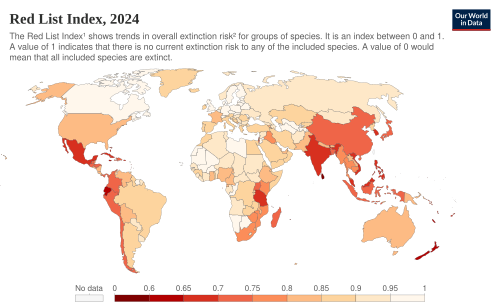
Key Facts
- Founded: 1964.
- Purpose: To track extinction risk and guide global biodiversity conservation.
- Current Status (2023): Out of 150,388 surveyed species, 42,108 are considered at risk of extinction.
- Primary Threats: Human activities, specifically land development, hunting, and overfishing.
- Assessment Partners: Major contributors include BirdLife International, the World Conservation Monitoring Centre, and the Zoological Society of London's Institute of Zoology.
Evolution of the Red List
Early Red Data Lists (1966–1979)
Initially, the Red Data Lists were designed for specialists and published in a loose-leaf format for easy updates. The first volumes appeared in 1966, covering mammals and birds. This was followed by reptiles and amphibians in 1968, angiosperms (flowering plants) in 1970, and freshwater fishes in 1979.
Expanding Public Awareness
In 1969, the IUCN made its first attempt to reach a non-specialist audience with The Red Book: Wildlife in Danger. This publication provided a broader overview of mammals, birds, reptiles, amphibians, fishes, and plants.
Modern Releases and Trends
Over the last two decades, the Red List has expanded significantly in scope and detail:
- 2006: Evaluated 40,168 species and 2,160 subspecies or subpopulations.
- 2007: Highlighted the crisis for great apes, raising the western lowland gorilla and Cross River gorilla to "Critically Endangered" due to poaching and the Ebola virus.
- 2008: The "Blue List" focused on mammals, revealing that nearly one in four mammal species was at risk of disappearing.
- 2012: Released at the Rio+20 Earth Summit, assessing 63,837 species. It revealed that 41% of amphibians and 33% of reef-building corals were threatened.
![The percentage of species in several groups by their conservation status according to the IUCN Red List.[7]](/images/de/b4/deb4368b6767122acc1b5034e924ecec4f1915c167287ddee8de59d83c9f4841.png)
Conservation Categories and Criteria
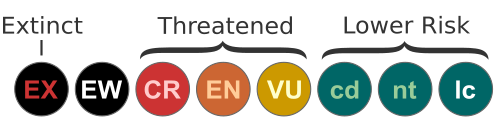
Species are classified into nine groups based on criteria such as population size, rate of decline, geographic distribution, and population fragmentation. The term threatened specifically encompasses three categories: Critically Endangered, Endangered, and Vulnerable.
| Category | Abbreviation | Description |
|---|---|---|
| Extinct | EX | No reasonable doubt that the species is no longer extant. |
| Extinct in the Wild | EW | Survives only in captivity or outside its native range. |
| Critically Endangered | CR | In an extremely critical state of risk. |
| Endangered | EN | Very high risk of extinction in the wild. |
| Vulnerable | VU | High risk of human-caused extinction without intervention. |
| Near Threatened | NT | Close to qualifying for a threatened category in the near future. |
| Least Concern | LC | Widespread and abundant. |
| Data Deficient | DD | Inadequate information to make an assessment. |
| Not Evaluated | NE | Has not yet been assessed against the criteria. |
![Number of species in each IUCN Red List Category as of March 2026[7]](/images/a1/36/a13663337cffbb4e17dd6d1887dd52b121881e057a0912ae1ab77879b9335602.png)
Framework Changes and Special Tags
The classification system has evolved. The 1994 version used a "Lower Risk" category, but the 2001 framework (Version 3.1) separated Near Threatened and Least Concern into their own categories. Additionally, BirdLife International uses the Possibly Extinct (PE) tag for Critically Endangered species that are likely gone, as well as a "Possibly Extinct in the Wild" tag for those surviving only in captivity.
Scientific Criticism and Improvements
Despite its importance, the Red List has faced academic scrutiny. In 1997, critics raised concerns regarding the secrecy and documentation of data sources, leading the IUCN to implement better documentation and peer-review processes. In 2002, some researchers warned that governments might misuse the list to draw inappropriate conclusions about resource exploitation.
More recently, a 2016 study in Science Advances argued that the categorization process is outdated. The researchers suggested that incorporating geospatial data, such as satellite and aerial imaging, could lead to more accurate classifications and potentially increase the number of species identified as high-risk.
Frequently Asked Questions
What does it mean for a species to be "threatened"?
In the context of the IUCN Red List, a species is considered "threatened" if it falls into any of the following three categories: Critically Endangered, Endangered, or Vulnerable.
How often are species re-evaluated?
The IUCN aims to have every species re-evaluated at least every ten years, though they strive to do so every five years when possible.
Who is responsible for assessing the species?
Assessments are carried out by Red List Authorities (RLA), including the IUCN Species Survival Commission (SSC) Specialist Groups and partners like BirdLife International.
What is the difference between Extinct and Extinct in the Wild?
Extinct (EX) means the species is entirely gone. Extinct in the Wild (EW) means the species no longer exists in its natural habitat but survives in captivity, cultivation, or outside its native range.
Why is the Red List criticized?
Criticisms have focused on historical issues with data documentation, the potential for government misuse of the data, and the need for more modern geospatial data to improve classification accuracy.