Weimar: A Cultural Heartland of Thuringia
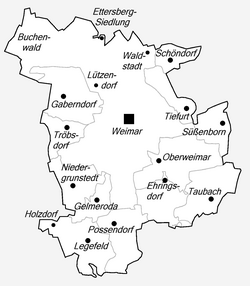
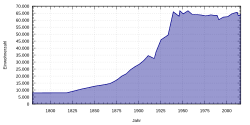
Located in the heart of Central Germany, Weimar is a city of profound historical and cultural significance. Situated in the state of Thuringia between Erfurt and Jena, it serves as a cornerstone of the region's metropolitan area. While it maintains a modest population of approximately 65,000, its influence on German literature, art, and political history is global.
From its roots as a medieval trade center to its role as the birthplace of the Weimar Republic and a hub for the Bauhaus movement, the city offers a dense layering of European heritage.
Key Facts
- Location: Thuringia, Germany, between Erfurt and Jena.
- Population: 65,954 (as of December 31, 2024).
- UNESCO Status: Home to two World Heritage Sites: Classical Weimar and the Bauhaus.
- Key Figures: Closely associated with Johann Wolfgang von Goethe and Friedrich Schiller.
- Political Legacy: Site of the 1919 National Assembly where the Weimar Constitution was developed.
Historical Evolution
Medieval Growth and Early Modernity
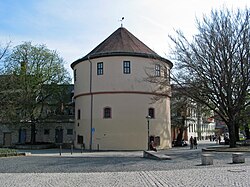
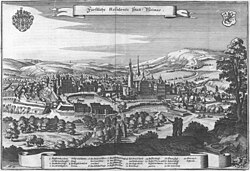
Weimar's urban development accelerated after 1346 when it became part of the Wettin territory. The Wettins fostered growth by granting privileges to citizens and abolishing socage (a form of land tenure). By 1438, the city gained trade privileges for woad, a plant used to produce blue dye. The completion of the city walls and castle in the 16th century solidified its status as a full city.
The Golden and Silver Ages
The period between 1758 and 1832 is known as the Golden or Classical Age, marking Weimar's peak as a center of European intellectualism. This was followed by the Silver Age (1832–1918), during which the city focused on the curation of its heritage, establishing numerous museums and archives. Unlike many German cities of the late 19th century, Weimar avoided heavy industrialization, remaining a sanctuary for artists, clerks, and rentiers.
The Weimar Republic and the Nazi Era
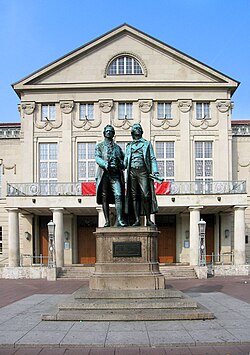
Following the German Revolution of 1918–19, the last reigning grand duke of Saxe-Weimar-Eisenach, William Ernest, abdicated. The city then became the namesake for the Weimar Republic, with the National Assembly meeting at the German National Theatre to draft the new constitution.
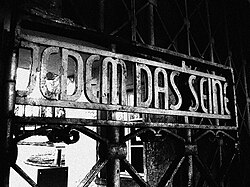
The city's history took a dark turn in 1937 when the Nazi regime established the Buchenwald concentration camp approximately 8 km from the city center. Between 1938 and 1945, roughly 240,000 people were incarcerated there, with an estimated 56,545 deaths. The camp provided slave labor for local industries, including the Wilhelm-Gustloff-Werk arms factory.
Post-War Recovery and Modern Era
After German reunification in 1990, Weimar overcame initial economic hardships through significant restoration funding. In 1991, it hosted the first trilateral meeting of foreign ministers from Germany, France, and Poland, creating the Weimar Triangle format. The city was named the European Capital of Culture in 1999 and is now a popular residential hub for professionals working in nearby Erfurt and Jena.
Geography and Climate
Weimar is situated at an elevation of 208 meters. Its climate is characterized by moderate extremes, with the highest recorded temperature reaching 37.6 °C in July 2022 and the lowest dropping to −25.0 °C in January 1982.
| Metric | Winter (Jan) | Summer (Jul) | Annual Average |
|---|---|---|---|
| Mean Max Temp (°C) | 10.5 | 31.5 | - |
| Mean Min Temp (°C) | −2.5 | 12.8 | - |
| Avg Precipitation (mm) | 25.0 | 80.8 | 534.7 |
| Sunshine Hours | 59.7 | 224.7 | 1,706.5 |
Culture and Architectural Heritage
UNESCO World Heritage Sites
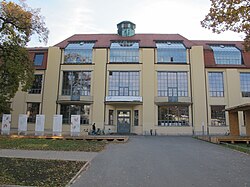
Weimar is unique for hosting two distinct UNESCO World Heritage designations: Classical Weimar (inscribed 1998) and the Bauhaus (inscribed 1996). These sites represent the pinnacle of German classicism and the birth of modern functionalist architecture, respectively.
Palaces and Parks
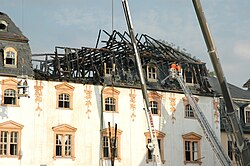
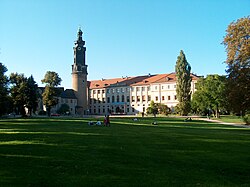
The city is renowned for its ducal residences. Schloss Belvedere, built in the Baroque style between 1724 and 1732, features a grand orangery. Other notable residences include Schloss Ettersburg and Schloss Tiefurt. The Park an der Ilm, an English landscape garden established between 1778 and 1833, contains Goethe's garden house and the Römisches Haus.
Key Landmarks
- German National Theatre: Built in 1906/07, this neo-classicist building is where the Weimar Constitution was developed.
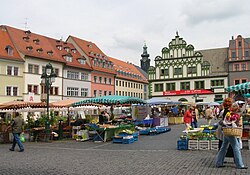
- Town Hall: A Neo-Gothic structure built between 1837 and 1841.
- Museums: The city hosts the Goethe-Nationalmuseum, Schiller-Museum, and the Bauhaus-Museum.
Infrastructure and Administration
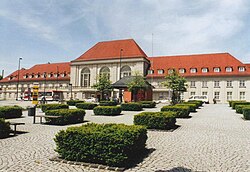
Weimar is well-connected by rail and road. While the Erfurt-Weimar Airport exists, it primarily handles rare flights to Mediterranean regions; most air travelers use Frankfurt or Berlin Brandenburg airports. The city's internal transport is managed by an extensive bus network centered at Goethe Square.
Administratively, the city is led by a Lord Mayor. In the May 2024 election, Peter Kleine was elected with 72.7% of the vote. The city council is composed of 42 seats, with the CDU and Weimarwerk Citizens' Alliance holding the largest shares.
Frequently Asked Questions
Why is Weimar famous?
Weimar is world-renowned for its cultural heritage, specifically as the center of German Classicism (associated with Goethe and Schiller) and as the birthplace of the Bauhaus movement. It is also historically significant as the site where the first democratic German constitution was drafted.
What are the UNESCO World Heritage sites in Weimar?
The city has two: "Classical Weimar," which includes the city center and the Park an der Ilm, and the "Bauhaus and its Sites in Weimar, Dessau and Bernau."
What is the significance of the Buchenwald Memorial?
The Buchenwald concentration camp, established by the Nazis in 1937, serves as a memorial to the approximately 240,000 people incarcerated there and the 56,545 who died, highlighting the atrocities of the Nazi regime.
How does one get to Weimar?
Weimar is easily accessible via the Thuringian Railway. While there is a local airport (Erfurt-Weimar), most international visitors arrive via Frankfurt or Berlin airports and travel by train or road.
Who are the most notable people associated with Weimar?
The city is most closely linked to literary giants Johann Wolfgang von Goethe and Friedrich Schiller, as well as architects like Walter Gropius and artists such as Wassily Kandinsky and Paul Klee.