Max Bill: The Polymath of Concrete Art and Swiss Design
Max Bill (1908–1994) was a towering figure of 20th-century modernism. A true polymath, he excelled as an architect, artist, painter, typeface designer, industrial designer, and graphic designer. His work bridged the gap between the rigorous theories of the Bauhaus and the practical application of industrial design, leaving an indelible mark on the visual landscape of Switzerland and beyond.
Key Facts
- Education: Studied at the Bauhaus in Dessau (1927–1929) under masters like Wassily Kandinsky and Paul Klee.
- Design Legacy: A primary influence on Swiss graphic design and the creator of the iconic "Ulmer Hocker" stool.
- Academic Impact: Co-founder of the Ulm School of Design (HfG Ulm) in 1953.
- Artistic Philosophy: Championed concrete art, seeking to make the laws of physics and mathematics perceptible through the senses.
- Notable Collaborations: Long-term designer for Junghans clocks and watches.
Early Life and Bauhaus Foundations
Born in Winterthur, Switzerland, on December 22, 1908, Bill began his creative journey with an apprenticeship as a silversmith from 1924 to 1927. This technical foundation paved the way for his studies at the Bauhaus in Dessau, where he was immersed in the avant-garde teachings of Oskar Schlemmer, Paul Klee, and Wassily Kandinsky. After moving to Zurich in 1929, he began applying these modernist principles to architecture, designing his own house and studio in Zurich-Höngg between 1932 and 1933.
The Philosophy of Concrete Art
Bill is often mislabeled as a pure rationalist, but he viewed himself as a phenomenologist—someone interested in how the human body and senses experience form. He sought to create concrete art, which he defined as art that visually represents the "New Physics" of the early 20th century. Rather than depicting a subject, his work embodied mathematical and scientific concepts.
His artistic output included spare geometric paintings and spherical sculptures, often utilizing the Möbius strip (a surface with only one side and one boundary) as a conceptual basis. He worked across various media, including stone, wood, metal, and plaster.
Industrial Design and the "Ulmer Hocker"
In the realm of industrial design, Bill was celebrated for his precise proportions and clarity. His long-standing partnership with Junghans resulted in some of the most elegant clocks and watches of the era, characterized by a timeless, minimalist aesthetic.

One of his most enduring contributions is the 1954 "Ulmer Hocker" (Ulm Stool). While developed alongside designer Hans Gugelot, the stool is frequently called the "Bill Hocker" because the original concept was sketched by Bill on a cocktail napkin. The piece is highly versatile, serving as a stool, shelf element, side table, or speaker's desk.
![Junghans clock, design by Max Bill[1]](/images/b7/53/b7535c1ea961506e4af01b863f7d2e33d607664c0e29c2f9551af62d97b22dae.jpg)
The Ulm School of Design and Teaching
Bill's influence extended deeply into education. In 1944, he became a professor at the Kunstgewerbeschule Zürich. However, his most significant academic achievement came in 1953 when he co-founded the Ulm School of Design (HfG Ulm) with Otl Aicher and Inge Aicher-Scholl. The school evolved from the Bauhaus tradition to integrate art with science, notably introducing semiotics (the study of signs and symbols) into the design curriculum.
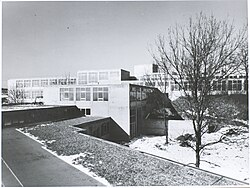
Beyond Ulm, Bill held a chair in Environmental Design at the Hochschule für bildende Künste Hamburg from 1967 to 1974 and lectured globally on the theories of Le Corbusier and Mies van der Rohe.
Architecture and Public Works
Bill's architectural portfolio ranges from functional office buildings in Germany and a radio studio in Zurich to a bridge in eastern Switzerland. In his later years, he continued to design major institutions, including a museum of contemporary art in Florence (1981) and the Bauhaus Archive in Berlin (1987).
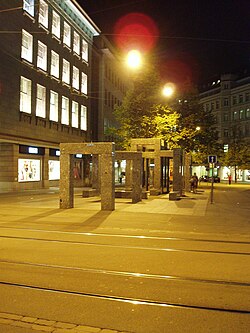
His public sculptures often sparked conversation. The Pavillon-Skulptur (1983) in Zürich and the Endlose Treppe (Endless Stairs, 1991), created for philosopher Ernst Bloch, exemplify his commitment to geometric continuity and monumental form.
Summary of Max Bill's Career
| Field | Key Contribution / Work | Notable Detail |
|---|---|---|
| Industrial Design | Ulmer Hocker & Junghans | Focus on precise proportions and versatility. |
| Education | HfG Ulm (Founder) | Integrated art, science, and semiotics. |
| Fine Art | Concrete Art | Based on mathematical forms and the Möbius strip. |
| Architecture | Bauhaus Archive (Berlin) | Modernist approach to institutional spaces. |
| Graphic Design | Swiss Style | Decisive influence on 1950s Swiss graphic design. |
Frequently Asked Questions
What is Concrete Art in the context of Max Bill?
Concrete art is a form of non-representational art that does not refer to the natural world. For Max Bill, it meant creating objects and paintings that visually embodied mathematical laws and the principles of physics, making abstract science perceptible to the human senses.
What is the significance of the Ulmer Hocker?
The Ulmer Hocker is a masterpiece of functionalist design. Its significance lies in its extreme versatility and minimalist construction, allowing it to function as a stool, table, or shelving unit, embodying the "form follows function" ethos.
How did Max Bill influence Brazilian art?
A 1951 retrospective of Bill's work at the São Paulo Museum of Modern Art acted as a catalyst for Brazil's artistic revolution, sparking a movement toward concrete art and influencing artists such as Franz Weissmann.
What was the relationship between the Bauhaus and the Ulm School of Design?
The Ulm School of Design (HfG Ulm) was founded in the tradition of the Bauhaus but evolved to be more scientific. While the Bauhaus focused on the synthesis of art and craft, Ulm integrated art with science and semiotics to meet the needs of modern industrial society.
What happened to Max Bill's estate after his death?
Because the estate was not settled, it was divided between his son, Jakob, and his widow, Angela Thomas. This led to the creation of two separate foundations: the Swiss Max Bill Foundation and the Max Bill Georges Vantongerloo Foundation.