Bauhaus: The Revolutionary School That Defined Modern Design
The Bauhaus was more than just a school; it was a radical movement that fundamentally altered the landscape of art, architecture, and design in the 20th century. Emerging from the liberal spirit of the Weimar Republic after World War I, the Bauhaus sought to bridge the gap between fine art and functional craftsmanship, creating a legacy known globally as the International Style.
At its core, the Bauhaus philosophy was driven by the belief that art should meet the needs of society. Influenced by the 19th-century English designer William Morris, the school championed the idea that there should be no distinction between form and function. This resulted in a minimalist aesthetic characterized by a total absence of ornamentation and a focus on harmony between an object's purpose and its design.
Key Facts

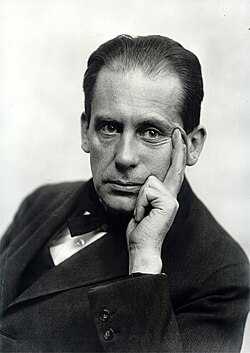
- Founding: Established by Walter Gropius in 1919.
- Locations: Operated in three German cities: Weimar (1919–1925), Dessau (1925–1932), and Berlin (1932–1933).
- Core Philosophy: "Form follows function," emphasizing utility and the removal of unnecessary decoration.
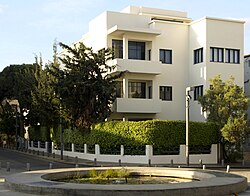
- Global Impact: Led to the creation of the "White City" in Tel Aviv, the world's highest concentration of Bauhaus architecture.
- UNESCO Status: The Bauhaus building in Dessau was designated a World Heritage Site in 1996.
The Evolution of the Bauhaus
The Weimar Years (1919–1925)
The school began in Weimar, Thuringia, with state support from the Social Democrat-controlled government. This era was marked by intense experimentation and growing political tension. To prove its value to conservative critics, the school showcased the experimental Haus am Horn in 1923. However, following a shift in the state government in 1924, funding was slashed, leading the school to seek a new home.
The Dessau Era (1925–1932)
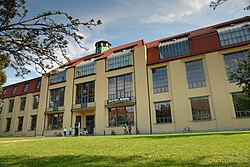
The move to Dessau marked a pivotal shift toward industrial design and the futuristic lines of the International Style. Walter Gropius designed the iconic Dessau facilities, which served as the school's longest-serving location. During this period, the school expanded its curriculum, notably introducing a formal architecture program in 1927 under the influence of Hannes Meyer.

The Berlin Finale (1932–1933)
Under the leadership of Ludwig Mies van der Rohe, the Bauhaus moved to a derelict factory in Berlin. The faculty and students rehabilitated the space, painting the interior white to align with their aesthetic. Despite efforts to keep the school running, the Gestapo closed the facility in 1933. Under pressure from the Nazi regime, which viewed the school as a center of communist intellectualism, the leadership voluntarily shut down the institution.

Architectural and Design Legacy
While the Bauhaus manifesto claimed that all creative activity aimed toward building, the school's early architectural output was primarily the work of Walter Gropius. His designs, such as the Sommerfeld and Otte houses in Berlin, set the stage for the definitive 1926 Bauhaus building in Dessau.
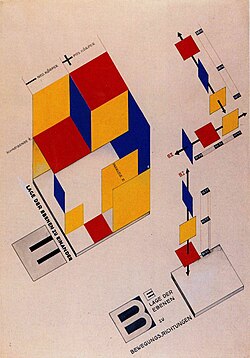
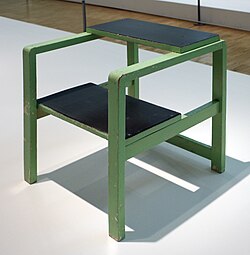
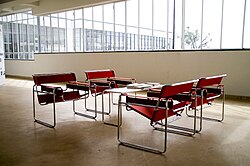
Beyond buildings, the school revolutionized product design. From the Wassily Chair by Marcel Breuer to the typography of Herbert Bayer and the mechanical stage designs of Joost Schmidt, the Bauhaus applied its rigorous functionalist approach to every aspect of daily life.
Global Influence and the White City
Following the school's closure, many of its key figures emigrated to the United States, where they became the vanguard of the International Style. Mies van der Rohe and László Moholy-Nagy (who founded the Institute of Design in Chicago) brought these principles to American soil.
Simultaneously, Jewish Bauhaus architects emigrated to Palestine, creating the White City of Tel Aviv. This area remains the most significant international concentration of Bauhaus-style architecture in the world.
Bauhaus Summary Table

| Period | City | Director | Key Focus/Outcome |
|---|---|---|---|
| 1919–1925 | Weimar | Walter Gropius | Founding and early experimentation |
| 1925–1932 | Dessau | Gropius / Hannes Meyer | Industrial design and architecture program |
| 1932–1933 | Berlin | Mies van der Rohe | Final operations before Nazi closure |
Frequently Asked Questions

What does the term "Bauhaus" actually mean?
The name was coined by Walter Gropius and refers to "building" or "construction." It was intended to evoke the Bauhütte, the medieval guilds of builders and stonemasons, envisioning a modern collaborative environment where craftsmen and artists worked together.
Why was the Bauhaus school closed?
The school was closed in 1933 due to pressure from the Nazi regime, which characterized the institution as a center of communist intellectualism and "degenerate" art.
What is the "International Style"?
The International Style is the architectural and design movement born from the Bauhaus. It is defined by a lack of ornamentation, the use of modern materials like glass and steel, and a strict adherence to the principle that form should follow function.
Where can I see the most Bauhaus buildings today?
While the original sites are in Germany (Weimar, Dessau, and Bernau), the highest concentration of Bauhaus-style architecture in the world is found in the White City of Tel Aviv.
Did the Bauhaus only focus on architecture?
No. While architecture was the ultimate goal, the school excelled in typography, furniture design, weaving, pottery, and stage design, treating all these disciplines as essential components of a unified artistic vision.