Wave Physics: Mechanics, Electromagnetic Radiation, and Quantum Theory
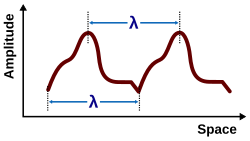
In mathematics and physical science, a wave is defined as a propagating dynamic disturbance—a change from equilibrium—of one or more quantities. These disturbances move through space and time, transporting energy, momentum, and information. While some waves oscillate repeatedly about a resting value at a specific frequency, others may appear as single, solitary pulses.
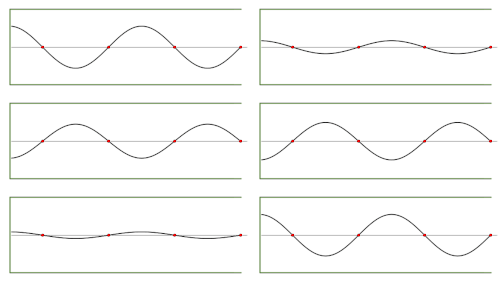
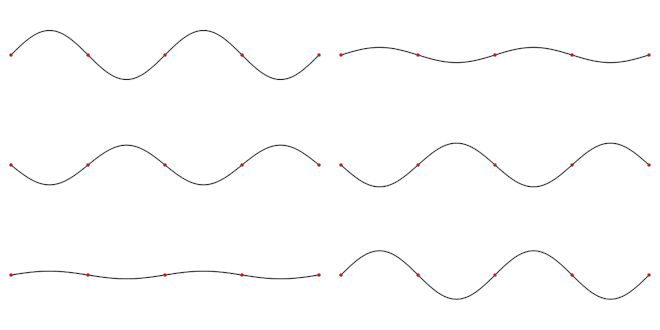
Waves are generally categorized by how they travel. A traveling wave occurs when the entire waveform moves in one direction. Conversely, a standing wave is formed by the superposition of two identical periodic waves traveling in opposite directions, resulting in specific positions called nulls where the amplitude is zero or significantly reduced.
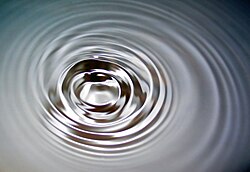
Key Facts
![Example of biological waves expanding over the brain cortex, an example of spreading depolarizations[3]](/images/fb/20/fb20d463340a7642e1490fa79c68049f4f0904ab8acae9db801ad78c27b0a490.gif)
- Mechanical waves require a physical medium to propagate via local stress and strain.
- Electromagnetic waves can travel through a vacuum and consist of oscillating electric and magnetic fields.
- Gravitational waves are disturbances in the curvature of spacetime predicted by general relativity.
- Wave-particle duality in quantum mechanics suggests that particles with momentum possess a wavelength.
- The Doppler effect describes the change in wave frequency relative to an observer moving toward or away from the source.
Types of Waves
Mechanical Waves
Mechanical waves are local deformations (strain) in a physical medium. They propagate from particle to particle by creating local stresses that affect neighboring particles. Common examples include:
- Acoustic waves: Variations in local pressure and particle motion (sound).
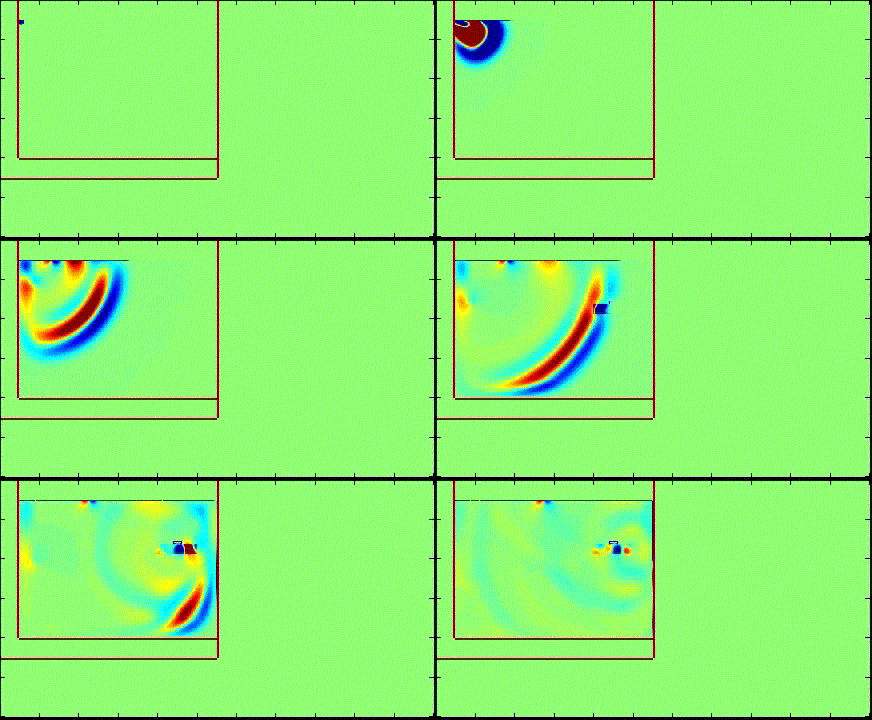
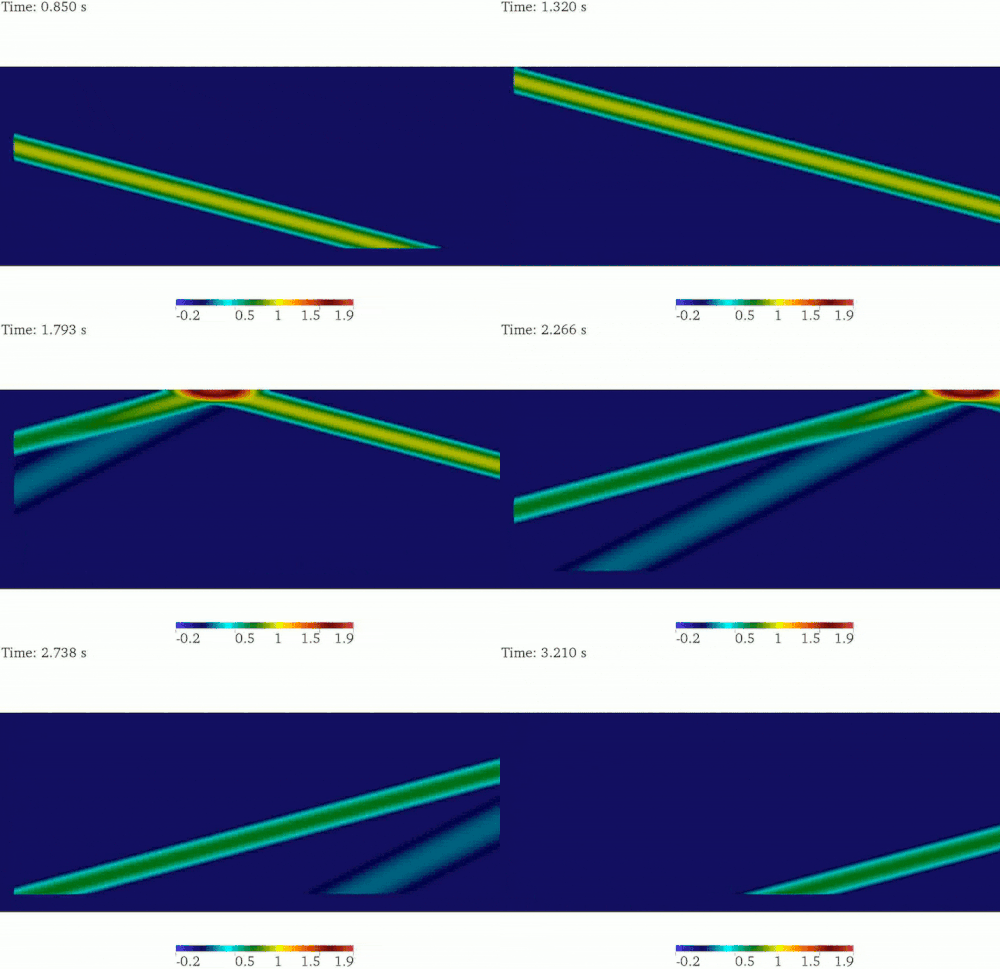
- Seismic waves: Vibrations traveling through the Earth's crust, including P-waves and SV-waves.
- Surface waves: Perturbations propagating across the surface of liquids, such as ocean waves.
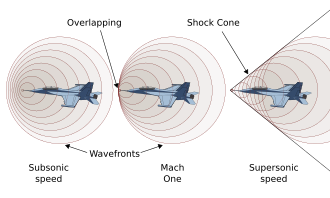
- Shock waves: High-pressure waves often formed by supersonic motion.
Electromagnetic Waves
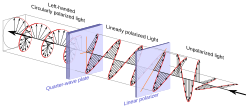
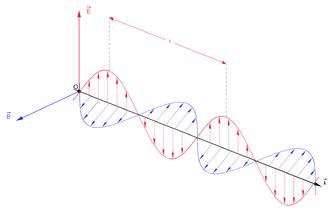
Electromagnetic waves consist of coupled electric and magnetic fields oscillating at right angles to the direction of propagation. Unlike mechanical waves, they do not require a medium and can travel through a vacuum at the speed of light. Depending on their frequency and wavelength, they are classified into various bands:
- Radio waves and Microwaves
- Infrared radiation and Terahertz waves
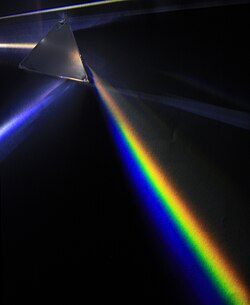
- Visible light (the only band visible to the human eye)
- Ultraviolet, X-rays, and Gamma rays
Quantum Mechanical Waves
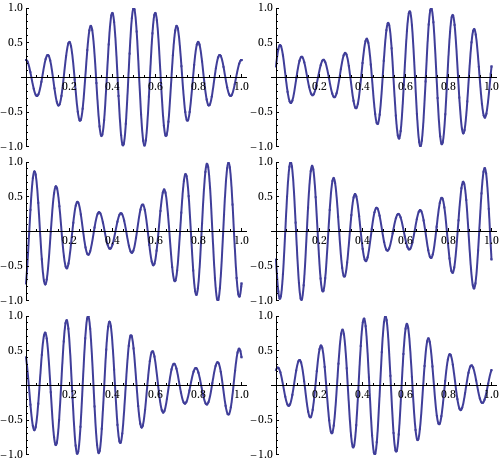
In the realm of quantum mechanics, Louis de Broglie postulated that all particles with momentum have an associated wavelength. These are described by a wave function, often modeled using the Schrödinger or Dirac equations. A localized wave packet is created by a narrow range of wavelengths; the more localized the envelope of the packet, the larger the spread of required wavelengths.
![A propagating wave packet; in general, the envelope of the wave packet moves at a different speed than the constituent waves.[30]](/images/c4/e3/c4e38cf48d3bb68d0706fb7bc8875fd40855e5a8e877d80cb9238878db91c61f.gif)
Wave Properties and Behaviors
Waveforms and Modulation
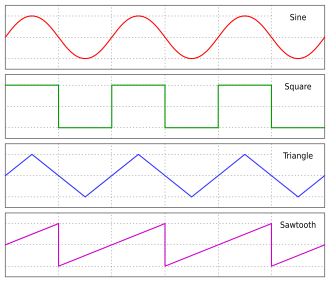
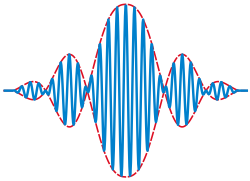
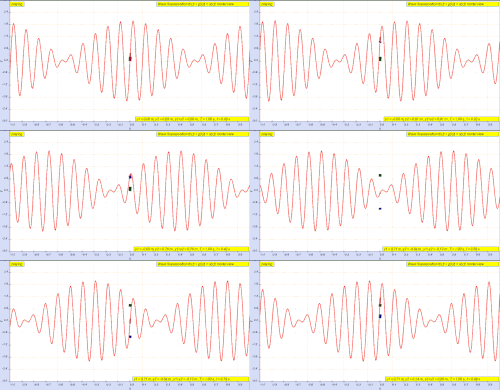
Waves can take various shapes, including sine, square, triangle, and sawtooth waveforms. Amplitude modulation occurs when the amplitude of a carrier wave is varied by another signal, creating an envelope that defines the overall shape of the wave.
Velocity: Phase vs. Group
The speed of a wave can be described in two ways: phase velocity, the rate at which the phase of a single frequency component travels, and group velocity, the speed at which the overall envelope (or wave packet) propagates. In some media, these two velocities can differ or even move in opposite directions.

Standard Wave Phenomena
Waves interact with their environment and other waves in predictable ways:
- Reflection: Bouncing back when hitting a boundary.
- Refraction: Changing direction and wavelength when entering a medium with a different velocity.
- Diffraction: Bending around obstacles or spreading through openings.
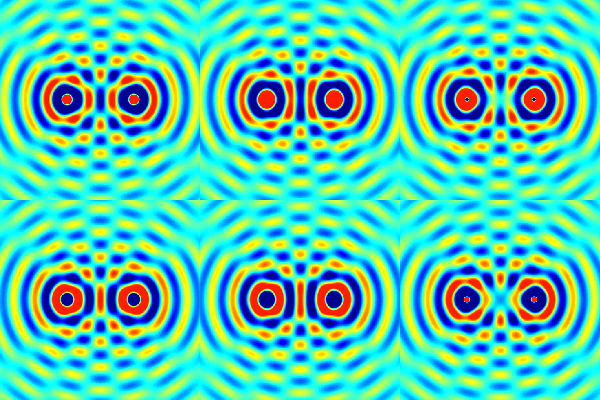
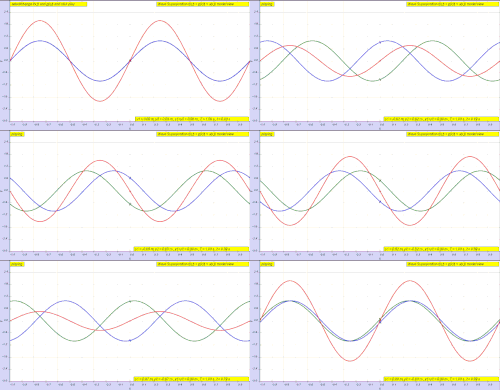
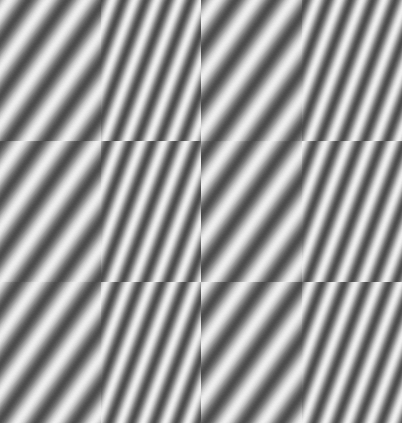
- Interference: The superposition of two waves to form a resultant wave, which can be constructive (in phase) or destructive (out of phase).
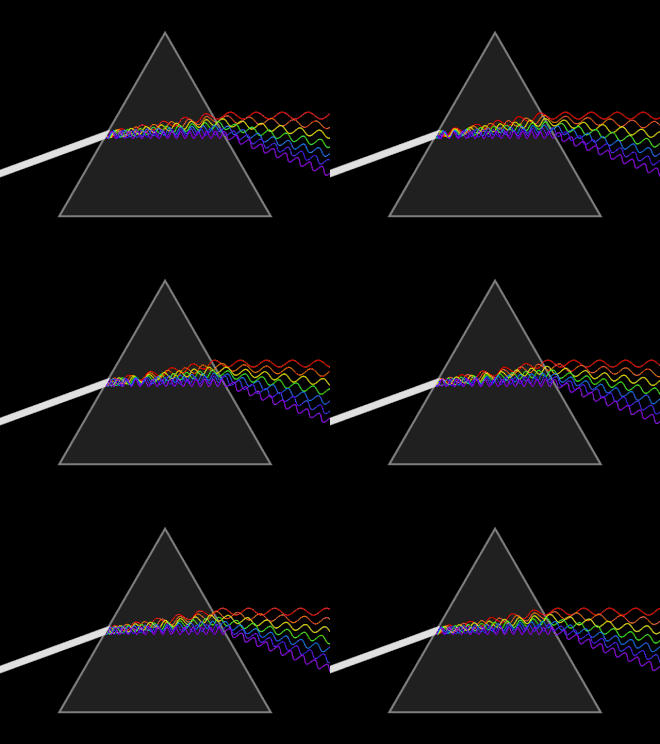
- Dispersion: The separation of waves into different frequencies, often seen when light passes through a prism.
Summary of Wave Classifications
| Wave Type | Medium Required | Primary Mechanism | Examples |
|---|---|---|---|
| Mechanical | Yes | Stress and Strain | Sound, Seismic, Water waves |
| Electromagnetic | No | Electric/Magnetic Fields | Light, X-rays, Radio |
| Gravitational | No (Spacetime) | Spacetime Curvature | Black hole mergers |
| Quantum | N/A | Probability Amplitude | Electron wave functions |
Frequently Asked Questions

![The propagation of SV-wave in a homogeneous half-space (The vertical displacement field)[clarification needed]](/images/fb/b1/fbb15f5b6b18403f1de738bd8822d4443568f7f69d34bd7a38c7143ce2b65cd0.gif)

What is the difference between a traveling wave and a standing wave?
A traveling wave moves its entire waveform through a medium in a specific direction. A standing wave is created when two identical waves move in opposite directions and overlap, creating fixed points of zero amplitude called nodes.
Can electromagnetic waves travel through a vacuum?
Yes, electromagnetic waves do not require a physical medium to propagate and can travel through the vacuum of space, which is how light from stars reaches Earth.
What is the Doppler effect?
The Doppler effect is the change in the observed frequency of a wave when there is relative motion between the wave source and the observer, such as the change in pitch of a passing siren.
What are gravitational waves?
Gravitational waves are disturbances in the curvature of spacetime that propagate at the speed of light, as predicted by Albert Einstein's theory of general relativity. Their first observation was announced on February 11, 2016.
How does wave-particle duality work?
Wave-particle duality is the concept that every particle or quantum entity may be described as either a particle or a wave. For example, electrons exhibit wave-like properties such as interference and diffraction.