Gravitational Waves: Ripples in the Fabric of Spacetime
Imagine the universe not as a void, but as a flexible fabric. When massive objects accelerate, they create ripples in this fabric that stretch and squeeze space itself. These are gravitational waves: waves of spacetime curvature produced by the relative motion of gravitating masses, propagating outward at the speed of light.
First predicted by Albert Einstein as a core consequence of his general theory of relativity, these waves represent a fundamental departure from Newtonian physics. While Newton's law of universal gravitation suggested that gravity acts instantaneously across any distance, general relativity proves that gravitational influence travels as radiation, carrying energy across the cosmos.
Key Facts
- Speed: Gravitational waves travel at the speed of light.
- Nature: They are ripples in spacetime curvature that transport energy as gravitational radiation.
- Detection: First observed indirectly via binary pulsars and directly since 2015 by observatories like LIGO and Virgo.
- Sources: Generated by massive accelerating objects, such as merging black holes or neutron stars.
- Precision: In 2017, the difference between the speed of gravity and light was constrained to be smaller than one part in 10.
The Mechanics of Spacetime Ripples
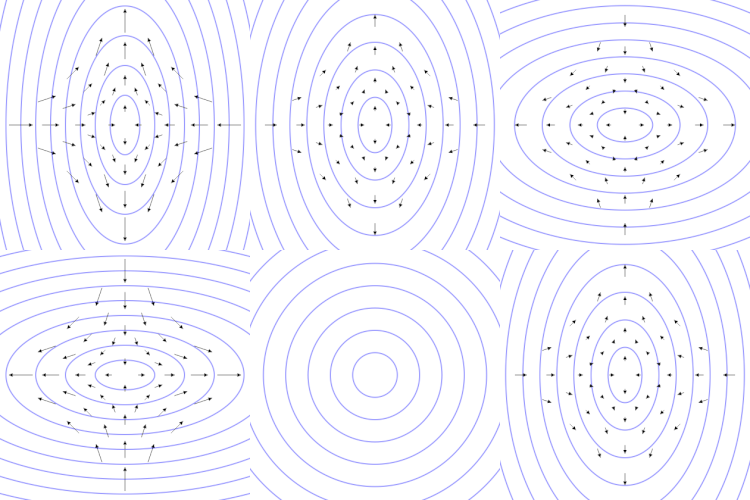
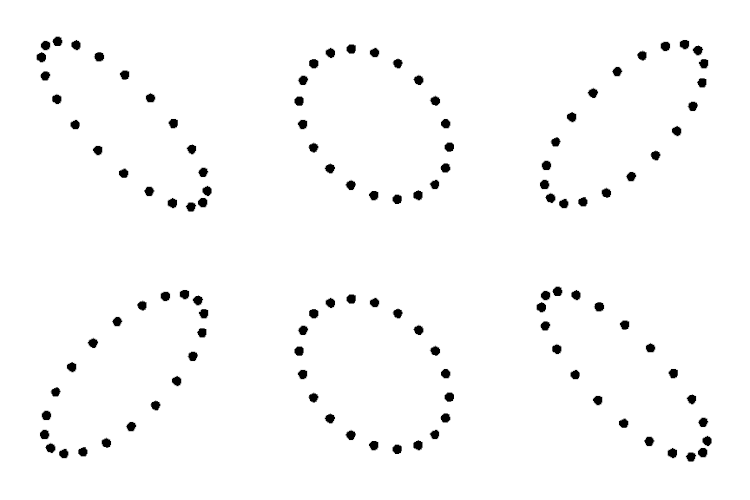
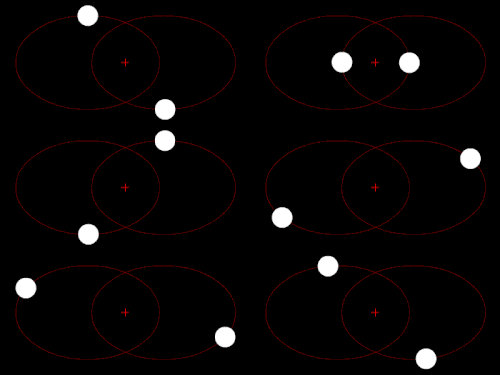
Gravitational waves are described by characteristics similar to light waves, including speed, wavelength, and frequency. They follow the wave equation c = λf. To visualize their effect, consider a ring of particles in space; as a wave passes through, the ring will distort in specific patterns depending on the wave's polarization.
Polarization Effects
There are two primary polarizations of gravitational waves: "plus" and "cross." A plus-polarized wave stretches space in one direction while squeezing it in the perpendicular direction. A cross-polarized wave does the same but is rotated by 45 degrees.

Sources of Gravitational Radiation
Not every moving mass creates detectable waves. Only specific, high-energy movements of massive objects produce signals strong enough for our instruments to perceive.
Compact Binaries
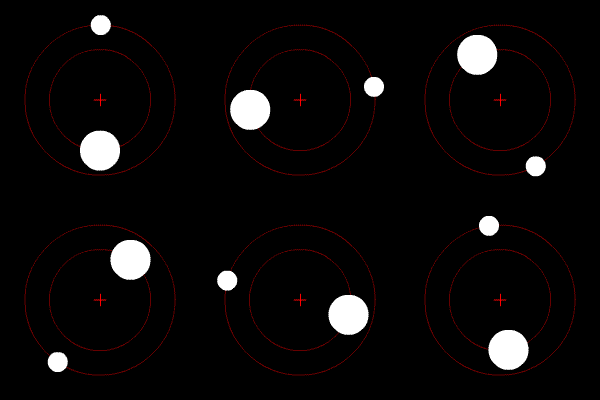
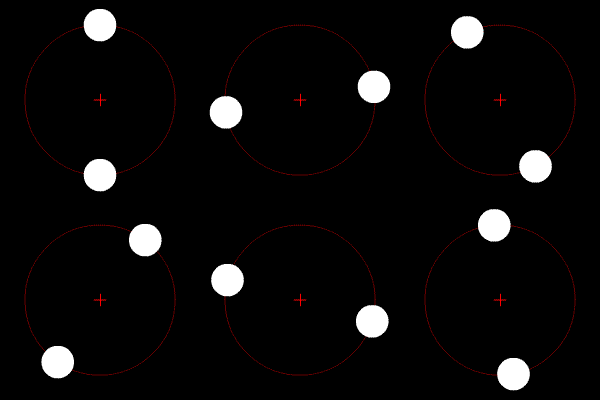
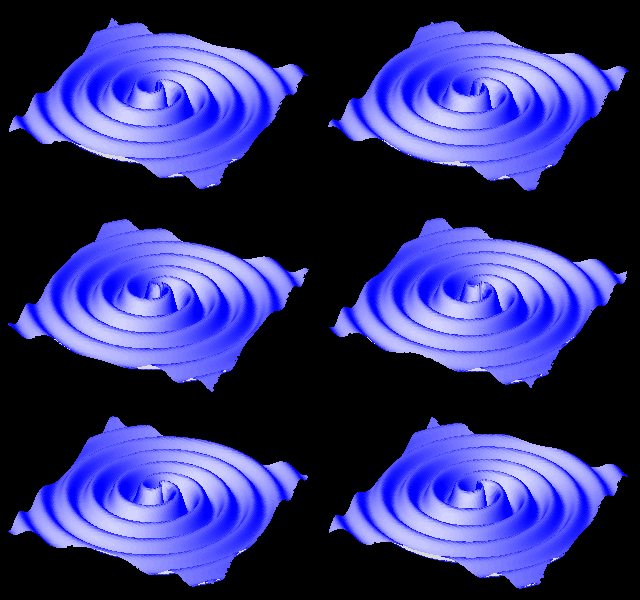
The most common sources are compact binaries—pairs of incredibly dense objects orbiting one another. These include:
- Black Hole Binaries: Two black holes spiraling inward and eventually merging.
- Neutron Star Binaries: Two neutron stars orbiting each other, often resulting in a massive explosion and a burst of gravitational waves.
- Mixed Binaries: A pairing of one black hole and one neutron star.
![Artist's impression of merging neutron stars, a source of gravitational waves[75]](/images/06/10/06108918a4963faf686784e3681a75bcd7399533d863c4b90d3f8fc75132cae0.jpg)
Other Cosmic Events
Beyond binaries, other violent events can generate these ripples, such as supernovae (the collapse of massive stars) and spinning neutron stars with slight asymmetries. Scientists also hypothesize the existence of primordial gravitational waves, which would have arisen from cosmic inflation—a phase of accelerated expansion immediately following the Big Bang.
![Primordial gravitational waves are hypothesized to arise from cosmic inflation, a phase of accelerated expansion just after the Big Bang (2014).[30][31][32]](/images/81/b9/81b9eb67a9199fb9667c83d80ed37c790c4dcd08d2fefdfd1c403641ae12bca4.webp)
Detecting the Invisible
Detecting gravitational waves is immensely difficult because they only distort spacetime by a tiny fraction. Astronomers use several methods to find them.
Laser Interferometry
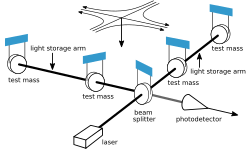
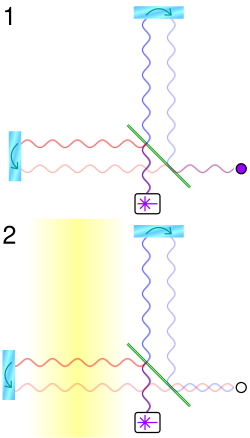
Ground-based detectors like LIGO (Laser Interferometer Gravitational-Wave Observatory) and Virgo use L-shaped vacuum tunnels. A laser beam is split and sent down two perpendicular arms. If a gravitational wave passes through, it slightly changes the length of the arms, altering the interference pattern of the light when the beams recombine.
Pulsar Timing Arrays
By observing a network of pulsars (rapidly rotating neutron stars that act as cosmic clocks), scientists can detect the "hum" of a gravitational wave background. If a wave passes between Earth and the pulsars, it shifts the timing of the pulses arriving at our telescopes.
![Plot of correlation between pulsars observed by NANOGrav vs angular separation between pulsars, compared with a theoretical Hellings-Downs model (dashed purple) and if there were no gravitational wave background (solid green)[123][124]](/images/95/68/9568b4674c8f1e56fc1dcde1e93f965d4d83e3e9e49ca63891cc586a56dd75e7.webp)
The BICEP2 Controversy
In 2014, the BICEP2 radio telescope announced the detection of primordial gravitational waves in the cosmic microwave background. However, by 2015, it was determined that the signal was actually caused by cosmic dust in the Milky Way, not the early universe.
![Now disproved evidence allegedly showing gravitational waves in the infant universe was found by the BICEP2 radio telescope. The microscopic examination of the focal plane of the BICEP2 detector is shown here.[30][31] In January 2015, however, the BICEP2 findings were confirmed to be the result of cosmic dust.[104]](/images/4e/e0/4ee01b427ca19a83e487c0dffb57237bc44d16367dbae3bfcc05a0a2388b37ac.jpg)
Gravitational Wave Summary
| Source Type | Example Event | Detection Method | Key Characteristic |
|---|---|---|---|
| Compact Binaries | Black Hole Merger | Interferometers (LIGO/Virgo) | High-frequency "chirp" signals |
| Stellar Collapse | Supernova | Interferometers | Burst-like signals |
| Cosmic Background | Cosmic Inflation | CMB Polarimetry / Pulsar Arrays | Low-frequency stochastic hum |
| Binary Pulsars | PSR 1913+16 | Radio Astronomy (Indirect) | Orbital decay over time |
![The gravitational wave spectrum with sources and detectors. Credit: NASA Goddard Space Flight Center[68]](/images/fe/00/fe0057bed5e62ce59636631afdd5e13f0a8e1f8b17c70bbddcbd5927b4bb25da.jpg)
Frequently Asked Questions
How do gravitational waves differ from sound waves?
While both are waves, sound waves travel through a medium (like air or water) by compressing molecules. Gravitational waves are ripples in the actual geometry of spacetime itself and can travel through a vacuum.
Why did it take so long to detect them?
The effect of gravitational waves on matter is incredibly small. It requires instruments capable of measuring changes in distance smaller than the diameter of an atomic nucleus over several kilometers.
What is the significance of the GW170817 event?
GW170817 was a landmark event because it was detected by both gravitational wave observatories and traditional telescopes (gamma-ray and optical). This confirmed that gravitational waves travel at nearly the same speed as light.
Can we use gravitational waves to see the early universe?
Yes. Because gravitational waves interact very weakly with matter, they can travel from the very beginning of the universe without being absorbed or scattered, potentially allowing us to "see" back to the Big Bang.