Gravity: The Fundamental Force Shaping the Universe
Gravity, derived from the Latin word gravitas meaning "weight," is one of the fundamental interactions of nature. At its simplest, it is the force that draws material objects toward one another. While we experience it as the pull that keeps our feet on the ground, its influence extends across the entire cosmos, acting as the primary architect of the universe's large-scale structures.
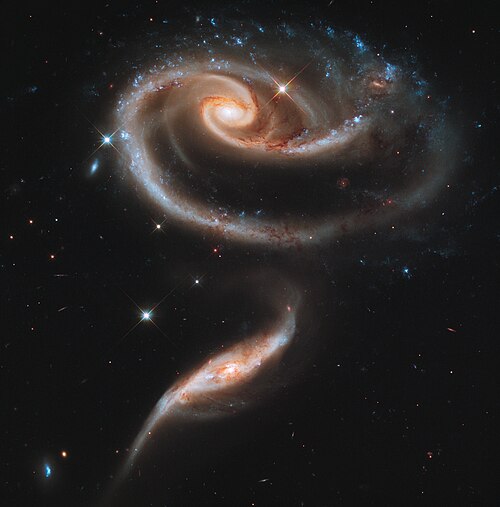
From the early universe, the gravitational attraction between clumps of dark matter and primordial hydrogen clouds caused gas to coalesce. This process led to the condensation and fusion of matter to form the first stars, which eventually organized into galaxies and massive clusters. Although gravity has an infinite range, its strength diminishes as the distance between objects increases.
Key Facts
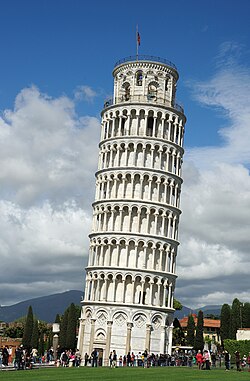
- Infinite Range: Gravity affects all objects with mass, regardless of distance, though it weakens as they move apart.
- Universal Driver: It is responsible for the formation of stars, galaxies, and the overall structure of the cosmos.
- Spacetime Curvature: According to general relativity, gravity is not just a force but a result of mass warping the fabric of spacetime.
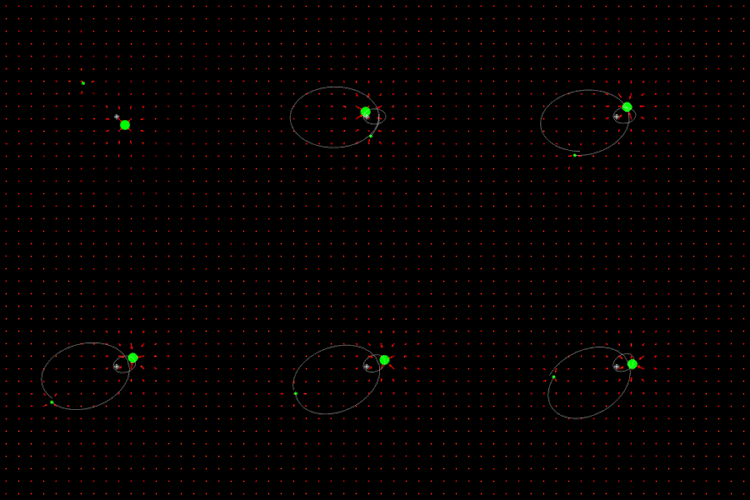
- Gravitational Waves: Massive cosmic events, such as black hole mergers, create ripples in spacetime that can be detected on Earth.
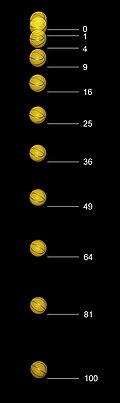
- Inverse-Square Law: In most practical applications, the force of gravity is proportional to the product of two masses and inversely proportional to the square of the distance between them.
The Evolution of Gravitational Theory

The Scientific Revolution and Newton
The formal scientific understanding of gravity advanced significantly during the Scientific Revolution. In 1657, Robert Hooke hypothesized that the Moon possessed its own gravity, later forming predictions based on this hypothesis in the 1660s and 1670s.
Sir Isaac Newton later refined these ideas into the law of universal gravitation. Newton proposed that the same force pulling an apple toward the Earth also keeps the Moon in orbit. This relationship was later condensed into the inverse-square law, expressed as F = G(m1m2 / r²), where F is the force, m1 and m2 are the masses, r is the distance between centers, and G is the gravitational constant.
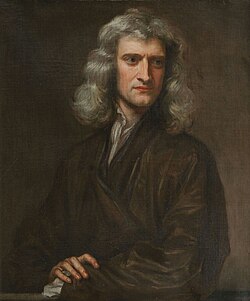
While Newton discussed proportionality, he did not use the constant G himself; this value (6.674 × 10⁻¹¹ m³⋅kg⁻¹⋅s⁻²) was eventually measured by Henry Cavendish in 1797.
Einstein and General Relativity
In 1915, Albert Einstein proposed the general theory of relativity, which fundamentally changed our understanding of gravity. Instead of a direct force acting at a distance, Einstein described gravity as the curvature of spacetime caused by the uneven distribution of mass.
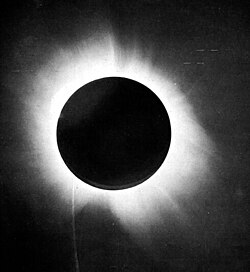
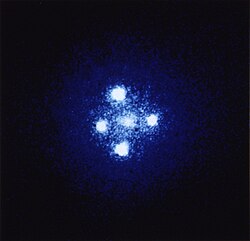
The most extreme manifestation of this curvature is a black hole, a region where spacetime is so warped that nothing—not even light—can escape once it crosses the event horizon. Other phenomena predicted by Einstein include gravitational lensing, where a massive foreground object (like a galaxy) bends the light from a distant source, creating multiple images of that source.
Modern Observations and Evidence
Gravitational Waves and LIGO
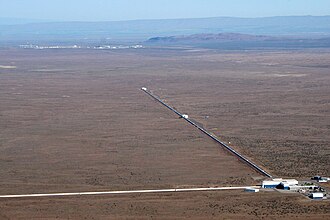
One of the most significant confirmations of general relativity occurred in September 2015. The LIGO (Laser Interferometer Gravitational-Wave Observatory) detected faint gravitational waves—ripples in spacetime. These waves were emitted during the collision of two black holes approximately 1.3 to 1.5 billion light-years away. This discovery, which earned the Nobel Prize in Physics in 2017, provides a new way to observe the universe, including the nature of the Big Bang and the formation of neutron stars.
Frame Dragging and Dark Matter
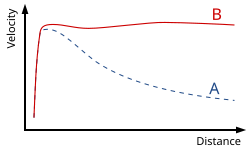
Further evidence for Einstein's theories came in 2011 via Gravity Probe B, which confirmed frame dragging—the phenomenon where a rotating massive object twists the surrounding spacetime. In the realm of astrophysics, gravity also points toward the existence of dark matter. Observations of spiral galaxy rotation curves show a discrepancy between predicted and observed speeds, suggesting that an invisible mass is providing additional gravitational pull.
Gravity Summary Table
| Feature | Newtonian Gravitation | General Relativity |
|---|---|---|
| Nature of Gravity | An attractive force between two masses | Curvature of spacetime caused by mass |
| Key Formula/Concept | Inverse-Square Law | Einstein Field Equations |
| Primary Application | Planetary motion, Earth-based physics | Black holes, cosmology, high-mass objects |
| Prediction of Waves | No | Yes (Gravitational Waves) |
Frequently Asked Questions
What is the difference between mass and weight?
While often used interchangeably, mass is the amount of matter in an object, whereas weight is the result of the gravitational force acting on that mass. On Earth, the total force acting on a body at rest is the result of gravitational force and the centrifugal force from the Earth's rotation.
How do black holes relate to gravity?
Black holes are regions of space where mass is so concentrated that the resulting curvature of spacetime is infinite. This creates a gravitational pull so strong that nothing, including light, can escape once it passes the event horizon.
What are gravitational waves?
Gravitational waves are ripples in the fabric of spacetime caused by the acceleration of massive objects, such as the merger of two black holes or neutron stars. They were first directly observed by LIGO in 2015.
What is gravitational lensing?
Gravitational lensing occurs when a massive object, such as a galaxy, acts as a lens by bending the light from a more distant object behind it. This can result in the distant object appearing as multiple images, a phenomenon known as Einstein's Cross.
Why is dark matter necessary to explain gravity?
Astronomers noticed that the outer stars of spiral galaxies rotate faster than they should based on the visible mass. To account for this extra gravitational pull, scientists hypothesize the existence of dark matter, which provides the necessary mass without emitting light.