Universe Composition, Age, and Structure
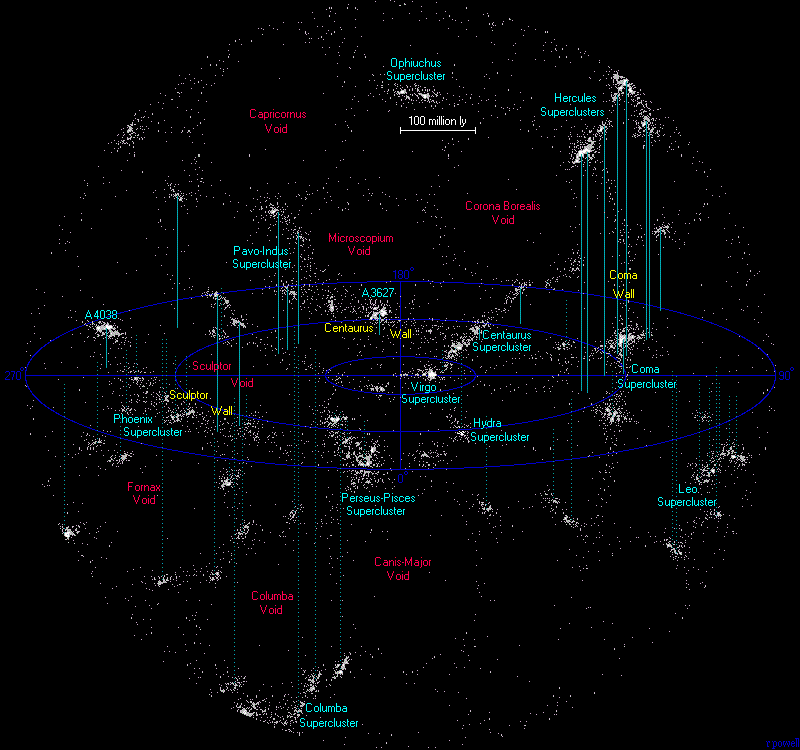
The universe encompasses all of space, time, matter, and energy. From the smallest subatomic particles to the vastest galactic superclusters, the cosmos operates under fundamental laws of physics that have evolved over billions of years. Modern astronomy, aided by tools like the Hubble Ultra-Deep Field, allows us to peer back into the distant past to observe galaxies that formed shortly after the beginning of time.
Key Facts
- Age: Approximately 13.787 ± 0.020 billion years.
- Observable Diameter: 93 billion light-years (8.8 × 1026 meters).
- Composition: 68.3% dark energy, 26.8% dark matter, and 4.9% ordinary matter.
- Average Temperature: 2.72548 K (−270.4 °C).
- Shape: Flat, with a small error margin of 0.4%.
The Big Bang and Cosmic Evolution
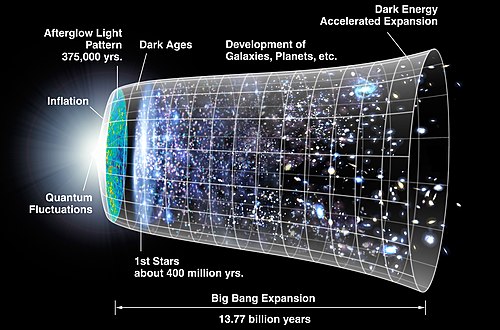
The prevailing scientific model for the origin of the universe is the Big Bang. This event marked the beginning of the expansion of space-time. In the earliest moments, the universe was an incredibly hot, dense point that expanded rapidly, cooling as it grew. This expansion allowed for the formation of the first elementary particles, followed by the synthesis of light elements.
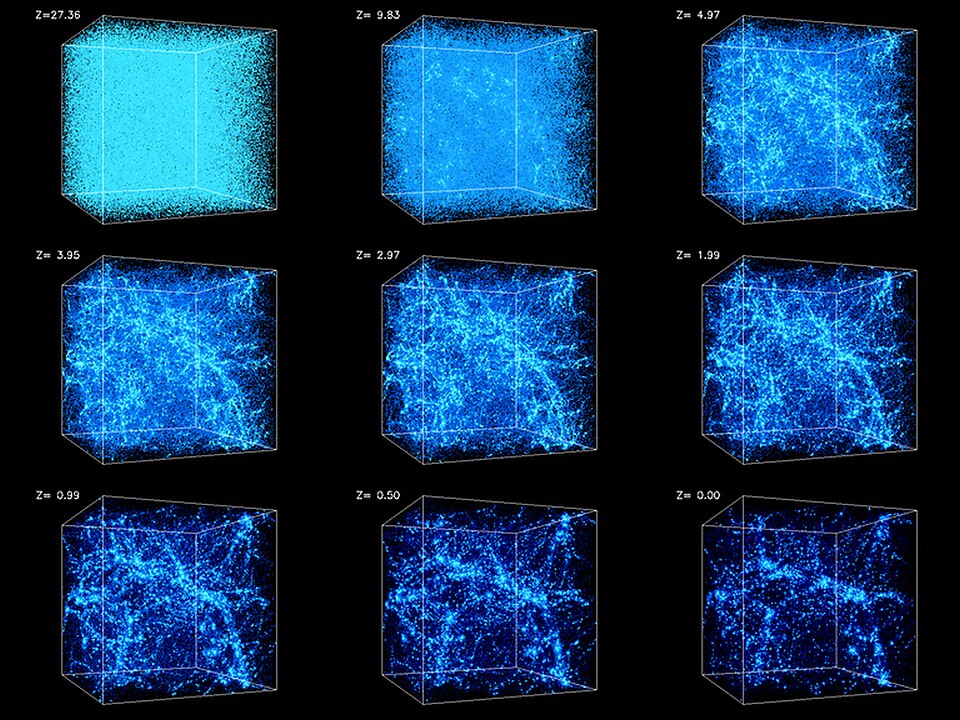
Over time, gravity pulled matter together to form the first stars and galaxies. The distribution of this matter was not uniform; small density fluctuations in the early universe led to the creation of the large-scale structures we see today, such as filaments and voids.
Physical Properties and Scale
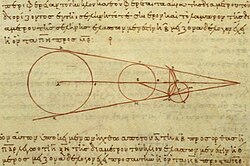
The observable universe is the spherical region of the universe comprising all matter that can be observed from Earth at the present time. Because light travels at a finite speed, looking deeper into space is equivalent to looking back in time.
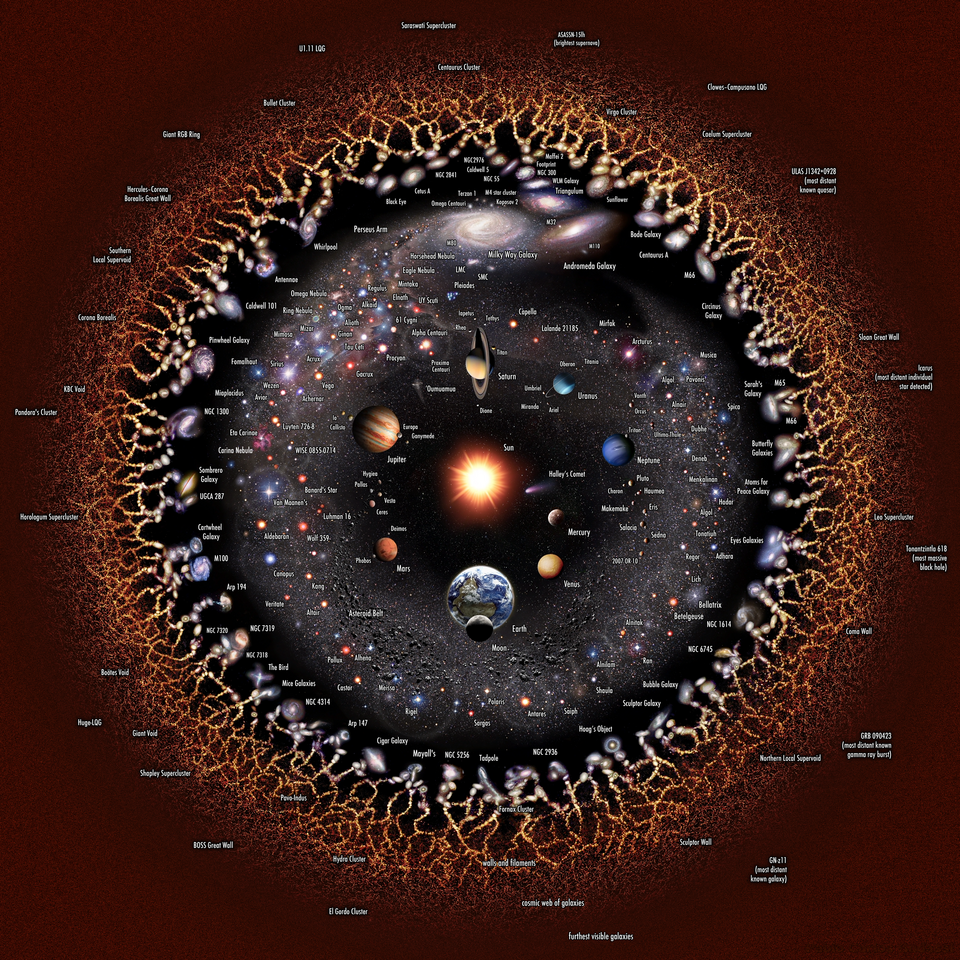
The scale of the universe is staggering. Objects range from the smallest fundamental particles to massive superclusters. The distribution of these objects is characterized by a "cosmic web" where galaxies are grouped into clusters and superclusters, separated by immense, empty regions known as voids.
![Masses and sizes of objects in the Universe[109]](/images/bd/29/bd29b1b1dd51280244a59215f80014e6526d5987530976d80354aca71575399c.png)
The Shape of the Universe
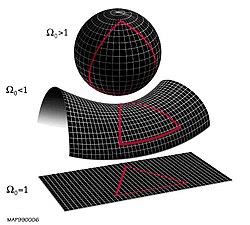
Cosmologists study the curvature of space-time to determine the overall shape of the universe. Current data suggests the universe is flat, meaning that parallel lines will never meet and the angles of a triangle add up to 180 degrees. However, other theoretical possibilities include a closed (spherical) or open (hyperbolic) geometry.
Composition of the Cosmos

The universe is composed of three primary components, most of which are invisible to traditional telescopes.
Ordinary (Baryonic) Matter
Making up only 4.9% of the universe, baryonic matter is the "normal" matter that forms stars, planets, and living organisms. This matter is composed of atoms, which are built from protons, neutrons, and electrons.
Dark Matter
Dark matter accounts for 26.8% of the universe. It does not emit, absorb, or reflect light, making it invisible. Scientists infer its existence through its gravitational effects on visible matter, such as the rotation speeds of galaxies.
Dark Energy
The largest component, dark energy, makes up 68.3% of the universe. It is a mysterious force that acts as a repulsive pressure, causing the expansion of the universe to accelerate over time.
![Comparison of the contents of the universe today to 380,000 years after the Big Bang, as measured with 5 year WMAP data (from 2008).[100] Due to rounding, the sum of these numbers is not 100%.](/images/32/c5/32c512866d13f3653b71c9b0b31d39b88ce2a71c0549b802e0b11da70d7e6a88.webp)
Fundamental Particles
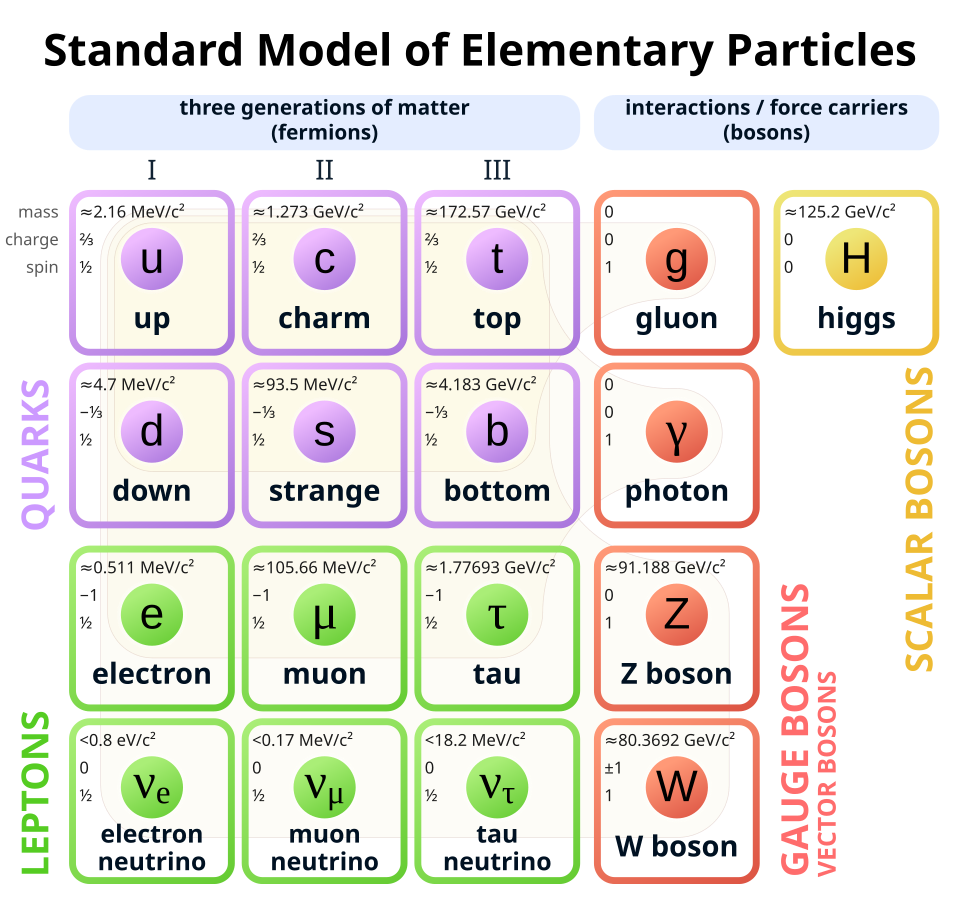
At the most basic level, the universe is constructed from elementary particles described by the Standard Model. These are divided into two main categories: fermions and bosons.
- Fermions: The building blocks of matter, including quarks (which form hadrons like protons and neutrons) and leptons (such as electrons and neutrinos).
- Bosons: Force-carrying particles, such as photons (light), gluons (strong nuclear force), and W and Z bosons (weak nuclear force).
Summary of Universal Characteristics
| Property | Value/Description |
|---|---|
| Age | 13.787 ± 0.020 Billion Years |
| Diameter | 93 Billion Light-Years |
| Average Density | 9.9 × 10⁻²⁷ kg/m3 |
| Average Temperature | 2.72548 K |
| Geometry | Flat (0.4% error) |
Frequently Asked Questions
How old is the universe?
The universe is estimated to be approximately 13.787 billion years old, with a small margin of error of 0.020 billion years.
What is the difference between dark matter and dark energy?
Dark matter provides additional gravity that helps hold galaxies together, while dark energy acts as a repulsive force that accelerates the expansion of the universe.
Is the universe infinite?
While the observable universe has a finite diameter of 93 billion light-years, the total size of the entire universe remains unknown and could potentially be infinite.
What is baryonic matter?
Baryonic matter is the ordinary matter composed of protons and neutrons. It includes everything we can see and touch, from gas clouds and stars to humans.
Why is the universe considered "flat"?
Based on measurements of the cosmic microwave background, the geometry of the universe is flat within a 0.4% error margin, meaning it does not curve significantly in any direction.