General Relativity: The Geometric Theory of Gravity
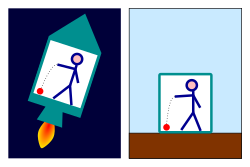
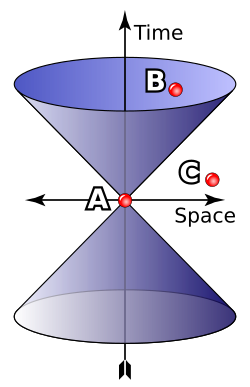
Published by Albert Einstein in May 1916, general relativity is the modern geometric theory of gravitation. It serves as the accepted description of how macroscopic objects interact via gravity in the universe. By generalizing the principles of special relativity and refining Isaac Newton's law of universal gravitation, Einstein provided a unified description of gravity not as a force, but as a geometric property of four-dimensional spacetime (the fusion of three-dimensional space and one-dimensional time).
At its core, the theory posits that the curvature of spacetime is directly determined by the energy, momentum, and stress of the matter and radiation present within it. This relationship is mathematically defined by the Einstein field equations, a complex system of second-order partial differential equations. As physicist John Archibald Wheeler famously summarized: "Space-time tells matter how to move; matter tells space-time how to curve."
Key Facts
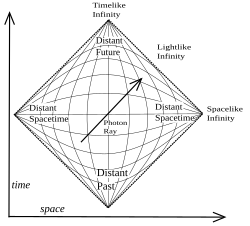
- Nature of Gravity: Gravity is the result of spacetime curvature caused by mass and energy.
- Newtonian Relation: Newton's laws are a specific prediction of general relativity for almost flat spacetime around stationary masses.
- Experimental Status: All tests of general relativity to date have been in agreement with the theory.
- Cosmological Impact: The theory provided the framework for discovering the Big Bang and cosmic microwave background radiation.
- Quantum Conflict: A self-consistent theory of quantum gravity that reconciles general relativity with quantum physics has not yet been found.
From Classical Mechanics to Spacetime Geometry
In classical mechanics, gravity was viewed as an instantaneous force between two masses. General relativity transforms this view, suggesting that massive objects warp the fabric of spacetime around them. This warping dictates the motion of other objects, which follow the shortest paths (geodesics) through this curved geometry.
While Newtonian gravity works well for low-mass, low-velocity systems, it fails to explain several phenomena that general relativity predicts with precision. These include the way time slows down near massive bodies and how light bends when passing through a gravitational field.
Consequences and Predictions of the Theory
Gravitational Time Dilation and Redshift
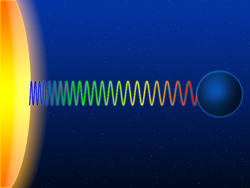
General relativity predicts that time passes more slowly in stronger gravitational fields, a phenomenon known as gravitational time dilation. Similarly, light escaping from a massive body loses energy, causing its frequency to shift toward the red end of the spectrum, known as gravitational redshift.
Light Deflection and Gravitational Lensing
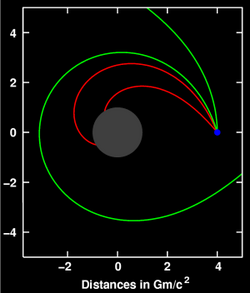
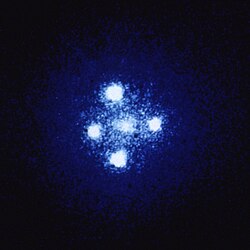
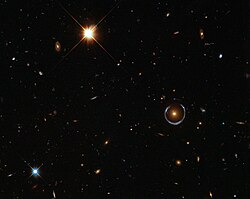
Because mass curves spacetime, light does not always travel in a straight line. When light passes near a compact, massive body, its path is deflected. This effect can create a gravitational lens, where a foreground galaxy or black hole warps and magnifies the light from a distant object behind it, sometimes creating multiple images of the same source.
Gravitational Waves
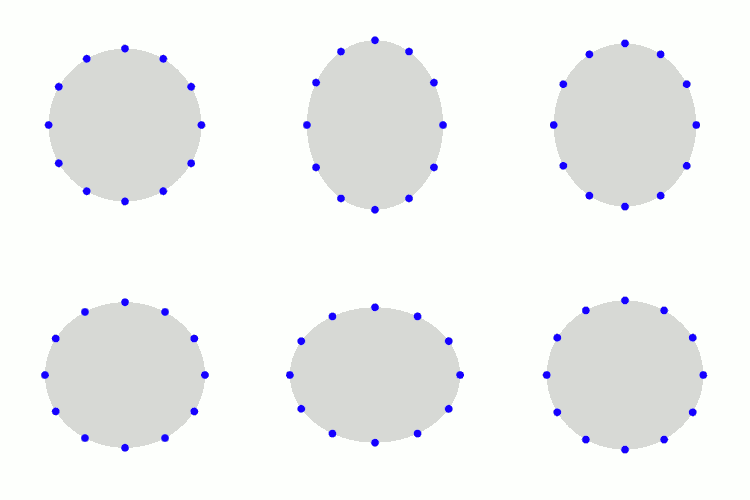
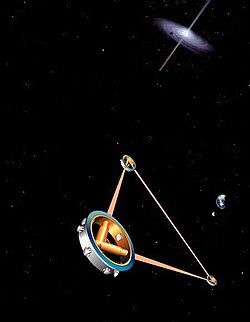
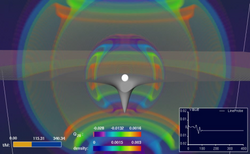
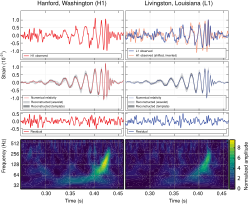
The theory predicts that the acceleration of massive objects creates ripples in the fabric of spacetime called gravitational waves. These waves propagate outward at the speed of light, carrying information about violent cosmic events, such as the merger of two black holes.
Orbital Effects and Decay
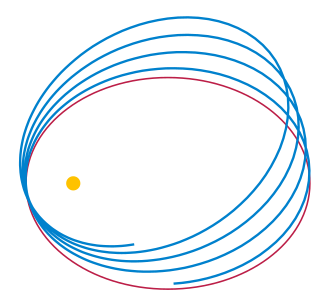
General relativity explains anomalies in planetary orbits that Newtonian physics could not. A primary example is the precession of apsides (the shift in the closest point of an orbit), most notably observed in the orbit of Mercury. Additionally, the theory predicts orbital decay in binary systems, as energy is lost through the emission of gravitational waves.
![Orbital decay for PSR J0737−3039: time shift, tracked over 16 years (2021).[96]](/images/96/22/96228d3ca7e58f7d07eb071851551eec9b7c63b6c891b16e1baa8dcd94f802f4.png)
Black Holes and Advanced Concepts
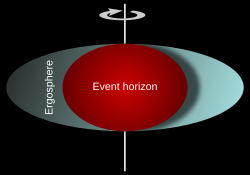
One of the most extreme predictions of general relativity is the existence of black holes—regions of spacetime where curvature becomes so intense that nothing, not even light, can escape. These objects are characterized by an event horizon, the boundary beyond which escape is impossible, and a singularity at the center where density becomes infinite.
Rotating black holes also possess an ergosphere, a region outside the event horizon where spacetime is dragged along with the black hole's rotation, potentially allowing for the extraction of energy.
The Quest for Quantum Gravity
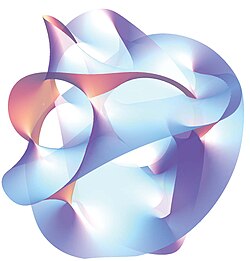
Despite its success, general relativity is not a complete theory of everything. It describes the macroscopic universe but clashes with the laws of quantum physics, which govern the subatomic world. Scientists are currently exploring various theories to unify gravity with the strong, weak, and electromagnetic interactions. Prominent candidates include string theory, which posits extra dimensions compactified into complex shapes, and loop quantum gravity, which uses spin networks to describe the quantum nature of space.
Summary of General Relativity Concepts
| Feature | Newtonian Gravity | General Relativity |
|---|---|---|
| Nature of Gravity | Attractive force between masses | Curvature of spacetime |
| Space and Time | Absolute and separate | Unified 4D spacetime |
| Light Path | Straight lines (mostly) | Bends near massive objects |
| Time Flow | Constant everywhere | Varies by gravitational strength |
| Extreme Objects | Not predicted | Black holes and singularities |
Frequently Asked Questions
How does general relativity differ from special relativity?
Special relativity focuses on the physics of observers moving at constant speeds, particularly near the speed of light, and introduces the concept of spacetime. General relativity expands this by including acceleration and gravity, describing gravity as the curvature of that spacetime.
What is a gravitational lens?
A gravitational lens occurs when a massive object (like a galaxy cluster) curves spacetime so significantly that it acts like a lens, bending and magnifying the light from a more distant object located behind it.
What are gravitational waves?
Gravitational waves are ripples in the curvature of spacetime that travel at the speed of light. They are generated by the acceleration of massive objects, such as colliding black holes or neutron stars.
Why is the singularity in a black hole a problem for physics?
A singularity is a point of infinite density and curvature. At this point, the equations of general relativity break down, and the laws of classical physics no longer apply, indicating the need for a theory of quantum gravity.
Does general relativity predict time travel?
The theory allows for certain "exotic" solutions, such as warp drives or closed timelike curves, which theoretically could allow for time travel or faster-than-light transportation, though these remain highly speculative and may be physically impossible.