Albert Einstein: The Life and Legacy of a Scientific Visionary
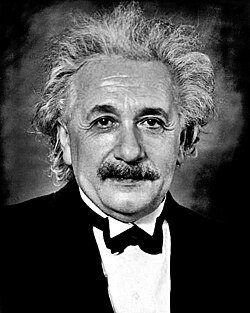
Albert Einstein remains the most iconic figure in theoretical physics, a man whose intellectual curiosity fundamentally altered our understanding of space, time, and energy. From his early days as a patent clerk in Switzerland to his final years at the Institute for Advanced Study in Princeton, Einstein's journey was marked by a relentless pursuit of the laws governing the universe.
His work bridged the gap between classical physics and the modern era, introducing concepts that seemed paradoxical at the time but were later proven through rigorous observation. Beyond his equations, Einstein was a complex human being—a musician, a pacifist, and a global celebrity who used his platform to advocate for civil rights and international cooperation.
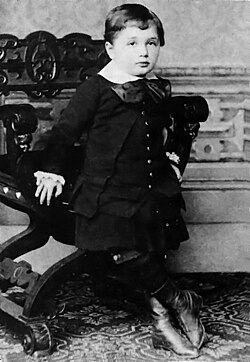
Key Facts
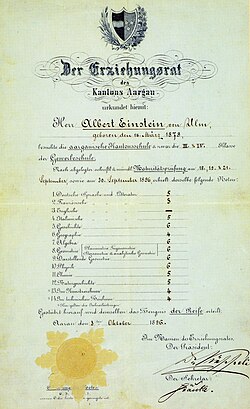
- Born: March 14, 1879, in Ulm, German Empire.
- Died: April 18, 1955, at age 76.
- Most Famous Equation: E = mc2 (mass–energy equivalence).
- Nobel Prize: Awarded the 1921 Nobel Prize in Physics for his discovery of the law of the photoelectric effect.
- Major Theories: Special Relativity and General Relativity.
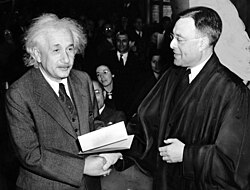
- Citizenship: Held citizenship in the German Empire, Switzerland, and the United States.
Early Life and Education
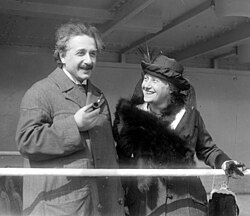
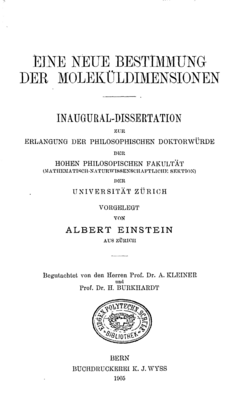
Einstein's early years were spent in the German Empire, where he developed a lifelong passion for music and science. He pursued his higher education at the Swiss Federal Polytechnic School, earning a teaching diploma in 1900. He later attended the University of Zurich, where he earned his PhD in 1905.
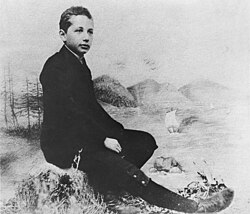
Before achieving academic fame, Einstein worked as an assistant at the Swiss Patent Office from 1902 to 1909. This period of professional stability provided him with the mental space to conduct the theoretical research that would soon revolutionize physics.
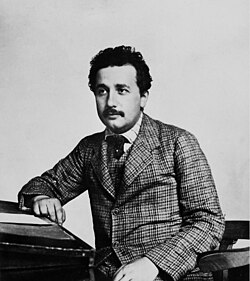
The Annus Mirabilis of 1905
![Einstein with other physicists and chemists at the Kaiser Wilhelm Institute, Berlin, 1920[c]](/images/93/55/935511a71784cfb0d567586eee53a663e172be385e94efcaa597a059e4871fd1.jpg)
The year 1905 is known as Einstein's Annus Mirabilis (Miracle Year), during which he published four groundbreaking papers that changed the course of science. These papers addressed the photoelectric effect, Brownian motion, special relativity, and the equivalence of mass and energy.
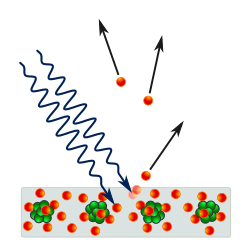
The photoelectric effect—the process where light striking a metal surface ejects electrons—provided critical evidence for the quantization of light, leading to the Planck–Einstein relation (E = hf). His work on Brownian motion provided empirical evidence for the existence of atoms, while special relativity redefined the relationship between space and time.
Summary of 1905 Publications
| Paper Focus | Key Concept | Significance |
|---|---|---|
| Photoelectric Effect | Light Quanta | Established light as particles (photons) |
| Brownian Motion | Molecular Kinetic Theory | Proved the existence of molecules/atoms |
| Special Relativity | Electrodynamics of Moving Bodies | Redefined space and time as relative |
| Mass-Energy Equivalence | E = mc2 | Linked energy and mass as interchangeable |
General Relativity and Global Fame
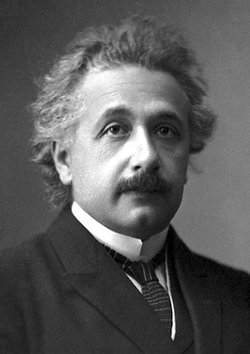
Building upon special relativity, Einstein spent a decade developing the General Theory of Relativity. This theory proposed that gravity is not a force in the traditional sense, but a curvature of spacetime caused by mass and energy. This was mathematically expressed through the Einstein field equations.
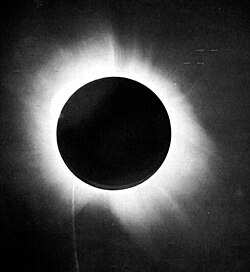
The theory gained worldwide validation in 1919 when observations of a solar eclipse confirmed that gravity could bend light. This discovery catapulted Einstein to international stardom, making him a household name and a symbol of genius.
![The New York Times reported confirmation of the bending of light by gravitation after observations (made in Príncipe and Sobral) of the 29 May 1919 eclipse were presented to a joint meeting in London of the Royal Society and the Royal Astronomical Society on 6 November 1919.[98]](/images/03/f0/03f039380db7d9b23f0c0b8babc41ad936baafce2475e7cc0a53f99dbe627258.png)
Academic Career and Later Years
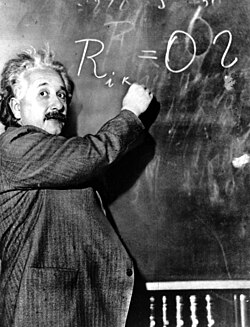
Einstein held prestigious positions across Europe, including roles at the University of Bern, University of Zurich, Charles University in Prague, and ETH Zurich. He eventually became the director of the Kaiser Wilhelm Institute in Berlin and a professor at Humboldt University.
![Einstein with colleagues at the ETH Zurich, 1913[b]](/images/33/88/33888095b1fde4506fd4025c7f8b950209eb351488fcc0257442a34d6ae26916.jpg)
Due to the rise of the Nazi regime in Germany, Einstein immigrated to the United States in 1933, where he became a resident scholar at the Institute for Advanced Study in Princeton. During this time, he continued to explore the Unified Field Theory—an attempt to reconcile gravity with electromagnetism—though he never fully completed it.
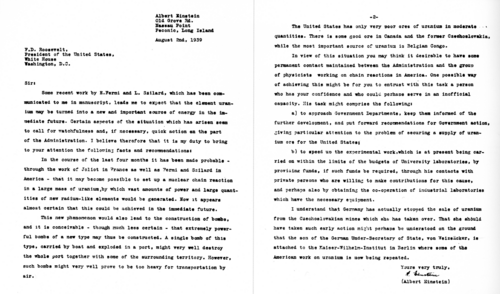
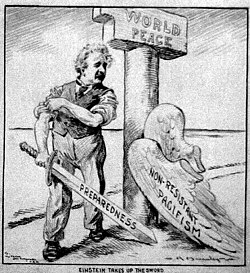
Despite his contributions to the theoretical foundations that made nuclear energy possible, Einstein was a lifelong pacifist. However, he famously signed the Einstein–Szilard letter to President Roosevelt, warning of the potential for Germany to develop atomic weapons, which contributed to the start of the Manhattan Project.
Personal Life and Philosophy
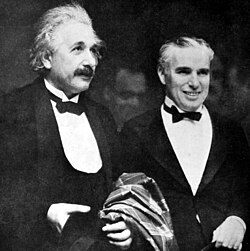
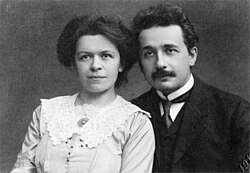
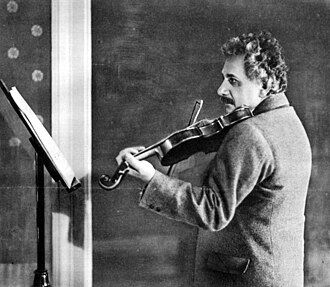
Einstein's personal life was as complex as his scientific work. He was married twice: first to Mileva Marić (1903–1919) and later to his cousin Elsa Löwenthal (1919–1936). He was a devoted violinist, finding that music often aided his scientific intuition.
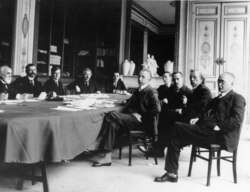
Politically, he was an advocate for Zionism and a vocal critic of racism and nationalism. He served as a member of the International Committee on Intellectual Cooperation for the League of Nations from 1922 to 1932, promoting global peace and intellectual exchange.
Frequently Asked Questions
![Landing card for Einstein's 26 May 1933 arrival in Dover, England from Ostend, Belgium,[132] enroute to Oxford[133]](/images/2c/c1/2cc13d56a324288d31b01175e5926cca0befdaa76ccc46f67a869d977c55fc30.jpg)
Why did Einstein win the Nobel Prize?
Although he is most famous for relativity, Einstein was awarded the 1921 Nobel Prize in Physics specifically for his discovery of the law of the photoelectric effect, which helped establish the quantum nature of light.
What is the difference between Special and General Relativity?
Special Relativity (1905) focuses on the speed of light and the relationship between space and time for observers in uniform motion. General Relativity (1915) expands this to include gravity, describing it as the curvature of spacetime caused by mass.
Did Einstein work on the atomic bomb?
Einstein did not work on the Manhattan Project itself. However, his mass-energy equivalence formula (E = mc2) provided the theoretical basis for nuclear energy, and he urged the US government to investigate atomic weapons to prevent Nazi Germany from obtaining them first.
What was the EPR Paradox?
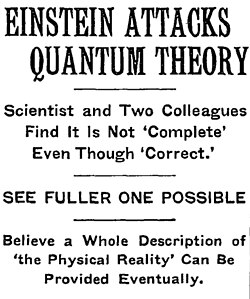
The Einstein-Podolsky-Rosen (EPR) paradox was a thought experiment intended to demonstrate that quantum mechanics was an incomplete theory, specifically challenging the concept of non-locality (what is often called "spooky action at a distance").
What was Einstein's relationship with the state of Israel?
Einstein was a supporter of Zionism and helped found the Hebrew University. In 1952, he was offered the presidency of Israel, but he declined the offer, citing a lack of aptitude for official functions.