Cosmology: The Science and History of the Universe
Derived from the Ancient Greek words cosmos (the universe) and logia (study of), cosmology is the comprehensive study of the nature and origin of the universe. While the term first appeared in English in 1656 in Thomas Blount's Glossographia, it evolved by 1731 through philosopher Christian Wolff into a branch of metaphysics dealing with the physical world. Today, cosmology is a multidisciplinary field investigated by astronomers, physicists, and philosophers alike.
Because cosmology often deals with the largest scales of existence, it frequently blends scientific observation with theoretical propositions. This includes physical cosmology, which relies on empirical data, as well as religious or mythological cosmologies based on creation myths and esoteric traditions.
Theoretical astrophysicist David N. Spergel describes cosmology as a "historical science." This is because the speed of light is finite; therefore, when scientists observe distant reaches of space, they are effectively looking back in time.
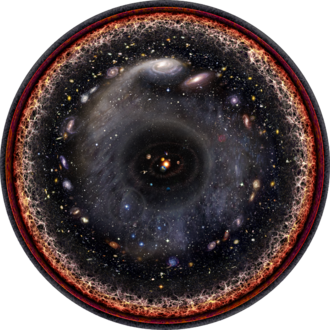
Physical Cosmology
Physical cosmology is a sub-branch of astronomy focused on the universe as a whole. It examines the chronology of the cosmos, its origin, large-scale structures, dynamics, and ultimate fate, governed by the laws of physics.
Modern physical cosmology is dominated by the Big Bang Theory, which integrates observational astronomy with particle physics. Specifically, scientists utilize the Lambda-CDM model, a standard parameterization of the Big Bang that accounts for the influence of dark matter and dark energy.
The Great Debate and the Expansion of the Universe
In the early 20th century, a pivotal conflict known as the Great Debate (1917–1922) shaped our understanding of the cosmos. Heber Curtis argued that spiral nebulae were separate "island universes" (galaxies) far beyond our own, while Harlow Shapley believed the Milky Way constituted the entire universe. This was resolved in 1923 and 1924 when Edwin Hubble detected Cepheid Variables in the Andromeda Galaxy, proving that spiral nebulae existed well outside the Milky Way.
Following this, Georges Lemaître proposed the Big Bang model in 1927. This theory was later supported by Hubble's 1929 discovery of redshift (the stretching of light as objects move away) and the 1964 discovery of the cosmic microwave background radiation by Arno Penzias and Robert Woodrow Wilson.
![Except for the few stars in the foreground (which are bright and easily recognizable because only they have diffraction spikes), every speck of light in the composite photo is an individual galaxy, some of them as old as 13.2 billion years; the observable universe is estimated to contain more than 2 trillion galaxies.[1] From the Hubble eXtreme Deep Field.](/images/47/13/471337ddc634fc380cd6f0177432ce7b835ae7ffac6ec51f86300c96401e750d.jpg)
Composition of the Universe
Data reported at the Planck 2014 meeting in Italy provided a precise snapshot of the universe's age and makeup. Astronomers determined that the universe is 13.8 billion years old and consists of the following components:
- Dark Energy: 68.5%
- Dark Matter: 26.6%
- Atomic Matter: 4.9%
Key Facts
- The observable universe is estimated to contain more than 2 trillion galaxies.
- The universe is approximately 13.8 billion years old.
- Only 4.9% of the universe is composed of ordinary atomic matter.
- The Lambda-CDM model is the current standard for Big Bang parameterization.
- The "Great Debate" of 1920 helped establish that galaxies exist beyond the Milky Way.
Historical and Philosophical Perspectives
Beyond physical science, cosmology has been explored through various philosophical and mythological lenses. Philosophers often question the ultimate material components of the universe—exploring concepts like atomism and hylomorphism—and debate whether the cosmos possesses a purpose, a study known as teleology.
Throughout history, humans have proposed numerous models to explain the heavens, ranging from the geocentric (Earth-centered) models of Aristotle and Ptolemy to the heliocentric (Sun-centered) models of Copernicus and Kepler.
The following table summarizes key historical cosmological models:
| Model Name | Author/Date | Classification | Key Characteristic |
|---|---|---|---|
| Hindu Cosmology | Rigveda (c. 1700–1100 BCE) | Cyclical/Infinite | Universe manifests and unmanifests in trillion-year cycles. |
| Aristotelian | Aristotle (384–322 BCE) | Geocentric | Static, steady state, and finite extent. |
| Heliocentric | Copernicus (1473–1543) | Heliocentric | Sun-centered with circular planetary orbits. |
| Newtonian | Isaac Newton (1642–1727) | Static/Infinite | Steady state and infinite in extent. |
| Big Bang | Georges Lemaître (1927) | Expansion | Universe began from a singularity and is expanding. |
| Cosmic Inflation | Alan Guth (1980) | Modified Big Bang | Solves the horizon and flatness problems. |
Frequently Asked Questions
What is the difference between astronomy and cosmology?
While astronomy is the broad study of celestial objects, physical cosmology is a specific sub-branch that focuses on the universe as a whole, including its origin, evolution, and ultimate fate.
What is the Lambda-CDM model?
The Lambda-CDM model is the current standard mathematical framework for the Big Bang. "Lambda" represents the cosmological constant (dark energy), and "CDM" stands for Cold Dark Matter.
Why is cosmology called a "historical science"?
Because light travels at a finite speed, the light we see from distant galaxies left those objects millions or billions of years ago. Observing the distant universe is effectively observing the past.
How was the "Great Debate" resolved?
The debate was resolved when Edwin Hubble identified Cepheid Variables in the Andromeda Galaxy, proving that it was a separate galaxy located far beyond the boundaries of the Milky Way.
What is the composition of the universe?
According to data from the Planck mission, the universe is composed of approximately 68.5% dark energy, 26.6% dark matter, and only 4.9% ordinary atomic matter.