Maxwell's Equations: The Foundation of Classical Electromagnetism
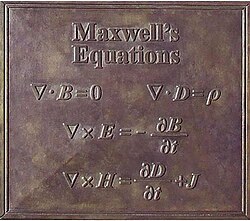
At the heart of modern technology lies a set of coupled partial differential equations that describe how electric and magnetic fields are generated and altered by charges and currents. Known as Maxwell's equations, these mathematical pillars form the basis of classical electromagnetism, classical optics, and the design of electric and magnetic circuits. From the power grids that light our cities to the wireless signals that connect our devices, these equations provide the essential model for power generation, electric motors, radar, and lenses.
The unification of these phenomena was the crowning achievement of physicist and mathematician James Clerk Maxwell. In 1861 and 1862, Maxwell published an early version of these equations, effectively merging the previously separate studies of magnetism, electricity, and light into a single, cohesive theory. While Maxwell originated the concepts, the modern, streamlined formulation used by scientists today is largely credited to Oliver Heaviside.
Key Facts
- Unification: Maxwell's equations unified electricity, magnetism, and optics into one field of study.
- Light as Radiation: The equations prove that light is a form of electromagnetic radiation, traveling at a constant speed.
- Two Variants: They exist in microscopic forms (universal but complex) and macroscopic forms (practical for materials).
- Core Components: The set consists of four primary laws: Gauss's law, Gauss's law for magnetism, Faraday's law, and the Ampère-Maxwell law.
- Foundation: Together with the Lorentz force law, they describe the behavior of all classical electromagnetic systems.
The Four Fundamental Laws
Maxwell's equations describe the interaction between the electric field (E) and the magnetic field (B). To understand them, we must look at the four laws that comprise the set.
Gauss's Law
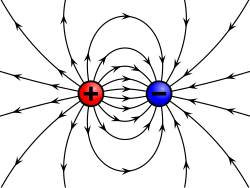
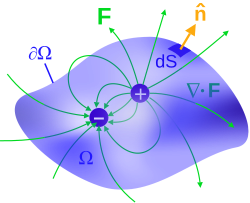
Gauss's law describes how electric charges produce electric fields. It establishes that the electric flux through a closed surface is proportional to the total enclosed electric charge. In simpler terms, positive charges act as sources and negative charges act as sinks for the electric field.
Gauss's Law for Magnetism
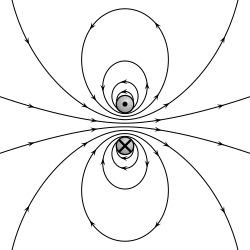
Unlike electric fields, magnetic fields have no known "magnetic charges" (monopoles). Gauss's law for magnetism states that the total magnetic flux through a closed surface is always zero. This means magnetic field lines never begin or end; they always form continuous loops.
Faraday's Law of Induction
Faraday's law describes how a time-varying magnetic field creates (induces) an electric field. This principle is the operational basis for electric generators and transformers, where changing magnetic environments are used to produce electrical current.
Ampère-Maxwell Law
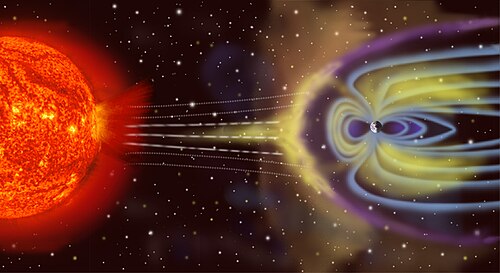
Originally, Ampère's law related magnetic fields to the electric currents that produce them. Maxwell added a critical term—the displacement current—which shows that a changing electric field also generates a magnetic field. This addition was the key to predicting the existence of electromagnetic waves.

Mathematical Formulations and Notation
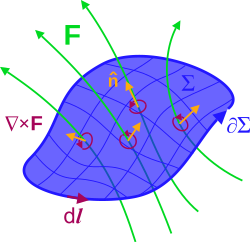
Maxwell's equations can be expressed in two primary mathematical formats: differential equations, which describe the fields at a specific point in space, and integral equations, which describe the fields over a volume or surface.
The equations utilize several universal constants and operators:
- Permittivity of free space (ε0): A measure of how an electric field affects a vacuum.
- Permeability of free space (μ0): A measure of how a magnetic field affects a vacuum.
- Nabla symbol (∇): The three-dimensional gradient operator used to calculate divergence (∇·) and curl (∇×).
| Law Name | Physical Meaning | Differential Form |
|---|---|---|
| Gauss's Law | Electric charges produce electric fields | ∇·E = ρ / ε0 |
| Gauss's Law for Magnetism | No magnetic monopoles exist | ∇·B = 0 |
| Faraday's Law | Changing magnetic fields induce electric fields | ∇×E = -∂B / ∂t |
| Ampère-Maxwell Law | Currents and changing electric fields induce magnetic fields | ∇×B = μ0(J + ε0∂E / ∂t) |
Electromagnetic Waves and the Speed of Light
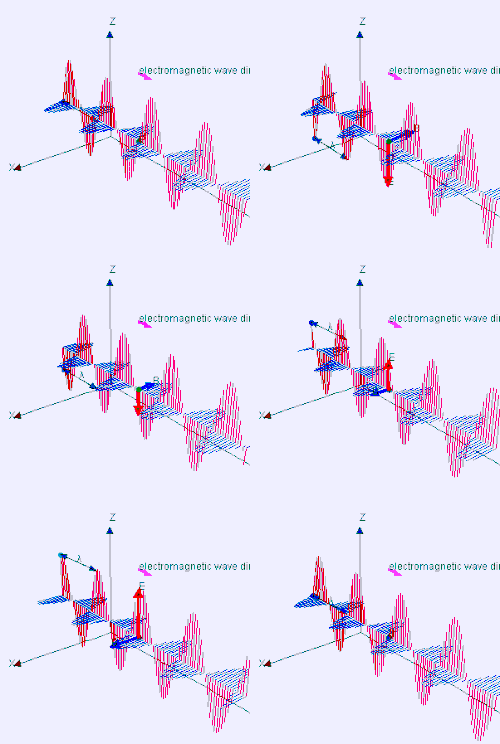
One of the most profound results of these equations occurs in a vacuum, where there are no charges (ρ = 0) and no currents (J = 0). In this environment, the equations show that oscillating electric and magnetic fields can sustain each other, propagating through space as a wave.
Maxwell discovered that the speed of these waves is determined by the constants ε0 and μ0. When he calculated this value, it matched the known speed of light. This led to the groundbreaking realization that light itself is an electromagnetic wave, alongside X-rays and radio waves.
Microscopic vs. Macroscopic Perspectives
Depending on the scale of the problem, physicists use different versions of the equations:
- Microscopic Equations: These relate fields to the total charge and current, including the complex movements of atoms and electrons. They are universally applicable but mathematically unwieldy for large-scale calculations.
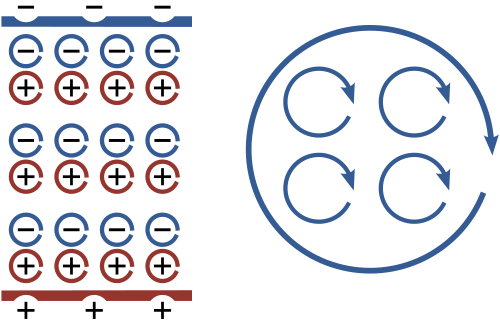
- Macroscopic Equations: These use auxiliary fields (displacement and magnetizing fields) to average out the microscopic details. This version is used for practical engineering and physics involving materials.
Frequently Asked Questions
Why are Maxwell's equations considered a unification?
They are a unification because they combined electricity, magnetism, and optics—which were previously studied as separate forces—into a single theoretical framework, proving that light is an electromagnetic wave.
What is the difference between the differential and integral forms?
The differential form describes the behavior of the fields at a single point in space (local), while the integral form describes the behavior of the fields over a specific region, such as a volume or a surface (global).
Do magnetic monopoles exist?
According to Gauss's law for magnetism, magnetic monopoles do not exist; magnetic field lines always form closed loops, meaning you cannot have a North pole without a South pole.
How do these equations relate to the speed of light?
By analyzing the equations in a vacuum, Maxwell found that the fields propagate as waves at a speed defined by the permittivity and permeability of free space, which exactly matches the measured speed of light.
What is the role of the Lorentz force law?
While Maxwell's equations describe how charges and currents create fields, the Lorentz force law describes how those fields, in turn, exert force on charges and currents.