Electrostatics: The Physics of Stationary Electric Charges
From the sudden cling of plastic wrap to your skin to the complex operations of modern laser printers, the forces of electricity are constantly at work. Electrostatics is the branch of physics dedicated to studying these phenomena, specifically focusing on stationary or slow-moving electric charges on macroscopic objects. In this realm, we can analyze electric fields and potentials without the complicating interference of magnetic effects.
The history of this science dates back to classical antiquity. Ancient observers noted that materials like amber could attract lightweight particles after being rubbed. In fact, the Greek word for amber, ḗlektron, became the linguistic root for the word "electricity." Today, we understand these interactions through the study of forces exerted by electric charges on one another.

Key Facts
- Electrostatics studies stationary electric charges where quantum effects are negligible.
- Coulomb's Law defines the force between two point charges based on their magnitude and distance.
- Electric Field is a vector field representing the force exerted on a test charge at any given point.
- Electrostatic Induction occurs when an external charge causes mobile charges in a conductor to separate.
- Electrostatic Potential (voltage) is the work required per unit charge to move a particle between points.
Fundamental Principles of Charge Interaction
Coulomb's Law
At the heart of electrostatics lies Coulomb's law. This law states that the magnitude of the electrostatic force—whether attractive or repulsive—between two point charges is directly proportional to the product of the charges' magnitudes and inversely proportional to the square of the distance between them. The force acts along the straight line connecting the two charges. If the charges share the same sign, they repel; if they have opposite signs, they attract.
The Electric Field and Superposition
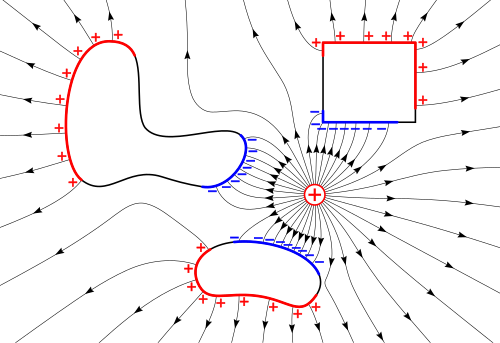
To understand how charges influence their surroundings, physicists use the concept of the electric field. This is a vector field defined as the electrostatic force acting on a hypothetical small test charge at a specific point, divided by that test charge's magnitude. We often visualize this using field lines, which begin on positive charges and terminate on negative charges. The density of these lines indicates the strength of the field.
When dealing with multiple charges, we apply the superposition principle. This principle allows us to calculate the total electric field at any point by summing the individual contributions from every source particle in the system.
Gauss's Law
Gauss's law provides a powerful way to calculate electric fields by looking at the total electric flux through a closed surface. It states that the total flux through any closed surface in free space is proportional to the total electric charge enclosed within that surface. This mathematical relationship is essential for solving complex problems involving symmetrical charge distributions.
Mathematical Frameworks: Potential and Energy
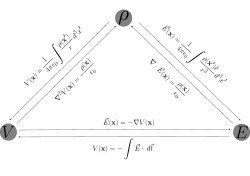
Because the electric field is irrotational (meaning it has no "curl"), it can be expressed as the gradient of a scalar function known as the electrostatic potential, commonly referred to as voltage. The electric field always points from regions of high potential to regions of low potential.
The relationship between charge density and potential is described by two critical equations:
- Poisson's equation: Relates the potential to the charge density.
- Laplace's equation: A specific form of Poisson's equation used when there is no unpaired electric charge in a region.
Electrostatic Energy and Pressure
Moving a charge within an electric field requires work, which is stored as electrostatic potential energy. This energy can be calculated for a single test particle or for an entire collection of charges. Furthermore, in conductive materials, the presence of an external field creates electrostatic induction, where charges move to the surface to balance the field. This can result in electrostatic pressure, a force acting normal to the surface of the conductor.
Summary of Electrostatic Concepts
| Concept | Definition | Key Relationship/Unit |
|---|---|---|
| Coulomb's Law | Force between two point charges | Inversely proportional to distance squared |
| Electric Field | Force per unit charge | Newtons per Coulomb (N/C) |
| Electric Potential | Work per unit charge | Volts (V) |
| Gauss's Law | Relation of flux to enclosed charge | $\Phi = Q_{enclosed} / \epsilon_0$ |
Frequently Asked Questions
What is the electrostatic approximation?
The electrostatic approximation is used when a system's electric field results from static charges, meaning there are no significant time-varying magnetic fields present. This allows for analysis using only electrostatic principles.
How does electrostatic induction work?
Electrostatic induction is the process where an external electric field causes mobile charges within a conductive object to separate. This creates induced surface charges that respond to the external field.
What is the difference between electric potential and electric potential energy?
Electric potential (voltage) is the amount of work required per unit charge to move a charge between points, whereas electric potential energy is the total work done on a specific particle or collection of particles.
Why is the electric field zero inside a conductor?
Inside a conductor, the external electric field is balanced by the movement of charges to the surface through induction. These induced surface charges create an opposing field that cancels the external field within the interior of the metal.
What is the triboelectric effect?
The triboelectric effect is the process where surfaces become electrically charged after being in contact with a different material, often through friction or rubbing, leading to the separation of charges.