Statistical Mechanics: Bridging Microscopic Motion and Macroscopic Matter
Statistical mechanics is a sophisticated mathematical framework that utilizes probability theory and statistical methods to analyze large assemblies of microscopic entities. Often referred to as statistical physics or statistical thermodynamics, this field seeks to explain the aggregate properties of matter by applying the physical laws that govern atomic and molecular motion.
While classical thermodynamics describes the behavior of matter on a large scale, statistical mechanics provides the "why" by linking macroscopic physical properties—such as temperature, pressure, and heat capacity—to microscopic parameters. These parameters fluctuate around average values and are defined by specific probability distributions.
Key Facts
- Core Purpose: To clarify the properties of matter in aggregate based on the laws of atomic motion.
- Founding Figures: Developed primarily by Ludwig Boltzmann, James Clerk Maxwell, and Josiah Willard Gibbs.
- Scope: Applies to diverse fields including biology, neuroscience, computer science, information theory, and sociology.
- Key Concept: Uses ensembles (probability distributions over possible states) to represent systems.
- Versatility: Works for both classical and quantum mechanical systems.
The Evolution of Statistical Mechanics
The roots of the field trace back to 1738, when Daniel Bernoulli published Hydrodynamica. Bernoulli proposed that gases consist of numerous molecules moving in all directions; he argued that their impact on surfaces creates gas pressure and that heat is simply the kinetic energy of this motion, laying the groundwork for the kinetic theory of gases.
The formalization of the field is credited to three pivotal physicists:
- James Clerk Maxwell: In 1859, Maxwell formulated the first statistical law in physics—the Maxwell distribution of molecular velocities. He also provided the mechanical argument that molecular collisions lead to temperature equalization and equilibrium.
- Ludwig Boltzmann: Inspired by Maxwell, Boltzmann developed the fundamental interpretation of entropy as a collection of microstates. In the 1870s, he introduced the equilibrium statistical ensemble and explored non-equilibrium states through his H-theorem.
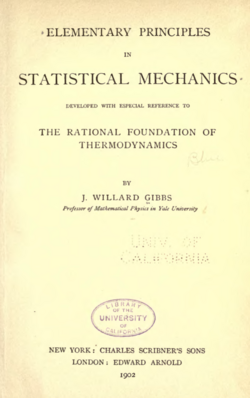
- Josiah Willard Gibbs: In 1884, Gibbs coined the term "statistical mechanics." His 1902 work, Elementary Principles in Statistical Mechanics, formalized the field as a general approach applicable to all mechanical systems, regardless of whether they are gaseous or non-gaseous.
Core Principles: Mechanics and Ensembles
At its heart, statistical mechanics relies on the concept of the state of a system. In classical mechanics, this is encoded as a phase point; in quantum mechanics, it is a pure quantum state vector. The progression of this state over time is governed by equations of motion, such as Hamilton's equations (classical) or the Schrödinger equation (quantum).
Because tracking every single particle is impossible, physicists use an ensemble—a probability distribution over all possible states. An ensemble can represent the various states a single system might occupy (epistemic probability) or a large collection of independent systems.
Statistical Thermodynamics
While statistical mechanics involves dynamics, statistical thermodynamics focuses on statistical equilibrium (steady state). In this context, equilibrium does not mean particles have stopped moving (which would be mechanical equilibrium), but rather that the ensemble itself is no longer evolving.
Thermodynamic Ensembles
There are three primary equilibrium ensembles used to describe isolated systems within a finite volume. In the macroscopic limit, these three approaches yield identical results consistent with classical thermodynamics.
| Ensemble | Fixed Variables | Microscopic Feature | Macroscopic Function |
|---|---|---|---|
| Microcanonical | Energy, Volume, Number of particles | Number of microstates | Boltzmann entropy |
| Canonical | Temperature, Volume, Number of particles | Canonical partition function | Helmholtz free energy |
| Grand Canonical | Temperature, Volume, Chemical potential | Grand partition function | Grand potential |
Non-Equilibrium Statistical Mechanics
Many real-world phenomena occur out of equilibrium, driven by imbalances. Non-equilibrium statistical mechanics models the speed of these irreversible processes. Examples include:
- Heat transport: Driven by temperature imbalances.
- Electric currents: Driven by voltage imbalances.
- Chemical reactions: Driven by a decrease in free energy.
- Dissipation: Including friction and quantum decoherence.
Key theoretical tools used to bridge the gap between near-equilibrium states and macroscopic observation include the fluctuation–dissipation theorem, Onsager reciprocal relations, and Green–Kubo relations.
Broad Applications and Quantum Integration
The ensemble formalism extends far beyond physics. It is used in weather forecasting (ensemble forecasting), the analysis of neural network dynamics, and the regression analysis of gravitational orbits.
When applied to quantum systems, the field becomes quantum statistical mechanics. Here, the statistical ensemble is described by a density operator—a non-negative, self-adjoint operator on a Hilbert space. This allows the framework to address the unique probabilistic nature of quantum states.
Frequently Asked Questions
What is the difference between statistical mechanics and classical thermodynamics?
Classical thermodynamics describes macroscopic properties (like pressure and temperature) empirically. Statistical mechanics explains these properties by analyzing the microscopic behavior and probability distributions of atoms and molecules.
Who are the primary founders of statistical mechanics?
The field was founded by James Clerk Maxwell, who developed probability distributions for molecular velocities; Ludwig Boltzmann, who linked entropy to microstates; and Josiah Willard Gibbs, who formalized the general approach and named the field.
What is a thermodynamic ensemble?
An ensemble is a theoretical probability distribution over all possible states of a system. It allows physicists to calculate macroscopic properties by averaging over these microscopic possibilities rather than tracking every individual particle.
What are the three main types of ensembles?
The three main ensembles are the Microcanonical (fixed energy, volume, and particle number), the Canonical (fixed temperature, volume, and particle number), and the Grand Canonical (fixed temperature, volume, and chemical potential).
How is statistical mechanics used outside of physics?
It is applied in biology (single-cell biology), neuroscience (neural network dynamics), computer science, information theory, and sociology to analyze complex systems with many interacting components.