Brownian Motion: The Random Dance of Particles and the Proof of Atoms
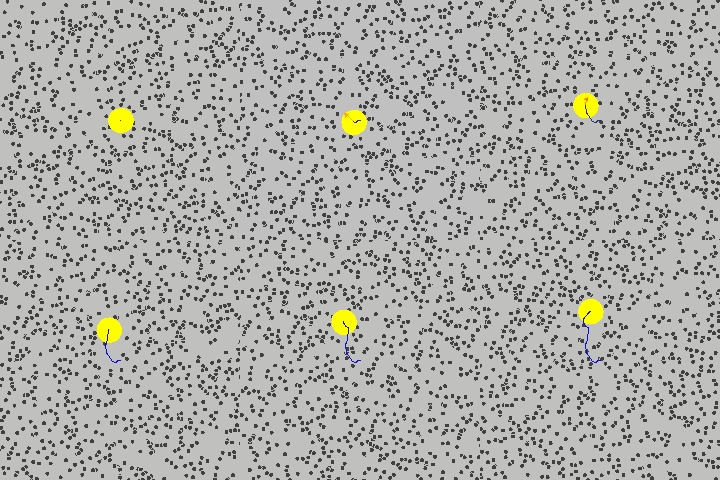
Imagine a tiny particle suspended in a glass of water. To the naked eye, the water is still, but under a microscope, that particle is engaged in a frantic, jittery dance, zig-zagging in every direction without any apparent cause. This phenomenon is known as Brownian motion—the random motion of particles suspended in a medium, such as a liquid or a gas.
At its core, Brownian motion is a manifestation of thermal equilibrium. In a fluid at a specific temperature, particles are constantly bombarded by the surrounding molecules of the medium. Because these collisions occur randomly and from all directions, the particle is pushed unevenly, resulting in a series of random fluctuations and relocations. This process is a cornerstone of statistical mechanics, illustrating how microscopic chaos leads to observable macroscopic behavior.
Key Facts
- Discovery: First described by botanist Robert Brown in 1827 using pollen grains.
- Theoretical Breakthrough: Albert Einstein modeled the motion in 1905, attributing it to collisions with water molecules.
- Experimental Proof: Jean Perrin verified Einstein's theory in 1908, providing empirical evidence for the existence of atoms.
- Mathematical Model: Often represented as the Wiener process, characterized by independent increments and continuous paths.
- Scientific Impact: Allowed for the calculation of the Avogadro constant and the size of atoms.
The History of a Random Walk
While the formal scientific discovery happened in the 19th century, the intuition behind it is ancient. The Roman philosopher-poet Lucretius described the motion of dust particles around 60 BC in his poem On the Nature of Things, using it as an early argument for the existence of atoms.
The modern scientific journey began in 1827 with Robert Brown. While observing pollen from the plant Clarkia pulchella in water, Brown noticed the grains (roughly 6.4 microns in size) moving continuously. To ensure this wasn't a biological property of living pollen, he repeated the experiment with inorganic matter, such as rock dust and glass. The motion persisted, proving the phenomenon was physical rather than biological.
![2-dimensional random walk of a silver adatom on an Ag(111) surface[1]](/images/6d/bf/6dbfa89b14b895e883eb1cbbfe2886ba2cd8afa4296a3c2edf8e87ec298bbe8a.gif)
The mathematical foundation arrived in 1900 through Louis Bachelier. In his doctoral thesis, The Theory of Speculation, Bachelier used a probabilistic analysis of stock markets to model random walks in continuous time. Though his work was pioneering, it remained largely unknown to the broader scientific community until the 1950s.
Einstein's Theory and the Atomic Proof
In 1905, Albert Einstein published a landmark paper that transformed Brownian motion from a curiosity into a tool for discovery. Einstein proposed that the jittery motion was caused by the bombardment of the suspended particles by individual molecules of the surrounding fluid.
Einstein's theory consisted of two primary components:
- The Diffusion Equation: He formulated an equation relating the diffusion coefficient to the mean squared displacement of the particles.
- Physical Quantities: He linked this coefficient to measurable physical properties, enabling the calculation of the Avogadro constant (approximately 6.02 × 10²³ mol-1) and the mass of an atom.
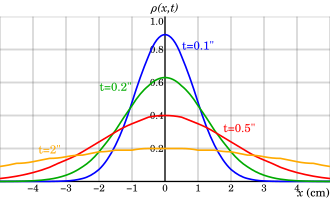
This theoretical framework provided the first convincing evidence that atoms and molecules actually exist. By dividing the molar mass of a gas by the Avogadro constant, scientists could finally determine the mass of a single atom.
Experimental Verification and Refinement
Confirming Einstein's predictions was a significant challenge. Early attempts by Theodor Svedberg and Victor Henri were inconclusive or disagreed with the formula. However, between 1908 and 1909, Jean Perrin and Chaudesaigues successfully verified the theory through rigorous experimentation.
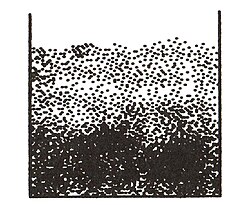
Perrin's work was so influential that he was awarded the Nobel Prize in Physics in 1926 for his work on the discontinuous structure of matter. He used granules of gamboge to observe how particles moved against gravity, finding that the relative change in density over 10 microns of suspension was equivalent to the change occurring in 6 km of air.
![Reproduced from the Jean Baptiste Perrin book Les Atomes: tracings of the motions of three colloidal particles of radius 0.53 μm, as seen under the microscope, with each point representing that particle's successive position every 30 seconds; the points are then joined by straight line segments (mesh size = 3.2 μm)[9]](/images/c0/17/c0171501a0d318c952c5425bc3db4020b5ea8d72a594078d819df189280b0f01.webp)
Other scientists, such as Marian Smoluchowski, also contributed to the theory. While Smoluchowski's mean squared displacement differed from Einstein's by a factor of 64/27 due to different kinematic collision analyses, Einstein's coefficient is generally regarded as the standard.
Summary of Brownian Motion Concepts
| Perspective | Key Contributor | Primary Contribution | Core Insight |
|---|---|---|---|
| Botanical | Robert Brown | Observation | Pollen grains move randomly in water. |
| Mathematical | Louis Bachelier | Stochastic Modeling | Random walks applied to continuous time. |
| Theoretical | Albert Einstein | Diffusion Equation | Motion is caused by molecular bombardment. |
| Experimental | Jean Perrin | Empirical Verification | Confirmed the existence of atoms/molecules. |
Mathematical and Modern Applications
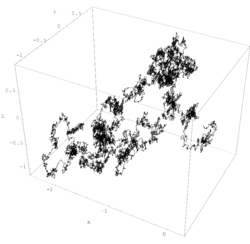
In mathematics, Brownian motion is formalized as the Wiener process. This process is defined by four characteristics: it starts at zero (W0 = 0), it is almost surely continuous, it has independent increments, and it follows a Gaussian distribution.
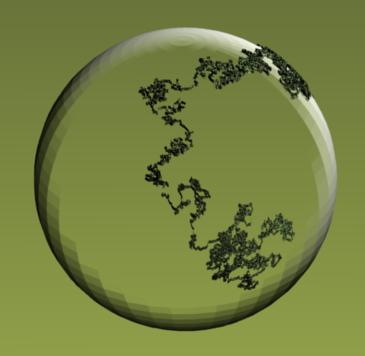
Today, the study of Brownian motion extends far beyond pollen in water. It is used to understand the motion of stars within galaxies, the behavior of nanoparticles, and the fluctuations of financial markets. It also appears in specialized forms, such as Brownian motion on a sphere or fractional Brownian motion in probability theory.
Frequently Asked Questions
What exactly causes Brownian motion?
Brownian motion is caused by the constant, random bombardment of a suspended particle by the molecules of the surrounding liquid or gas. Because these collisions are not perfectly balanced on all sides of the particle at any given moment, the particle is pushed in random directions.
Why was Brownian motion important for the proof of atoms?
Before Einstein and Perrin, atoms were largely a theoretical concept. By showing that the random motion of visible particles could be mathematically predicted based on the collisions of invisible molecules, Einstein provided a way to prove that matter is made of discrete particles.
What is the difference between the Wiener process and Brownian motion?
In a physical context, Brownian motion refers to the actual movement of particles in a fluid. In mathematics, the Wiener process is the idealized stochastic model used to describe this motion, characterized by continuous paths and independent increments.
How did Jean Perrin contribute to the theory?
Jean Perrin provided the experimental evidence needed to confirm Albert Einstein's theoretical predictions. His work on the distribution of granules in suspension allowed for the empirical determination of Avogadro's number, earning him the Nobel Prize in 1926.