Temperature: The Science of Thermal Energy and Absolute Zero
Temperature is a fundamental physical quantity that expresses how hot or cold an object is. While we often experience it as a sensation, in the realm of physics, it is deeply connected to the motion of particles and the distribution of energy. From the freezing point of water to the extreme heat of a star's core, temperature dictates the behavior of matter and the flow of energy throughout the universe.
At a microscopic level, temperature is related to the thermal vibration of particles. For instance, in a protein's alpha helix, the amplitude of these vibrations increases as the temperature rises.
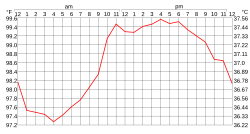
Key Facts
- SI Unit: The Kelvin (K) is the official International System of Units (SI) unit for temperature.
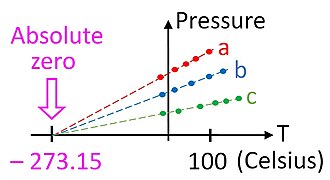
- Absolute Zero: Defined as 0 K, which equals −273.15 °C or −459.67 °F.
- The Third Law: It is experimentally impossible to reach absolute zero through any finite process.
- Scale Relationship: A change of one degree Celsius is exactly equal to a change of one Kelvin.
- Physical Effects: Temperature influences chemical reaction rates, the speed of sound in gases, and thermal radiation.
Common Temperature Scales
Humans use several different scales to measure temperature depending on the context, ranging from everyday weather reports to advanced laboratory research.
The Celsius Scale (°C)
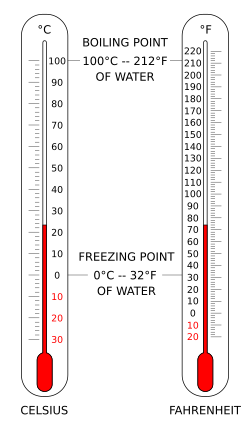
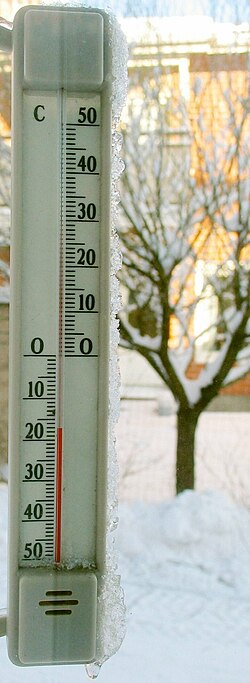
The Celsius scale is the most widely used system for common measurements globally. It is an empirical scale, meaning it was historically developed based on observable physical properties. Traditionally, 0 °C was defined as the freezing point of water and 100 °C as the boiling point at sea-level atmospheric pressure. Because liquid droplets can exist in clouds at sub-zero temperatures, 0 °C is often more accurately described as the melting point of ice.
The Fahrenheit Scale (°F)
Primarily used in the United States, the Fahrenheit scale provides a different numerical reference for temperature, though it measures the same physical phenomenon as Celsius.
The Kelvin Scale (K)
The Kelvin scale is an absolute scale used extensively in science. Unlike Celsius or Fahrenheit, it does not use the degree symbol (°). Historically, the Kelvin scale was defined using the triple point of water (the unique temperature and pressure where water exists as a solid, liquid, and gas simultaneously). However, since May 2019, the Kelvin has been redefined based on the Boltzmann constant, a fundamental constant that relates the average kinetic energy of particles in a gas with the temperature of the gas.
The Concept of Absolute Zero
Absolute zero represents the theoretical lowest point in the thermodynamic temperature scale. At this point, all classical translational motion of particles ceases, meaning they would be at complete rest in a classical model. However, according to the uncertainty principle in quantum mechanics, matter still possesses zero-point energy even at absolute zero.
The third law of thermodynamics states that absolute zero can be approached very closely but never actually reached. The lowest temperature ever attained in an experiment was 38 pK (38 trillionths of a kelvin).

Interestingly, while 0 K is the minimum for classical temperature, negative absolute temperatures can exist in certain physical systems. Paradoxically, these negative temperatures are actually hotter than any positive temperature.
Temperature and Kinetic Theory
The Kinetic theory of gases provides a microscopic way to understand temperature. It suggests that temperature is a measure of the average kinetic energy of the particles within a substance. This relationship is clearly visible when observing how pressure changes with temperature in different gas samples.
The Extremes of the Universe
Temperature spans a staggering range across the cosmos. While we experience temperatures near room temperature, the universe contains environments ranging from the near-absolute zero of the cosmic microwave background to the trillions of degrees found in particle collisions.
![An illustration of the range of cosmic temperatures[104]](/images/ab/d3/abd361045bd73d69e2c362c347ad20562cfb6b093f2b2fff597a6a860b8f3fb6.jpg)
| Object/Event | Kelvin (K) | Celsius (°C) | Peak Emittance Wavelength |
|---|---|---|---|
| Absolute Zero | 0 K | −273.15 °C | Infinite |
| Cosmic Microwave Background | 2.7260 K | −270.424 °C | 0.001 063 01 m |
| Sun's Visible Surface | 5778 K | 5505 °C | 501.5 nm |
| Sun's Core | 16 MK | 16,000,000 °C | 0.18 nm |
| CERN Proton Collisions | 10 TK | 10 trillion °C | 3 × 10 nm |
Frequently Asked Questions
What is the difference between Celsius and Kelvin?
The main difference is their starting point. The Celsius scale is based on the freezing and boiling points of water, while the Kelvin scale starts at absolute zero. Numerically, a one-degree change in Celsius is identical to a one-kelvin change, but the Kelvin scale is offset by 273.15.
Can temperature be negative?
On empirical scales like Celsius or Fahrenheit, negative temperatures are common (e.g., −10 °C). However, on the absolute Kelvin scale, temperatures cannot be negative in the traditional sense, though specialized physical states known as "negative absolute temperatures" do exist and are hotter than positive temperatures.
Why can't we reach absolute zero?
According to the third law of thermodynamics, it is impossible to reach absolute zero through any finite series of processes. As a system approaches absolute zero, the effort required to remove more heat increases exponentially.
How does temperature affect the speed of sound?
In a gas, the speed of sound is proportional to the square root of the absolute temperature. This means that as a gas gets hotter, sound travels through it more quickly.
What is the triple point of water?
The triple point is the specific temperature and pressure at which water can exist simultaneously in three states: solid (ice), liquid, and gas (vapor). Historically, this was used as a fixed reference point to define the Kelvin scale.