Bose-Einstein Statistics: Quantum Distributions and the Nature of Bosons
In the realm of quantum statistics, Bose-Einstein (B-E) statistics describes how a collection of non-interacting, identical particles occupy available discrete energy states when they reach thermodynamic equilibrium. Unlike classical particles, these quantum particles are indistinguishable, meaning they cannot be tracked or labeled individually. This fundamental property allows them to aggregate in the same state, a phenomenon that explains the cohesive streaming of laser light and the frictionless flow of superfluid helium.
The theoretical foundation of this behavior was established between 1924 and 1925 by Satyendra Nath Bose, who recognized that identical particles could be distributed in this specific manner. His work was later adopted and expanded by Albert Einstein, leading to the prediction of entirely new states of matter.
Key Facts
- Applicability: Applies to bosons, which are particles with integer spin.
- Core Characteristic: Bosons do not follow the Pauli exclusion principle, meaning an unlimited number of them can occupy the same energy state.
- Low-Temperature Effect: At very low temperatures, bosons can "condense" into the lowest energy state, forming a Bose-Einstein condensate.
- Classical Limit: At high temperatures or low concentrations, B-E statistics converge into the classical Maxwell-Boltzmann distribution.
- Indistinguishability: The theory relies on the fact that quantum particles are identical and cannot be distinguished from one another.
The Bose-Einstein Distribution
The expected number of particles in a specific energy state is determined by the Bose-Einstein distribution. This distribution is critical when quantum effects become significant, which occurs when the particle concentration reaches the quantum concentration. At this point, the interparticle distance equals the thermal de Broglie wavelength, causing the wavefunctions of the particles to overlap.
The average occupancy of a state is influenced by the absolute temperature, the Boltzmann constant, and the chemical potential (which is zero for a photon gas). While fermions (particles with half-integer spin) obey Fermi-Dirac statistics and are restricted by the Pauli exclusion principle, bosons are free to cluster.
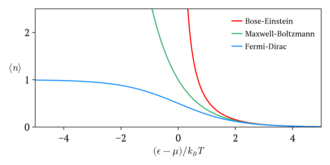
Comparison of Quantum Statistics
Different types of particles follow different statistical laws based on their spin and the restrictions on their occupancy:
| Statistic Type | Particle Type | Spin Value | Exclusion Principle | High-Temp Limit |
|---|---|---|---|---|
| Bose-Einstein | Bosons | Integer | No | Maxwell-Boltzmann |
| Fermi-Dirac | Fermions | Half-Integer | Yes | Maxwell-Boltzmann |
| Maxwell-Boltzmann | Classical | N/A | No | N/A |
Historical Development
The journey toward B-E statistics began with Max Planck's 1900 derivation of the Planck law to explain blackbody radiation. However, it was Satyendra Nath Bose who provided a new perspective while lecturing at the University of Dhaka. Bose attempted to show the inadequacies of contemporary radiation theory but made a statistical "error" that unexpectedly aligned with experimental results.
Bose realized that treating photons as indistinguishable particles—rather than distinct entities—was the key. He submitted his findings to the Philosophical Magazine, but after being rejected, he sent the manuscript to Albert Einstein. Einstein recognized the brilliance of the work, translated it into German, and ensured its publication in Zeitschrift für Physik in 1924.
This breakthrough led Bose and Einstein to extend the theory from photons to atoms, predicting the existence of the Bose-Einstein condensate, which was finally demonstrated experimentally in 1995.
Mathematical Derivations
Microcanonical Ensemble
In a microcanonical ensemble, the system has a fixed energy, volume, and number of particles. Because bosons are indistinguishable and can occupy the same state without limit, the number of ways to arrange particles in "boxes" (energy states) is a problem of combinatorics. Using Stirling's approximation for large numbers and applying constraints for the conservation of energy and particle number, the B-E distribution is derived.

Grand Canonical Ensemble
The distribution is more naturally derived from the grand canonical ensemble, where the system can exchange both energy and particles with a reservoir. In this model, each single-particle level is treated as a separate thermodynamic system. The grand partition function for bosons is evaluated as a geometric series, which converges only if the chemical potential is negative.
Interdisciplinary Applications
Beyond quantum physics, the Bose-Einstein distribution is used as a mathematical tool in various fields:
- Information Retrieval: Used in "Divergence From Randomness" (DFR) models for term weighting, helping identify significant relationships between terms and documents.
- Complex Networks: The evolution of the World Wide Web, citation networks, and business networks often follows Bose statistics. This helps explain "winner-takes-all" and "fit-get-rich" phenomena as thermodynamic phases of evolving networks.
Frequently Asked Questions
What is the main difference between bosons and fermions?
Bosons have integer spin and do not follow the Pauli exclusion principle, allowing multiple particles to occupy the same quantum state. Fermions have half-integer spin and are restricted to one particle per state.
What is a Bose-Einstein condensate?
It is a special state of matter that occurs at extremely low temperatures, where a large fraction of bosons collapse into the lowest possible energy state, behaving as a single quantum entity.
When do Bose-Einstein statistics become Maxwell-Boltzmann statistics?
Bose-Einstein statistics reduce to the classical Maxwell-Boltzmann distribution in the limit of high temperatures or very low particle concentrations.
Why was Satyendra Nath Bose's "error" important?
Bose's error involved treating particles as indistinguishable. While it seemed wrong by classical statistical standards, it correctly predicted the behavior of photons, leading to the creation of quantum statistics.
How is this theory applied outside of physics?
It is applied in computer science for information retrieval (term weighting) and in network science to model the growth and competition within complex systems like the internet.