Bose–Einstein Condensate: The Fifth State of Matter
In the realm of condensed matter physics, a Bose–Einstein condensate (BEC) represents a unique state of matter that emerges under extreme conditions. It typically forms when a gas of bosons—particles that follow Bose-Einstein statistics—at very low densities is cooled to temperatures approaching absolute zero (0 K, or −273.15 °C).
At these ultracold temperatures, a significant fraction of the bosons collapse into the lowest possible quantum state. This results in microscopic quantum-mechanical phenomena, such as wavefunction interference, becoming visible on a macroscopic scale. Essentially, the atoms lose their individual identities and begin to behave as a single, giant "super atom."
Key Facts
- Formation: Occurs when bosons are cooled to temperatures near absolute zero (0 K).
- Quantum Behavior: A large fraction of particles occupy the lowest quantum state, making quantum effects visible macroscopically.
- Discovery: First predicted in 1924–1925 by Albert Einstein and Satyendra Nath Bose.
- Experimental Success: First created in 1995 using rubidium and sodium atoms.
- Nobel Recognition: Eric Cornell, Carl Wieman, and Wolfgang Ketterle shared the 2001 Nobel Prize in Physics for their achievements in BEC.
The History and Discovery of BEC
The theoretical foundation for this state of matter was laid between 1924 and 1925. Albert Einstein predicted the phenomenon, building upon a pioneering paper by Satyendra Nath Bose regarding the field of quantum statistics. For decades, the BEC remained a theoretical curiosity until technology allowed scientists to reach the necessary ultracold temperatures.
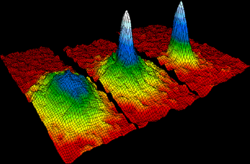
In 1995, the breakthrough occurred. Eric Cornell and Carl Wieman at the University of Colorado Boulder successfully created a condensate using rubidium atoms. Shortly thereafter, Wolfgang Ketterle at MIT achieved similar results using sodium atoms. These milestones proved that dilute gases of alkali atoms could be manipulated into this exotic state.
The Physics of Condensation
Critical Temperature
The transition to a Bose–Einstein condensate occurs at a specific critical temperature. This temperature depends on the particle density and the mass of the bosons. When the gas cools below this threshold, the particles begin to occupy the ground state in massive numbers.
The Ideal Bose Gas
In an ideal Bose gas, the state is described by an equation of state involving the thermal wavelength and fugacity. Because the occupation of the lowest state must be positive, a specific condition must be met regarding the density and temperature for condensation to occur.
Mathematical Modeling
To describe the behavior of weakly interacting gases, physicists use the Gross–Pitaevskii equation. This model helps predict the dynamics of the condensate, although it has certain weaknesses when dealing with strongly interacting systems.
Experimental Observations and Properties
Superfluidity and Vortices
One of the most striking properties of a BEC is superfluidity, where the fluid flows without viscosity. This leads to the creation of quantized vortices—tiny whirlpools of current. A singly charged vortex is considered the ground state, while multiply charged vortices possess higher energy levels.
Diverse Implementations
While alkali gases are the most common, BEC research has expanded into other areas:
- Superfluid Helium-4: An early example of condensation phenomena.
- Quasiparticles: Condensates can form from quasiparticles like exciton polaritons or magnons.
- Zero Gravity: Research conducted in Earth-orbiting labs (such as the Cold Atom Laboratory) allows for the study of BECs in microgravity.
- Solid State Physics: Applications and observations within crystalline structures.
| Feature | Description |
|---|---|
| Required Particles | Bosons (integer spin particles) |
| Temperature Range | Near Absolute Zero (0 K) |
| Primary Characteristic | Macroscopic occupation of the lowest quantum state |
| Key Physical Property | Superfluidity and wavefunction interference |
| Common Materials | Rubidium, Sodium, Hydrogen |
Frequently Asked Questions
What is a boson?
A boson is a type of subatomic particle that follows Bose-Einstein statistics, allowing multiple particles to occupy the same quantum state simultaneously, unlike fermions.
Why is absolute zero necessary for BEC?
Absolute zero is the point where thermal motion is minimized. This allows the particles to slow down enough that their wave-like nature overlaps, enabling them to merge into a single quantum state.
What is the difference between a BEC and a regular gas?
In a regular gas, atoms move independently and occupy various energy levels. In a BEC, the atoms act as a single coherent entity, exhibiting quantum properties on a scale visible to researchers.
What are quantized vortices?
Quantized vortices are topological defects in a superfluid BEC. They are essentially whirlpools where the circulation of the fluid is restricted to discrete, quantized values.
Can BECs exist in space?
Yes, BECs have been observed in Earth-orbiting research laboratories. Microgravity environments allow scientists to study the condensate for longer periods and under different conditions than on Earth.