Theory of Relativity
The theory of relativity consists of two groundbreaking physics theories developed by Albert Einstein: special relativity, published in 1905, and general relativity, published in 1915. Together, these theories transformed our understanding of the universe, superseding the 200-year-old laws of mechanics established by Isaac Newton.
While special relativity focuses on physical phenomena in the absence of gravity, general relativity explains the law of gravitation and its relationship to other forces of nature. These theories introduced revolutionary concepts such as 4-dimensional spacetime—a unified entity of space and time—and predicted extraordinary astronomical phenomena including black holes, neutron stars, and gravitational waves.
Key Facts
- Special Relativity (1905): Applies to observers in inertial frames of reference without gravity.
- General Relativity (1915): Describes gravity as the curvature of spacetime.
- Speed of Light: The absolute maximum speed for any physical object or information in a vacuum.
- Mass-Energy Equivalence: Expressed by the famous equation E = mc², showing mass and energy are interchangeable.
- Practical Use: Modern GPS systems must account for relativistic effects to maintain precision.
Development and Acceptance
Einstein did not work in isolation. Special relativity was built upon the empirical findings and theoretical work of scientists like Albert A. Michelson, Hendrik Lorentz, and Henri Poincaré, with further contributions from Max Planck and Hermann Minkowski. The term "theory of relativity" itself emerged around 1906, evolving from Planck's use of "relative theory" (Relativtheorie) to Alfred Bucherer's first use of Relativitätstheorie.
Special relativity was widely accepted by the 1920s, becoming an essential tool for the emerging fields of quantum mechanics, atomic physics, and nuclear physics. General relativity took longer to gain traction due to its complex mathematics and the astronomical scale of its predictions. It wasn't until around 1960 that it became central to physics, aided by new mathematical techniques and the discovery of quasars (1963), the 3-kelvin microwave background radiation (1965), and pulsars (1967).
Special Relativity
Special relativity is a theory regarding the structure of spacetime. It is based on two fundamental postulates that contradict classical mechanics: first, the laws of physics are identical for all observers in any inertial frame of reference (the principle of relativity); second, the speed of light in a vacuum is constant for all observers, regardless of the motion of the light source or the observer.
This framework replaces the Galilean transformations of classical mechanics with Lorentz transformations, leading to several counterintuitive consequences:
- Relativity of Simultaneity: Events that appear simultaneous to one observer may not be simultaneous to another moving relative to them.
- Time Dilation: Clocks in motion are measured to tick more slowly than stationary clocks.
- Length Contraction: Moving objects are measured to be shorter in the direction of their motion.
- Finite Maximum Speed: No object or signal can travel faster than the speed of light.
General Relativity
Developed between 1907 and 1915, general relativity is a theory of gravitation. It began with the equivalence principle, which posits that accelerated motion and being at rest in a gravitational field are physically identical. This implies that free fall is actually inertial motion—an object falls not because of a force, but because it is following the natural curvature of spacetime.
Working with mathematician Marcel Grossmann, Einstein utilized Riemannian geometry to formulate the theory. In 1915, he produced the Einstein field equations, which mathematically relate the curvature of spacetime to the mass, energy, and momentum within it. Key consequences include:
- Gravitational Time Dilation: Clocks run slower in stronger gravitational fields (deeper gravitational wells).
- Light Deflection: Light rays bend when passing through a gravitational field.
- Precession: Planetary orbits, such as that of Mercury, precess in ways that Newtonian gravity cannot explain.
Experimental Evidence
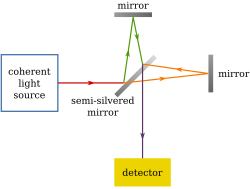
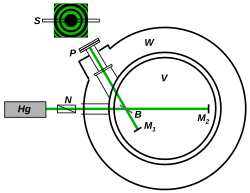
Relativity is a falsifiable theory, meaning its predictions can be tested. Special relativity was validated by three critical experiments: the Michelson–Morley experiment, the Kennedy–Thorndike experiment, and the Ives–Stilwell experiment.
The Michelson–Morley experiment (1881, 1887) attempted to detect the "aether wind" but returned a null result, suggesting that the speed of light is isotropic (independent of direction). The Kennedy–Thorndike experiment (1932) further concluded that the round-trip time for light is the same in all inertial reference frames. Finally, the Ives–Stilwell experiment (1938, 1941) confirmed the transverse Doppler effect, proving that the frequency of a moving atomic clock is altered as predicted.
General relativity has been confirmed through the observation of the perihelion precession of Mercury, the deflection of sunlight by the Sun, and the gravitational redshift of light, as well as evidence of frame dragging.
Modern Applications
Relativistic effects are not merely theoretical; they are critical for modern engineering. Satellite-based navigation systems, including GPS, GLONASS, and Galileo, must account for both special and general relativity to ensure precision. Because satellites move at high speeds and reside in a weaker gravitational field than users on Earth, their clocks tick differently. Without these corrections, the systems would fail. Additionally, high-precision instruments like particle accelerators and electron microscopes rely on relativistic calculations to function.
| Feature | Special Relativity | General Relativity |
|---|---|---|
| Published | 1905 | 1915 (Final form 1916) |
| Primary Focus | Spacetime structure (no gravity) | Gravitation and Cosmology |
| Key Concept | Constancy of light speed | Curvature of spacetime |
| Mathematical Basis | Lorentz transformations | Einstein field equations |
| Key Prediction | Time dilation / Length contraction | Black holes / Gravitational waves |
Frequently Asked Questions
What is the difference between special and general relativity?
Special relativity deals with the physics of objects moving at constant speeds in the absence of gravity, while general relativity explains gravity as the curvature of spacetime caused by mass and energy.
Why is the speed of light important in these theories?
The speed of light in a vacuum is a universal constant. In special relativity, it serves as the absolute speed limit for all matter and information, ensuring that the laws of physics remain consistent for all observers.
How does relativity affect my daily life?
The most common application is in GPS technology. Because satellites move quickly and are far from Earth's mass, their onboard clocks drift relative to clocks on the ground. Relativistic corrections are required to provide accurate location data.
What is the equivalence principle?
The equivalence principle is the foundation of general relativity; it states that the experience of being in an accelerated frame of reference is physically indistinguishable from being at rest in a gravitational field.
What is spacetime?
Spacetime is a four-dimensional mathematical model that fuses the three dimensions of space with the single dimension of time into a single, unified continuum.