Vultures: Nature's Essential Scavengers and Their Global Struggle
Vultures are specialized birds of prey that play a critical role in the environment by scavenging on carrion (dead animal flesh). With 23 extant species worldwide, these birds act as nature's cleanup crew, preventing the spread of disease by removing decaying organic matter from the landscape. While they are often viewed with apprehension, their biological adaptations and ecological contributions are indispensable to global health.
Key Facts
- Species Distribution: 16 species are native to Europe, Africa, and Asia (Old World), while 7 species are found in the Americas (New World).
- Biological Adaptation: Many species have bald heads to maintain hygiene while feeding and to assist in thermoregulation.
- Digestive Power: Vulture stomach acid is extremely corrosive (pH 1.0), allowing them to digest lethal toxins like anthrax and botulinum.
- Conservation Crisis: Many species are critically endangered due to poisoning, wind turbine collisions, and the drug diclofenac.
- Social Terms: A group in flight is a "kettle," a resting group is a "committee," and a feeding group is a "wake."
The Biology of Scavenging
Vultures possess unique physiological traits that allow them to survive on diets that would be fatal to other animals. Their highly acidic stomachs neutralize dangerous bacteria and viruses found in putrid carcasses. Beyond digestion, their physical appearance is a functional adaptation. The characteristic bald head prevents feathers from becoming soiled during feeding and helps the bird regulate its body temperature.
To manage heat and cold, vultures employ various behaviors. In cold weather, they hunch their bodies and tuck in their heads; in extreme heat, they stretch their necks and open their wings. Some species even urinate on their own legs, which provides evaporative cooling and uses uric acid to kill bacteria picked up while walking through carcasses.
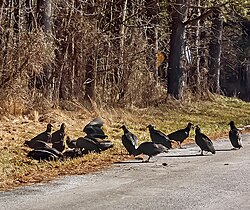
Taxonomy and Convergent Evolution
Although they look similar, Old World and New World vultures are not closely related. Their resemblance is a result of convergent evolution, where unrelated species independently evolve similar traits because they occupy similar ecological niches.
Old World Vultures
Found across Africa, Asia, and Europe, these birds belong to the family Accipitridae, making them relatives of eagles, hawks, and buzzards. These vultures rely primarily on their keen eyesight to locate carcasses from the air.
New World Vultures
Native to North and South America, these birds belong to the family Cathartidae. Unlike their Old World counterparts, several New World species possess an advanced sense of smell, allowing them to detect decaying animals from as far as a mile away.
| Feature | Old World Vultures | New World Vultures |
|---|---|---|
| Family | Accipitridae | Cathartidae |
| Distribution | Europe, Africa, Asia | North and South America |
| Primary Search Method | Sight | Smell (in several species) |
| Number of Species | 16 | 7 |
Feeding Behaviors and Intelligence
Vultures are opportunistic and highly observant. Recent research from 2020 indicates that they respond to auditory cues, such as the sounds of large mammals being killed or the noise made by other scavengers like hyenas. They also use the behavior of other birds as visual signals to find food.
New World vultures have a unique defense mechanism: they vomit when threatened. This is not a targeted attack, but rather a way to lighten their stomach load for a faster take-off, while the residue may distract a potential predator.
Conservation Challenges
Vulture populations are in a state of crisis across several continents. In South Asia, particularly India and Nepal, populations collapsed due to diclofenac, a veterinary drug that is toxic to vultures. This decline led to an increase in feral dog populations and disrupted traditional practices like the sky burials of the Parsees.
In Africa, threats include the illegal trade of vulture meat for the fetish market and accidental poisoning. A devastating example occurred in 2019 in northern Botswana, where 537 vultures died after consuming elephants poisoned by poachers. Poachers often use poison to kill vultures because their circling flight can alert rangers to a carcass.
As of a 2016 study, out of 22 species, nine are critically endangered and three are endangered. The loss of these birds increases the risk of disease transmission to humans by allowing pest populations and disease vectors to multiply unchecked.
Vultures in Culture and Myth
Vultures have held significant symbolic meaning in human history. In Ancient Egypt, the goddess Nekhbet was depicted as a vulture, symbolizing protection, purity, and motherhood. Because they transform death (carrion) into life, they were linked to the eternal cycle of rebirth. Royal wives often wore vulture crowns to invoke the protection of Nekhbet.
Frequently Asked Questions
Why do vultures have bald heads?
Bald heads are an adaptation for hygiene and temperature control. The lack of feathers prevents bacteria-laden carrion from sticking to the head and allows the birds to radiate heat to regulate their body temperature.
Do all vultures use smell to find food?
No. New World vultures are known for their advanced olfactory senses, but Old World vultures rely primarily on their vision to locate carcasses.
Why is the drug diclofenac dangerous to vultures?
Diclofenac is a veterinary drug that causes kidney failure in vultures. When they scavenge livestock treated with the drug, it leads to rapid population declines.
What happens to an ecosystem when vultures disappear?
Without vultures to remove carcasses, there is an increase in disease vectors and opportunistic scavengers, such as feral dogs, which can lead to higher rates of disease transmission and resource damage.
Why do New World vultures vomit when threatened?
They vomit to reduce their weight, making it easier to take off quickly and escape a predator. The vomited food may also serve as a distraction.