Golden Eagle: Biology, Distribution, and Ecology of a Premier Raptor
The golden eagle (Aquila chrysaetos) is one of the most formidable raptors in the world. A member of the Accipitridae family, this large bird of prey is renowned for its power, keen eyesight, and wide distribution across the Northern Hemisphere. From the rugged peaks of the Himalayas to the forests of North America, the golden eagle occupies a top position in the avian food chain.
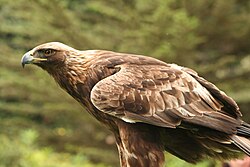
These eagles are characterized by their impressive size and a distinctive pale nape patch that contrasts with their generally brown plumage. Their presence in human culture is equally significant, having served as symbols of power for empires and as partners in the ancient art of falconry.
Key Facts
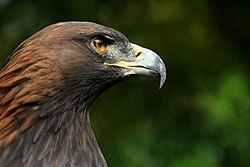
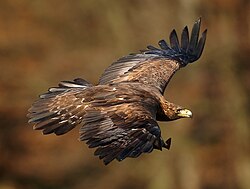
![Wintering eagle of the nominate subspecies in [[Finland]]](/images/b4/84/b4848404b7e15917347c6625936b7d7f2c51d774f6ebcf5411cb8ee71e6a9c6b.jpg)
- Scientific Name: Aquila chrysaetos
- Conservation Status: Least Concern (IUCN 3.1)
- Wingspan: Ranges from 1.8 to 2.34 meters (5 ft 11 in to 7 ft 8 in).
- Weight: Average males weigh 3.6 kg (7.9 lb) and females 5.1 kg (11 lb).
- Dietary Needs: Requires approximately 230 to 250 g of food daily.
- Distribution: Found across Eurasia and North America.
Taxonomy and Subspecies
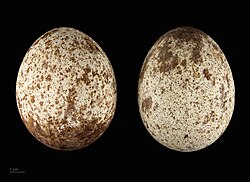
The golden eagle is divided into several subspecies, which vary primarily in size and coloration. These variations are often linked to the specific environments they inhabit.
Japanese Golden Eagle (A. c. japonica)
Found in northern Japan and parts of Korea, this is the smallest and darkest subspecies. Adults exhibit a slaty-grayish black color on the crown and back, with bright rufous (reddish-brown) nape feathers. Males average 2.5 kg (5.5 lb) and females 3.25 kg (7.2 lb).
Siberian/Kamchatkan Golden Eagle (A. c. kamtschatica)
Ranging from Western Siberia across Russia to the Kamchatka Peninsula, this subspecies is significantly larger than the Japanese variety, with wing lengths nearly equal to the largest subspecies, A. c. daphanea.
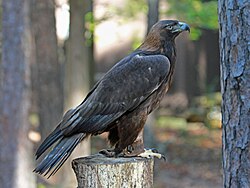
Physical Characteristics
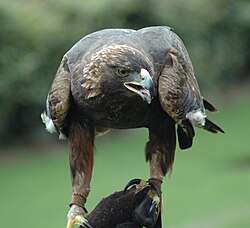
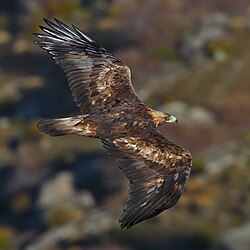
The golden eagle is a massive raptor, measuring between 66 and 102 centimeters (26 to 40 in) in length. It possesses the fifth largest wingspan of any living eagle species.
Sexual Dimorphism
Females are consistently larger than males, a trait known as sexual dimorphism. This difference is more pronounced in larger subspecies. For example, females of the Himalayan golden eagle are roughly 37% heavier and have 9% longer wings than their male counterparts.
Weight and Size Records
While average weights vary, the largest subspecies (A. c. daphanea) sees males at 4.05 kg and females at 6.35 kg. The heaviest wild golden eagle on record was a female in Wyoming, weighing 7.7 kg (17 lb). In contrast, captive birds bred for falconry can reach unnatural weights, with some recorded at 12.1 kg (27 lb).
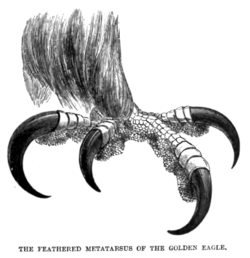
Habitat and Distribution

Golden eagles prefer rugged, mountainous terrain and open landscapes that allow for efficient hunting. Their range is vast, spanning across Eurasia and North America.
- Eurasia: They are found in the Alps, the Himalayas, and across Russia and Central Asia. In Spain, some populations are sedentary (non-migratory).
- North America: They are widely distributed, with significant populations in the Rocky Mountains and Alaska.

Feeding and Hunting Behavior
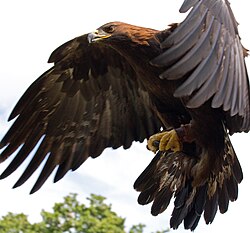
Golden eagles are opportunistic hunters that primarily operate during daylight hours, though some have been observed hunting shortly before sunrise and after sunset during breeding seasons.
Hunting Success and Diet
Research in Idaho indicates a hunting success rate of approximately 20%. While they require a daily average of 230 to 250 g of food, they experience cycles of "feast and famine." An eagle may go without food for a week and then consume up to 900 g (2.0 lb) in a single sitting.
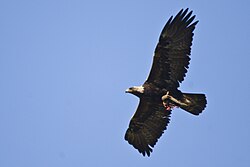
Life Cycle and Survival

The survival of golden eagles varies drastically depending on their age and environment. Juvenile eagles face the highest risks.
Survival Rates
In the western Rocky Mountains, 50% of nest-banded eagles die by age 2.5, and 75% die by age 5. In Denali National Park, juvenile survival rates in the first 11 months are estimated between 19% and 34%. Conversely, breeding adults in California show a higher survival rate of approximately 91%.
Longevity
Life expectancy varies by region; for instance, the average life expectancy in Germany is estimated at 13 years.
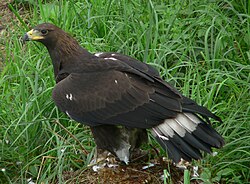
Summary of Subspecies and Physicals
| Subspecies | Common Name | Avg. Male Weight | Avg. Female Weight | Key Characteristic |
|---|---|---|---|---|
| A. c. japonica | Japanese Golden Eagle | 2.5 kg | 3.25 kg | Smallest and darkest plumage |
| A. c. daphanea | (Large Subspecies) | 4.05 kg | 6.35 kg | Among the heaviest in the genus |
| A. c. chrysaetos | Nominate Subspecies | ~3.6 kg (Species Avg) | ~5.1 kg (Species Avg) | Standard brown plumage |
Frequently Asked Questions



How do golden eagles differ from other eagle species?
Golden eagles are readily distinguished by their brown plumage, which is generally paler than other Aquila species, and a characteristic pale patch on the nape of the neck.
Are female golden eagles larger than males?
Yes, females are larger and heavier than males. In some subspecies, females can be up to 37% heavier and have significantly longer wings.
What is the diet of a golden eagle?
They are carnivorous raptors that hunt various prey. While they need about 230-250g of food daily, they are capable of gorging on up to 900g of meat after periods of fasting.
What is the survival rate for young golden eagles?
Survival rates for juveniles are quite low. In some regions, such as the Rocky Mountains, up to 75% of juveniles may die before reaching five years of age.
Where are golden eagles typically found?
They inhabit rugged, mountainous, and open areas across North America and Eurasia, including the Alps, the Himalayas, and the Rocky Mountains.