Black-chested Buzzard-Eagle
The black-chested buzzard-eagle (Geranoaetus melanoleucus) is a formidable bird of prey belonging to the family Accipitridae. Found across the open regions of South America, this species is known by several names, including the black buzzard-eagle, gray buzzard-eagle, and the Chilean blue eagle. While it possesses the imposing stature of an eagle, it is technically part of the buteonine lineage—a group of hawks—making it one of the largest extant representatives of its kind.
Key Facts
- Scientific Name: Geranoaetus melanoleucus
- Conservation Status: Least Concern (IUCN 3.1)
- Wingspan: 149 to 200 cm (4 ft 11 in to 6 ft 7 in)
- Primary Habitat: Mountainous or hilly terrain with sparse vegetation
- Diet: Primarily mid-sized mammals, including European rabbits and degus
- Distribution: South America, ranging from Venezuela to Argentina
Taxonomy and Systematics
The scientific name Geranoaetus is derived from the Ancient Greek words géranos (crane) and aetós (eagle), a reference to the bird's loud cries and grey upper wings. The specific epithet melanoleucus means "black-and-white," describing the contrasting colors visible from below.
The classification of this species has a complex history. Originally described by Louis Pierre Vieillot in 1819, it was initially placed in the genus Spizaetus. For a period in the mid-20th century, the name Buteo fuscescens was commonly used because Vieillot had mistaken the differently colored immature birds for a separate species. Today, while some authors include it in the genus Buteo, others place it in the monotypic genus Geranoaetus.
Because of its lineage, the black-chested buzzard-eagle is not considered a "true eagle" (such as those in the genus Aquila). Instead, it is closely allied with Buteo hawks, potentially sharing a close relationship with the red-backed and Puna hawks.
Physical Description
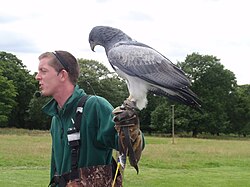
This raptor is characterized by a bulky, powerful build. It measures between 62 and 76 cm in length, with a wingspan reaching up to 200 cm. Adults feature dark grey upperparts with a blackish or bluish hue and a white underside. A distinctive ash-grey-and-white zone on the wings is often visible from a distance. Females are generally larger than males and exhibit a reddish-cinnamon tint on the secondaries of their wings.
One of the most identifying features of the bird is its short, wedge-shaped black tail. When perched, the long, broad wings cover the tail almost entirely, giving the bird a unique, nearly tailless appearance in flight.
Immature Plumage
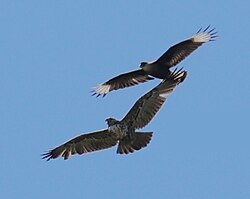
Juvenile birds look significantly different from adults, resembling the great black hawk. Their upperparts are deep brown or nearly black, lacking the light wing patches of adults. The underside is white or light buff with heavy dark streaks on the breast and bars on the belly. It typically takes 4 to 5 years for a bird to acquire full adult plumage.
Habitat and Distribution
The black-chested buzzard-eagle prefers hilly or mountainous terrain with sparse vegetation, shrublands, or Nothofagus forests. It is most commonly found at altitudes between 5,000 and 15,000 feet (1,500 to 4,600 m) above sea level, rarely descending into lowlands. It relies on large territories and frequently uses thermals—rising columns of warm air—to soar while searching for prey.
The species is divided into two recognized subspecies:
| Subspecies | Description | Distribution |
|---|---|---|
| Eastern (G. m. melanoleucus) | Larger; plain white underside | SE South America (Brazil, Paraguay, Uruguay, NE Argentina) |
| Western (G. m. australis) | Smaller; white with fine dark barring below | Andes (from NW Venezuela through the mountain range) |
Behavior and Ecology
As a top predator in its range, the black-chested buzzard-eagle feeds primarily on mid-sized mammals. In many regions, the introduced European rabbit has become a key prey item, making the eagle a beneficial ally to farmers. Other common prey include common degus, viscachas, and various caviid rodents. Occasionally, it hunts carnivores such as gray foxes and skunks, or birds like the burrowing owl and Chilean tinamou.
Reproduction
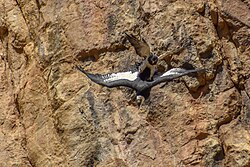
Nesting occurs in high trees, rocky cliffs, or even cacti. If these are unavailable, the birds may nest in bushes or on the ground. The nest is a massive structure of sticks, roughly 85 cm in diameter. Pairs bond through prolonged courtship flights over several weeks. A typical clutch consists of two eggs, though one or three may be laid, with an incubation period of approximately one month.
Conservation Status
The IUCN classifies the black-chested buzzard-eagle as Least Concern due to its wide distribution. Interestingly, some deforestation has actually benefited the species by creating more of the open habitat it prefers. However, populations have declined in parts of Argentina due to the use of strychnine baits by sheep farmers.
Frequently Asked Questions
Is the black-chested buzzard-eagle a true eagle?
No. Despite its size and appearance, it belongs to the buteonine lineage of hawks rather than the "true eagle" groups like Aquila.
How can you identify this bird in flight?
It is most easily identified by its long, broad wings and a very short, wedge-shaped tail that barely protrudes from beneath the wings.
What do black-chested buzzard-eagles eat?
Their diet consists mainly of mid-sized mammals, such as rabbits and degus, but they also eat other rodents, small carnivores, birds, and occasionally carrion.
Where is this species found?
It is native to South America, inhabiting open, mountainous, or hilly regions from Venezuela in the north down to Argentina in the south.
How long does it take for a juvenile to reach adult plumage?
Juveniles typically do not acquire their full adult coloration until they are 4 to 5 years old.