Unrestricted Submarine Warfare: History, Law, and Global Impact
Unrestricted submarine warfare is a naval strategy in which submarines sink merchant vessels—such as tankers and freighters—without providing any prior warning. Unlike traditional naval engagements, this approach removes the opportunity for the target ship to defend itself or for the crew to evacuate safely. Throughout the 20th century, the implementation of this strategy, primarily driven by German naval decision-making, fundamentally altered international relations and shifted the course of two World Wars.
Key Facts
- Definition: Sinking merchant ships without warning, bypassing traditional "cruiser rules."
- Primary Driver: Historically dominated by the Imperial German Navy and later Nazi Germany.
- Legal Conflict: Contradicts the 1899 Hague Convention and customary prize rules.
- Major Catalyst: The sinking of the RMS Lusitania helped draw the United States into World War I.
- Strategic Goal: To impose a naval blockade and starve an enemy population into surrender.
- Most Successful Campaign: The U.S. submarine effort in the Pacific during WWII, which decimated the Japanese merchant fleet.
The Legal Framework of Naval Warfare
Before the rise of the submarine, customary naval law followed cruiser rules (or prize rules). These regulations stipulated that while warships could be attacked freely, civilian or neutral ships could only be interfered with if they were carrying contraband. Crucially, the lives of the crew had to be protected before a ship was sunk. These formal limitations were further codified in the 1899 Hague Convention.
Submarines initially operated by attacking on the surface using deck guns. However, attacking while submerged provided a tactical advantage, as it prevented the target from escaping or fighting back. This shift in technology created a direct conflict with established maritime law.
Unrestricted Warfare in World War I
At the start of World War I, the Imperial German Navy faced internal criticism for its inactivity. To rectify this, Admiral Tirpitz and Admiral von Pohl proposed using U-boats as "miracle weapons." They believed a "shock effect" from unrestricted attacks could force Britain into a conciliatory mood within six weeks.
Chancellor Bethmann Hollweg accepted this strategy on February 1, 1915. While the campaign officially targeted Allied vessels, the German Admiralty encouraged commanders to minimize target identification, viewing the "accidental" sinking of neutral ships as a useful deterrent.
![Editorial cartoon by T. E. Powers from February 1915, the cartoon portrays a stylized RMS Lusitania as a perpetrator of flying the flag of the United States (despite the steamer being British) and not her true colors, which is a violation of the Hauge Convention and maritime law.[a] The Lusitania later became a victim of unrestricted submarine warfare three months after the cartoon was published when German submarine SM U-20 sank her. The incident sparked international outrage because of the killing of many civilians, and it would become one of the most harrowing examples of the horrors of unrestricted submarine warfare in history.](/images/99/18/991856745dc58e949aad0a6e557339110b32badcad0f50c0bbd8470b08427e13.jpg)
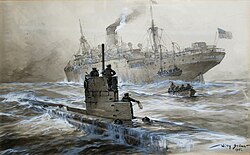
The most infamous incident occurred in May 1915, when the U-boat U-20 sank the RMS Lusitania, killing over a hundred American passengers. The resulting international outrage forced Germany to temporarily suspend unrestricted warfare and exclude passenger vessels from targets after the sinking of the Arabic in August 1915.
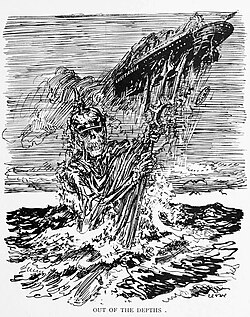
By early 1917, Admiral Henning von Holtzendorff successfully argued for the resumption of unrestricted attacks to starve Britain into surrender. The German high command calculated that the United States would be too slow to mobilize to prevent a German victory on the Western Front. This calculation proved fatal; the decision became a primary trigger for the United States to enter the war on the side of the British.
Interwar Efforts and the Path to World War II
Following World War I, global powers attempted to ban submarine attacks on merchant ships. The 1922 Washington Treaty on Poison Gas and Submarines sought to make submarines useless as commerce raiders, though France's failure to ratify it prevented it from taking effect. Later, the 1936 London Protocol on Submarine Warfare mandated that attacks follow prize rules, requiring crews to be placed in a "place of safety."
These treaties were often impractical. Small submarines lacked the space to take on large crews from merchant ships, and there was significant disagreement over whether emergency boats constituted a "place of safety." Additionally, Britain's desire to arm its merchant ships blurred the line between civilian and military vessels.
Despite 48 states accepting these prohibitions, they were rapidly abandoned at the onset of World War II. Germany implemented War Order No. 154, and the United States adopted unrestricted warfare in the Pacific theater.
Major Campaigns of Unrestricted Warfare
Throughout the two World Wars, four primary campaigns of unrestricted submarine warfare were waged:
- WWI U-boat Campaign (1915–1918): Germany's intermittent attacks against Britain and allies.
- The Battle of the Atlantic (1939–1945): A massive struggle between Nazi Germany, Fascist Italy, and the Allies.
- The Baltic Sea Campaigns (1941–1945): Nazi Germany's operations against the Allies in the Baltic region.
- The Pacific War (1941–1945): The conflict between the Allies and the Japanese Empire.
While Germany's efforts were significant, the U.S. submarine campaign in the Pacific was the most successful in terms of tonnage, reducing the Japanese merchant fleet to less than 25% of its original size.
| Campaign | Period | Primary Combatants | Key Outcome/Impact |
|---|---|---|---|
| WWI U-boat Campaign | 1915–1918 | Germany vs. Britain & Allies | Triggered U.S. entry into WWI |
| Battle of the Atlantic | 1939–1945 | Germany/Italy vs. Allies | Critical struggle for Atlantic supply lines |
| Baltic Sea Campaigns | 1941–1945 | Germany vs. Allies | Regional blockade in the Baltic Sea |
| Pacific War | 1941–1945 | USA/Allies vs. Japan | Devastated Japanese merchant fleet |
Frequently Asked Questions
What are "cruiser rules" in naval warfare?
Cruiser rules are customary laws requiring warships to stop and search merchant vessels and ensure the safety of the crew before sinking the ship, especially if the vessel is neutral or civilian.
Why did Germany use unrestricted submarine warfare?
Germany aimed to create a "shock effect" and impose a naval blockade to starve Britain and its allies into surrender, believing that the speed of the impact would outweigh the diplomatic risks.
How did the sinking of the Lusitania affect the war?
The sinking caused massive international outrage due to the death of many civilians, including Americans, which pressured the United States to move away from neutrality and eventually join World War I.
Why were interwar treaties like the London Protocol ineffective?
The treaties were often too vague and impractical. Submarines lacked the space to rescue crews, and the definition of a "merchant ship" became blurred when nations began arming their civilian vessels.
Which nation had the most successful unrestricted submarine campaign?
The United States had the most successful campaign during the Pacific War, utilizing submarines and mines to reduce the Japanese merchant fleet to less than a quarter of its initial tonnage.