Manifesto of the Ninety-Three: Germany's Intellectual Defense in WWI
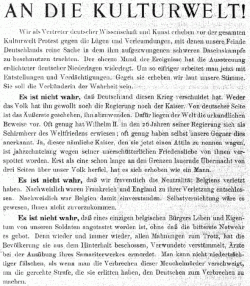
On October 4, 1914, a group of 93 prominent German scholars, artists, and scientists issued a proclamation titled "To the Civilized World" (An die Kulturwelt!), better known as the Manifesto of the Ninety-Three. This document served as a formal defense of Germany's actions at the onset of World War I, aiming to mobilize domestic support and counter negative international perceptions of the German Empire.
The manifesto was a strategic attempt to leverage the global prestige of German academia. By presenting a united front of the nation's most respected minds, the signatories hoped to convince the world—and the intellectuals of the Entente powers—that Germany was a victim of circumstance rather than an aggressor.
Key Facts
- Date: Published October 4, 1914.
- Signatories: 93 prominent Germans, including multiple Nobel laureates.
- Primary Goal: To contradict negative press (especially British) and justify German military actions.
- Outcome: Failed to sway international opinion; caused outrage among foreign intellectuals.
- Aftermath: By 1921, a majority of surviving signatories expressed regret.
Purpose and International Reaction
The manifesto was published in ten different languages to ensure a global reach. Its primary objective was to combat the "lies and calumnies" the authors believed were being spread by foreign governments and academic institutions. The authors sought to portray Germany as a civilized nation forced into a struggle for existence.
Beyond public relations, the document was designed to undermine the morale of the Entente powers. The signatories believed that by demonstrating the full support of world-renowned scientists, they could induce intellectuals in other countries to pressure their own governments for peace or concessions. However, this strategy backfired; the European and American press, along with global academic institutions, largely viewed the effort as a failure.
Core Arguments of the Manifesto
The text of the manifesto focused on several key denials and justifications regarding the early stages of the war:
- War Responsibility: It claimed that neither the German people, the Government, nor Kaiser Wilhelm II wanted the war, asserting that Germany had tried to prevent the conflict.
- Belgium: It denied that Germany trespassed in neutral Belgium without cause, claiming that France and England had planned similar incursions and that Belgian citizens had ambushed German troops.
- The Destruction of Louvain: The authors argued that the firing of parts of the town of Louvain was a necessary punishment for treacherous attacks by inhabitants, while claiming the Town Hall was saved through German sacrifice.
- International Law: It denied that German warfare ignored international laws, instead accusing Russian troops of butchering women and children in the east.
- Militarism: It defended German militarism as a necessary shield that protected German civilization from being extirpated.
Dissent and the Counter-Manifesto
Not all German intellectuals agreed with the proclamation. The composer Richard Strauss famously refused to sign, stating that declarations regarding war and politics were not fitting for an artist.
More significantly, astronomer Wilhelm Julius Foerster soon regretted his signature. Alongside physiologist Georg Friedrich Nicolai, he drafted the "Manifesto to the Europeans." This counter-document argued that educated men of all nations should ensure that the terms of peace would not become the source of future wars, suggesting that Europe should be transformed into an "organic whole."
Despite its noble intent, the counter-manifesto gained little traction. Only philosopher Otto Buek and physicist Albert Einstein signed it. The document remained unpublished at the time and was only brought to light later by Einstein.
Legacy and Regret
As the war concluded and the political landscape shifted, the prestige of the manifesto faded. A 1921 report by The New York Times revealed the lasting psychological toll of the document: of the 76 surviving signatories, 60 expressed varying degrees of regret. Some signatories even claimed they had not seen the final text of what they had signed.
| Category | Details |
|---|---|
| Original Title | To the Civilized World (An die Kulturwelt!) |
| Key Signatories | Max Planck, Wilhelm Röntgen, Fritz Haber, Ernst Haeckel |
| Main Targets | British press, Entente governments, foreign scholars |
| Counter-Movement | Manifesto to the Europeans (signed by Einstein) |
| Long-term Result | Widespread regret among signatories by 1921 |
Notable Signatories
The list of 93 included a wide array of disciplines, from theologians to Nobel laureates. Some of the most prominent figures included:
- Max Planck: Theoretical physicist and originator of quantum theory.
- Wilhelm Röntgen: Physicist known for the discovery of X-rays.
- Fritz Haber: Chemist who synthesized ammonia.
- Ernst Haeckel: Biologist who coined the term "ecology."
- Wilhelm Wundt: Physician and the "father of experimental psychology."
- Philipp Lenard: Physicist recognized for cathode rays research.
Frequently Asked Questions
What was the primary goal of the Manifesto of the Ninety-Three?
The primary goal was to defend Germany's honor against international criticism, specifically targeting the British press, and to justify Germany's military actions at the start of World War I as a necessary struggle for existence.
Did all German intellectuals support the manifesto?
No. Richard Strauss refused to sign on artistic grounds, and others, such as Wilhelm Julius Foerster, later repented and created a counter-manifesto supported by Albert Einstein.
How did the international community react to the proclamation?
The reaction was largely negative. Rather than swaying opinion, the manifesto outraged foreign intellectuals and was viewed as a failure by the European and American press.
What happened to the signatories after the war?
Many felt remorse. A 1921 New York Times report indicated that 60 out of 76 surviving signatories expressed some level of regret for having signed the document.
Who were some of the most famous scientists to sign the document?
The list included world-renowned figures such as Max Planck (quantum theory), Wilhelm Röntgen (X-rays), and Fritz Haber (ammonia synthesis).