Tübingen: Germany's Vibrant University City
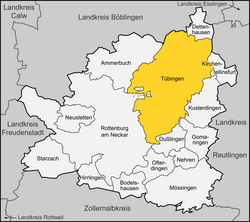
Nestled in the heart of Baden-Württemberg, Tübingen (known in Swabian as Dibenga) is a quintessential university town that blends medieval charm with a youthful, intellectual energy. Located just 30 kilometers south of Stuttgart, this city is defined by its relationship with the Neckar River and its prestigious academic heritage. With students making up nearly one-third of its 92,322 residents, Tübingen boasts one of the youngest demographics in Germany, with an average age of just under 40.
The city's geography is varied, ranging from the low-lying Neckar valley at 305 meters to the heights of the Schönbuch forest near Bebenhausen, which reaches 500 meters. Interestingly, the geographical center of the state of Baden-Württemberg is located within the city, in a small forest called Elysium near the university's Botanical Gardens.
Key Facts
- Population: 92,322 (as of December 31, 2024).
- Youthful Profile: Nearly 33% of the population are students.
- Environmental Leadership: Aiming for climate neutrality by 2030 and the first German city to tax disposable food packaging.
- Academic Hub: Home to a world-renowned university with alumni including Nobel laureates and global leaders.
- Geography: Situated in the Neckar valley in central Baden-Württemberg.
A Journey Through History
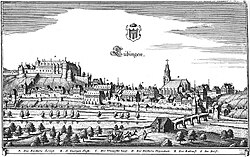
Tübingen's roots stretch back to the 12th century when the Counts of Zollern, serving as Imperial Counts Palatine, established their seat here. By 1231, the town was recognized as a civitas, a status that granted it civil liberties, a market, and its own court system. The 13th century saw the arrival of Franciscan and Augustinian monasteries, as well as a Latin school, which evolved into today's Uhland-Gymnasium. In 1342, the town and its castle transitioned to the Counts of Württemberg.
While a fire destroyed parts of the old town in 1789, the area was meticulously rebuilt in its original style, preserving the historic atmosphere visitors enjoy today. The city also became a center for media in 1798 with the founding of the Allgemeine Zeitung by Johann Friedrich Cotta. A quirky local landmark at the Cottahaus commemorates a visit by the poet Goethe with the sign "Hier kotzte Goethe" ("Goethe puked here").
In the modern era, Tübingen became a focal point for the 1968 German student movement, where activists protested the perceived continuities between the Federal Republic and the Nazi regime. This political legacy persists today; the Green Party has been the largest force in the local council since 2004, commanding over a third of the vote in the 2024 elections.
City Highlights and Culture
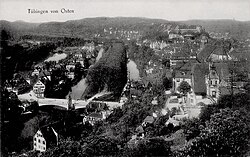
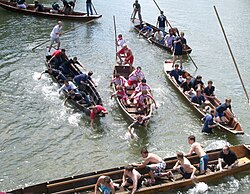
Tübingen is renowned for its picturesque architecture and unique traditions. The Stocherkahn (punting boats) are a symbol of the city, used for leisurely trips and competitive races on the Neckar. The city's skyline is dominated by the St. George's Collegiate Church and the imposing Castle Hohentübingen.
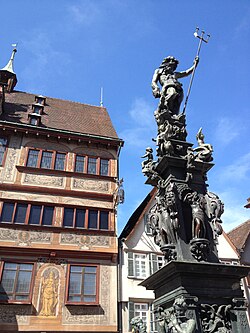
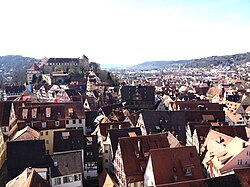
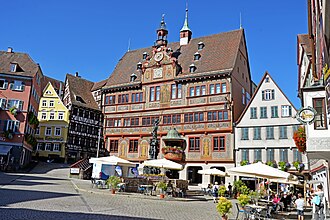
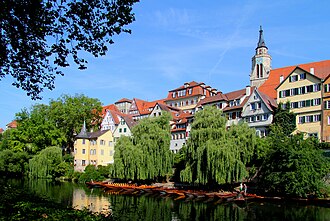
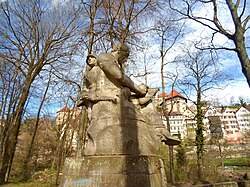
The city also acknowledges its darker history through memorials, such as the Nazi-era memorial featuring soldiers emerging from behind composer Friedrich Silcher.
Annual Events and Festivals
Tübingen's calendar is packed with cultural events throughout the year:
- June: The Stocherkahnrennen (poled boat race) and the Ract!festival.
- July: The Stadtfest, featuring gastronomy and performances in the old town.
- August: Organ concerts at St. George's Collegiate Church and summer concerts at Bebenhausen monastery.
- September: The Umbrisch-Provenzalischer Market and the Retromotor oldtimer festival.
- October: Jazz and Classic days, and the Drachenfest (kite festival) on Österberg hill.
- December: The Christmas market and the chocolART festival.
Governance and Infrastructure
Under the leadership of Lord Mayor Boris Palmer, Tübingen has positioned itself as a pioneer in sustainability. The city council has mandated a goal of becoming climate-neutral by 2030. To combat waste, Tübingen became the first city in Germany to implement a tax on disposable food packaging, charging restaurants for disposable cups, bowls, and cutlery.
The city is organized into 22 districts. The core city consists of 12 districts (including the Zentrum, Universität, and Französisches Viertel) with a population of about 51,000, while 10 outer districts (such as Bebenhausen and Pfrondorf) house approximately 31,000 residents.
Academic Excellence and Notable Figures
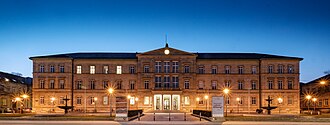
The University of Tübingen is the city's intellectual heart. Its alumni list reads like a directory of global achievement, including astronomer Johannes Kepler, Nobel Prize winner in Physics Ferdinand Braun, and Nobel Peace Prize laureate Albert Schweitzer. In the field of medicine, the university is linked to Alois Alzheimer and Nobel laureate Christiane Nüsslein-Volhard. Even Pope Benedict XVI held a chair of dogmatic theology here from 1966 to 1969.
Beyond the university, the city has been home to influential poets like Ludwig Uhland and composers like Friedrich Silcher.
| Category | Detail |
|---|---|
| State | Baden-Württemberg, Germany |
| Population (2024) | 92,322 |
| Area | 108.12 km² |
| Average Elevation | 341 m |
| Key Industry | Higher Education & Research |
| Climate Goal | Climate-neutral by 2030 |
Frequently Asked Questions
What is a Stocherkahn?
A Stocherkahn is a traditional flat-bottomed punting boat used on the Neckar River in Tübingen. They are used for tourism, music concerts, and an annual race held on the second Thursday of June.
Why is Tübingen considered a "young" city?
Tübingen is a major university hub where students account for nearly one in three residents, bringing the average age of the population down to just under 40 years.
What makes Tübingen's environmental policy unique?
Tübingen was the first city in Germany to introduce a tax on disposable food packaging to reduce waste, and it has set a target to be completely climate-neutral by 2030.
Who are some of the most famous people associated with Tübingen?
The city is associated with a vast array of intellectuals, including astronomer Johannes Kepler, humanitarian Albert Schweitzer, and Pope Benedict XVI, all of whom have ties to the university.
What are the best times to visit for festivals?
June is excellent for the boat races and Ract!festival, July for the Stadtfest, and December for the traditional Christmas market and chocolART festival.