Triads in Music: Construction, Types, and Harmonic Function
In the world of music theory, a triad is a set of three notes, or pitch classes, that can be stacked vertically in thirds. As the most common chords in Western music, triads serve as the fundamental building blocks of harmony, providing the structural foundation for everything from Baroque masterpieces to modern pop hits.
When notes are stacked in thirds, they create a specific vertical structure. Regardless of the order in which the notes are played (known as inversion), every triad consists of three specific members: the root (the foundation pitch), the third (the note above the root), and the fifth (the note above the third). The interval between the root and the third can be a minor third (three semitones) or a major third (four semitones). Similarly, the interval between the third and the fifth can be a minor or major third, resulting in a fifth that is diminished (six semitones), perfect (seven semitones), or augmented (eight semitones).
While most theorists define triads as tertian triads (stacked in thirds), some 20th-century theorists like Howard Hanson, Carlton Gamer, and Joseph Schillinger expanded the definition to include any combination of three different pitches, regardless of the intervals. In broader musicology, this general concept is often referred to as a trichord.
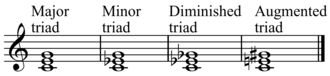
Key Facts
- Definition: A triad is a three-note chord typically built in thirds.
- Core Components: Every triad consists of a root, a third, and a fifth.
- Common Qualities: The four primary types are major, minor, diminished, and augmented.
- Stability: Major and minor triads are generally considered consonant (stable), while diminished and augmented triads are considered dissonant (unstable).
- Tonal Keys: Only major and minor triads can serve as the tonic (the home key) of a piece of music.
The History of the Triad
The role of the triad evolved significantly during the late Renaissance and the Baroque era (1600–1750). During this time, Western art music shifted from a "horizontal" contrapuntal approach—where multiple independent melody lines are interwoven—toward a "vertical" approach based on progressions (sequences of triads).
This vertical shift became the basis for the basso continuo accompaniment used throughout the Baroque period. The theoretical primacy of the triad was first proposed by Gioseffo Zarlino in the 1500s, and the specific term "harmonic triad" was later coined by Johannes Lippius in 1612.
Construction and Qualities
Triads are constructed by superimposing every other note of a diatonic scale. For example, a C major triad is formed using the notes C, E, and G, skipping the D and F. The specific combination of intervals determines the triad's quality.
Types of Triads
- Major Triad: Consists of a major third and a perfect fifth (R 3 5). It can also be viewed as a major third with a minor third stacked on top.
- Minor Triad: Consists of a minor third and a perfect fifth (R ♭3 5). It can also be viewed as a minor third with a major third stacked on top.
- Diminished Triad: Consists of a minor third and a diminished fifth (R ♭3 ♭5). It is formed by stacking two minor thirds.
- Augmented Triad: Consists of a major third and an augmented fifth (R 3 ♯5). It is formed by stacking two major thirds.
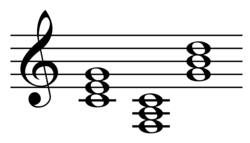
Triads can be played in two different spacings: close position, where the three upper voices are as close together as possible, or open position, where the notes are spread further apart.
| Triad Type | Intervals (from Root) | Semitone Pattern | Stability |
|---|---|---|---|
| Major | Major 3rd, Perfect 5th | 0-4-7 | Consonant |
| Minor | Minor 3rd, Perfect 5th | 0-3-7 | Consonant |
| Diminished | Minor 3rd, Diminished 5th | 0-3-6 | Dissonant |
| Augmented | Major 3rd, Augmented 5th | 0-4-8 | Dissonant |
Harmonic Function
In a diatonic key, the function of a triad is primarily determined by its root and its corresponding scale degree. Functional harmony relies heavily on primary triads, which express their role clearly and unambiguously:
- Tonic (I): Built on the first degree of the scale.
- Subdominant (IV): Built on the fourth degree of the scale.
- Dominant (V): Built on the fifth degree of the scale.
Other triads serve as auxiliary or supportive elements. These include the supertonic (ii), mediant (iii), submediant (vi), and leading-tone (vii) triads, built on the second, third, sixth, and seventh degrees of the scale, respectively.
Frequently Asked Questions
What is the difference between a triad and a trichord?
In traditional music theory, a triad specifically refers to a chord stacked in thirds (a tertian triad). A trichord is a more general term used by some theorists to describe any combination of three different pitches, regardless of the intervals between them.
Can a song be in the key of a diminished triad?
No. In standard tonal music, only major and minor triads can function as the tonic (the home key). While diminished or augmented triads may appear within a progression as temporary or passing chords, they cannot serve as the key of the piece.
What happens to the root of a triad during an inversion?
The root remains the same regardless of the inversion. Even if the third or the fifth is played as the lowest note, the root continues to be the foundational pitch that defines the chord's identity.
Which triads are considered stable in popular music?
Major and minor triads are generally considered consonant and stable. In contrast, diminished and augmented triads are viewed as dissonant and unstable, often creating tension that needs to resolve to a stable chord.