Major Scale: Theory, Structure, and Harmonic Applications
The major scale is a fundamental sequence of musical notes that forms the backbone of Western music, particularly within popular music and the common practice period. Defined by its bright and stable sound, a major scale is a diatonic scale—a seven-note scale—that contains a major triad on its tonic, or starting note.
While the term often refers specifically to the natural major scale (also known as the Ionian mode), the broader category of major scales includes variations such as the harmonic and melodic major scales, as well as the Lydian and Mixolydian modes.
Key Facts
- Structure: Comprised of 7 unique pitch classes; the 8th note is an octave (double the frequency) of the first.
- Interval Pattern: Whole, Whole, Half, Whole, Whole, Whole, Half.
- Prototypical Example: C Major (C–D–E–F–G–A–B), which uses only white keys on a piano.
- Global Names: Known as Sankarabharanam in Carnatic music and Bilaval in Hindustani classical music.
- Mathematical Basis: In equal temperament, a whole tone is twice the frequency ratio of a semitone.
The Natural Major Scale
The natural major scale is the most common iteration of the major scale. The simplest example is C major, as it is the only major scale that does not require sharps or flats. On a piano, this scale is played using only the white keys.
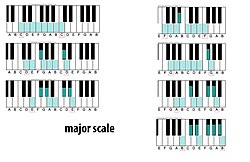
The internal structure of the scale is defined by a specific sequence of intervals: whole steps (whole tones) and half steps (semitones). The precise pattern is: whole, whole, half, whole, whole, whole, half.

From a structural perspective, a major scale can be viewed as two identical tetrachords (four-note sequences) separated by a whole tone. Each tetrachord follows the pattern: whole, whole, half. Mathematically, the sound frequency doubles between octaves. For example, the ratio for a perfect fifth (C to G) is 3/2 (1.5), while a major third (C to E) is 5/4 (1.25).
Scale Degrees and Harmony
Each note within the scale is assigned a specific name based on its position, known as the scale degree. These degrees determine the harmonic function of the note within a piece of music.
Naming the Scale Degrees
- Tonic (1st and 8th)
- Supertonic (2nd)
- Mediant (3rd)
- Subdominant (4th)
- Dominant (5th)
- Submediant (6th)
- Leading tone (7th)
Triads and Seventh Chords
Building chords on each scale degree creates a predictable pattern of harmony. These are often identified using Roman numeral analysis.
| Degree | Triad Quality | Roman Numeral | Seventh Chord Quality |
|---|---|---|---|
| 1st | Major | I | Major seventh (IM) |
| 2nd | Minor | ii | Minor seventh (ii) |
| 3rd | Minor | iii | Minor seventh (iii) |
| 4th | Major | IV | Major seventh (IVM) |
| 5th | Major | V | Dominant seventh (V) |
| 6th | Minor | vi | Minor seventh (vi) |
| 7th | Diminished | vii° | Half-diminished seventh (vii) |
Relationship to Major Keys
When a piece of music is written in a major key, the notes of the corresponding major scale are called diatonic notes. Any notes outside this scale are referred to as chromatic notes. The key signature of the piece indicates which sharps or flats are used to maintain the major scale's interval pattern.
For example, in E♭ major, the diatonic pitches are E♭, F, G, A♭, B♭, C, and D. The key signature for this key contains three flats (B♭, E♭, and A♭). The relationship between these keys is often visualized using the circle of fifths, which arranges the 12 relative major and minor keys based on their number of sharps or flats.
Variations of the Major Scale
Beyond the natural major scale, other variations exist to provide different emotional colors or melodic directions:
- Harmonic Major Scale: Features a minor sixth.
- Melodic Major Scale: Ascends as the Ionian mode and descends as the Aeolian dominant.
- Double Harmonic Major Scale: Contains both a minor second and a minor sixth; it is the fifth mode of the Hungarian minor scale.
- Other Major Modes: The Lydian and Mixolydian modes are also diatonic modes with a major tonic triad.
Frequently Asked Questions
What is the difference between a whole step and a half step?
A half step, or semitone, is the smallest interval between two notes in Western music. A whole step, or whole tone, consists of two semitones.
Why is C major considered the simplest major scale?
C major is the only major scale that consists entirely of natural notes, meaning it requires no sharps (#) or flats (♭) to maintain its structure.
What is a tetrachord in the context of a major scale?
A tetrachord is a series of four notes. A major scale is constructed from two identical tetrachords (whole, whole, half) separated by a whole tone.
What is the difference between a diatonic note and a chromatic note?
Diatonic notes are the seven notes that naturally belong to the specific key or scale being used. Chromatic notes are any pitches that fall outside of that specific scale.
How is a major scale abbreviated in musical notation?
Major keys are typically abbreviated using an uppercase letter for the tonic note (e.g., 'C' for C major), whereas minor keys often use a lowercase letter (e.g., 'a' for A minor).