Musical Modes: From Ancient Greece to Modern Theory
In the study of music theory, a mode (or modus) is a versatile term that describes the partitioning of an octave into a specific modal framework. Depending on the historical context, a mode can refer to a specific scale, a melodic formula, or a comprehensive system of tonal relationships. From the philosophical inquiries of Ancient Greece to the structured chants of the Western Church and the flexible scales of modern jazz, modes define the emotional and structural character of music.
Key Facts
- Modes are essentially scales that determine the melodic and harmonic movement of a piece of music.
- Ancient Greek modes were based on the Aristoxenian tradition and later interpreted through the mathematical lens of Pythagoras.
- Gregorian modes utilize a "final" (the ending note) and a "reciting tone" (the central melodic pitch).
- Modern diatonic modes are derived from the major scale, with the Ionian mode being identical to the standard major scale.
- Interval sequences (whole steps and half steps) distinguish one mode from another, creating different emotional "affects."
Ancient Greek Modes and Tonoi
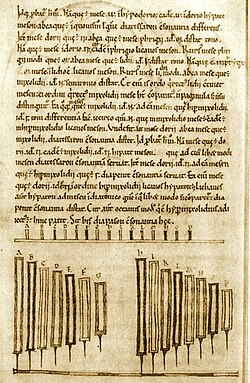
The foundations of modal theory began with the Greek scales of the Aristoxenian tradition. These included the Mixolydian, Lydian, Phrygian, Dorian, Hypolydian, Hypophrygian, and the Common (or Locrian/Hypodorian) scales. These early systems were not merely musical but were often tied to philosophical concepts in the works of Plato and Aristotle.
Parallel to these scales were the tonoi (singular: tonos), which referred to the pitch level or key of a piece. While the Aristoxenian school identified various tonoi such as the Hypermixolydian and Hypodorian, later theorists like Ptolemy viewed tonoi as seven octave species within a fixed octave, achieved through chromatic inflection. Pythagoras further refined these intervals arithmetically, establishing the ratios for the unison (1:1), octave (2:1), fifth (3:2), fourth (4:3), and major third (5:4).
The Western Church and Gregorian Modes
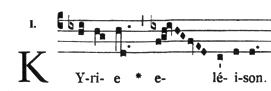
As music evolved into the Western Church tradition, the system of Gregorian modes emerged. These modes are defined by two primary markers: the final (the note on which a melody concludes) and the reciting tone (also known as the dominant or tenor), which is the pitch around which the melody primarily centers.
Authentic modes typically have a reciting tone a fifth above the final, while plagal modes have a reciting tone a third above. Over time, specifically during the 10th and 11th centuries, the reciting tones for modes 3, 4, and 8 shifted upward.

The Eight Gregorian Modes
The church system categorized music into eight modes, often associated with specific emotional qualities or "affects":
- Mode I (Dorian): Serious; Example: Veni sancte spiritus.
- Mode II (Hypodorian): Sad; Example: Iesu dulcis amor meus.
- Mode III (Phrygian): Mystic or vehement; Example: Kyrie fons bonitatis.
- Mode IV (Hypophrygian): Harmonious or tender; Example: Conditor alme siderum.
- Mode V (Lydian): Happy; Example: Salve Regina.
- Mode VI (Hypolydian): Devout or pious; Example: Ubi caritas.
- Mode VII (Mixolydian): Angelical or youthful; Example: Introibo ad altare.
- Mode VIII (Hypomixolydian): Perfect or knowledgeable; Example: Ad cenam agni providi.
![The eight musical modes. f indicates "final".[47]](/images/d6/ac/d6ac4d1c72c6a6384e957e2303c3fe10f32c73773c02bce2447b175f4a82cf8a.png)
Modern Diatonic Modes
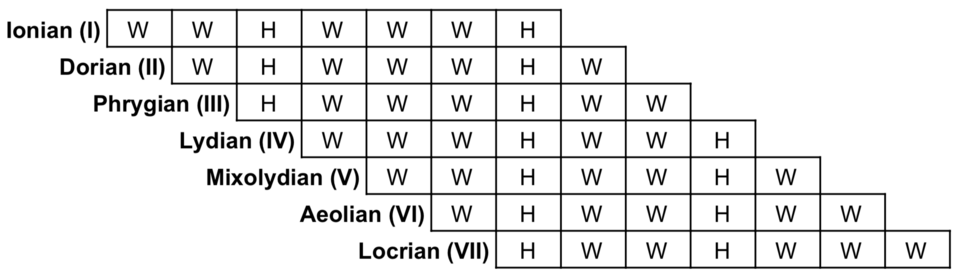
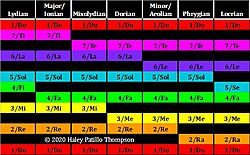
In modern music theory, diatonic modes are viewed as rotations of a single parent scale. For example, if you play the notes of a C major scale but start and end on D, you are playing the Dorian mode. These modes are defined by their unique sequences of whole (W) and half (H) steps.
| Mode | Tonic (Relative to Major) | Interval Sequence | Example (C-based) |
|---|---|---|---|
| Ionian | I | W–W–H–W–W–W–H | C–D–E–F–G–A–B–C |
| Dorian | ii | W–H–W–W–W–H–W | D–E–F–G–A–B–C–D |
| Phrygian | iii | H–W–W–W–H–W–W | E–F–G–A–B–C–D–E |
| Lydian | IV | W–W–W–H–W–W–H | F–G–A–B–C–D–E–F |
| Mixolydian | V | W–W–H–W–W–H–W | G–A–B–C–D–E–F–G |
| Aeolian | vi | W–H–W–W–H–W–W | A–B–C–D–E–F–G–A |
| Locrian | vii | H–W–W–H–W–W–W | B–C–D–E–F–G–A–B |
Beyond Diatonicism: Pentatonic and Heptatonic Scales
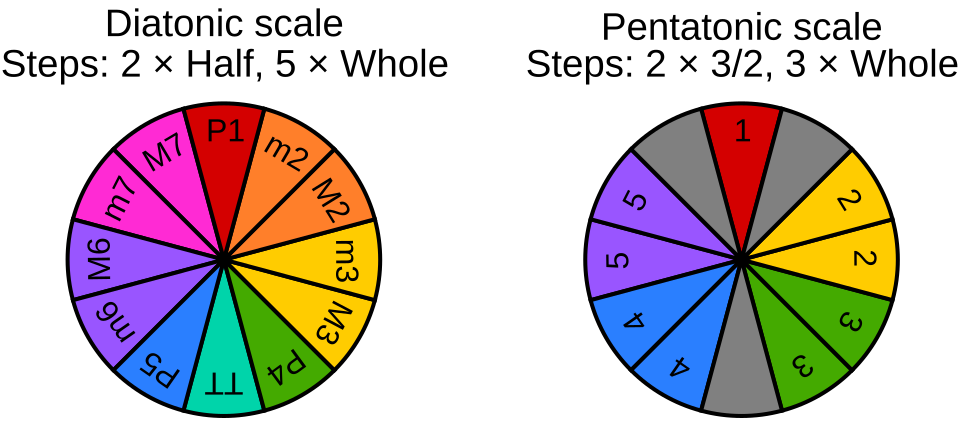
While diatonic modes use seven notes, other systems exist. The pentatonic scale uses only five notes per octave, creating a different harmonic feel compared to the diatonic scale. Additionally, various heptatonic (seven-note) scales are derived from the melodic minor, harmonic minor, and harmonic major scales, including the "Altered" and "Ukrainian Dorian" scales.
These modal concepts are not exclusive to Western music. Similar systems can be found globally, such as the Maqam in Arabic and Turkish music, Raga in Indian classical music, and Dastgah in Persian tradition.
Frequently Asked Questions
What is the difference between a mode and a scale?
While often used interchangeably, a scale is a sequence of notes, whereas a mode refers to the specific way those notes are organized around a tonic (the home note), which changes the melodic and harmonic character of the music.
What is a reciting tone in Gregorian chant?
The reciting tone, also called the dominant or tenor, is the pitch that a melody centers around or "holds" before moving toward the final note.
Which modern mode is the same as the major scale?
The Ionian mode is identical to the modern diatonic major scale.
How do the intervals define a mode?
Each mode has a unique sequence of whole and half steps. For example, the Phrygian mode begins with a half step, giving it a distinct, darker sound compared to the Ionian mode, which begins with a whole step.
What are some non-Western equivalents to musical modes?
Many cultures have similar systems, including the Indian Raga, the Arabic Maqam, the Byzantine Echos, and the Javanese Pathet.