Appoggiatura: The Art of Musical Ornamentation
In the world of music theory, an appoggiatura is a sophisticated ornament used to add emotional depth and tension to a melody. Derived from the Italian verb appoggiare, meaning "to lean upon," this technique involves placing a non-chord note—a tone that does not naturally belong to the current harmony—on a strong beat. This creates a momentary dissonance that "leans" into the principal, expected chord note, delaying its arrival and creating a sense of yearning or longing.
Typically appearing on the first or third beats of a measure in 4/4 time, the appoggiatura is usually positioned one degree higher or lower than the principal note and may be chromatically altered to enhance its expressive quality. This ornament is versatile, appearing frequently in both vocal compositions and instrumental works.

Key Facts
- Definition: A non-chord note that resolves to a regular chord note.
- Function: Accents the melody and delays the principal note to express emotion.
- Terminology: Also known as a "long appoggiatura" to distinguish it from the shorter acciaccatura.
- Direction: Historically, ascending appoggiaturas were called "forefalls," while descending ones were called "backfalls."
- Placement: Usually occurs on strong beats of a measure.
Notation and Performance
The appoggiatura is most commonly written as a small grace note prefixed to the principal note. In standard notation, these small characters usually lack an oblique stroke. However, because this same notation can be interpreted in various ways, the determination of whether a note is an appoggiatura often depends on performance practice—the established customs of how a specific style or era of music is played.
To eliminate ambiguity, composers may choose to notate the appoggiatura using full-size notes, explicitly showing exactly how the ornament should be performed in terms of rhythm and duration.
The Double Appoggiatura
A more complex variation is the double appoggiatura (Appoggiatura doppia). This ornament consists of two short notes preceding the principal note, with one placed above and the other below the target tone. These are typically written as small sixteenth notes.
The timing of a double appoggiatura is flexible and depends on the context of the melody:
- Duration: The time required for both grace notes is subtracted from the value of the principal note.
- Speed: They are generally slower when the principal note is long and faster when the principal note is short.
- Intervals: If the first note is at a significant distance from the principal note, the ornament is typically played slower than if both notes are close to the target.
Rare variations exist, such as the inverted double appoggiatura or the dotted double appoggiatura mentioned by C. P. E. Bach. In the dotted version, the first small note is dotted and receives the primary accent, while the principal note becomes as short as the second grace note.
Approaches and Resolutions
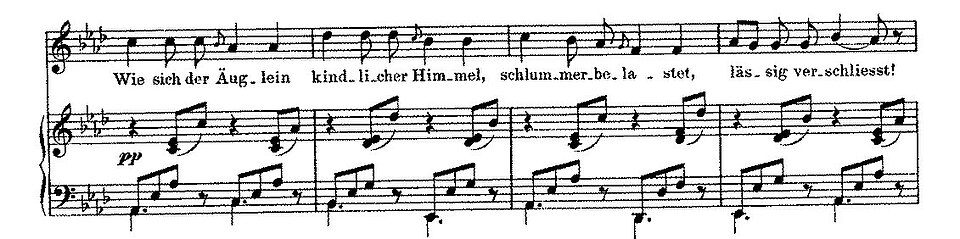
While appoggiaturas are frequently approached by a leap and resolved by a step, they can also be approached and resolved by step. A notable example of this specific movement can be found in Schubert's "Wiegenlied" D. 867.
| Type | Description | Key Characteristic |
|---|---|---|
| Appoggiatura | Single non-chord note resolving to a chord note | Expresses "yearning"; occurs on strong beats |
| Acciaccatura | Short appoggiatura | Played very quickly |
| Double Appoggiatura | Two short notes (one above, one below) | Duration subtracted from the principal note |
Frequently Asked Questions
What is the main difference between an appoggiatura and an acciaccatura?
The primary difference is duration and emphasis. An appoggiatura is a "long" ornament that takes up a significant portion of the beat and emphasizes the dissonance, whereas an acciaccatura is a "short" grace note played rapidly.
What does the term "forefall" and "backfall" mean?
These are older terms used to describe the direction of the ornament: a forefall is an ascending appoggiatura, and a backfall is a descending appoggiatura.
How is the timing of a double appoggiatura calculated?
The time taken to play the two preceding grace notes is subtracted from the rhythmic value of the principal note that follows them.
Can an appoggiatura be used in any type of music?
Yes, appoggiaturas are used in both vocal songs and instrumental works to add emotional expression and melodic interest.
How do musicians know if a grace note is an appoggiatura?
Since notation can be ambiguous, musicians rely on performance practice—the historical and stylistic conventions of the music—or look for full-size note notation provided by the composer.