Understanding Tree Bark: Anatomy, Function, and Uses
When we look at a tree, the first thing we notice is its bark. While it may seem like a simple protective skin, bark is a complex system of tissues essential for the survival of woody plants, including trees, shrubs, and woody vines. In botanical terms, bark refers to all the tissues located outside the vascular cambium—the layer of cells responsible for the plant's growth in thickness.
Bark is generally divided into two main components: the inner bark and the outer bark. The inner bark consists of living tissue in older stems and includes the innermost layer of the periderm. The outer bark, conversely, is composed of dead tissue on the surface, including the outermost periderm and everything external to it. In mature trees, this outermost dead layer is specifically known as the rhytidome.
Key Facts
- Bark comprises 10% to 20% of the total weight of woody vascular plants.
- The vascular cambium is the boundary; everything outside it is considered bark.
- Suberin, a waxy substance in cork cells, prevents water loss and blocks pathogens.
- Lignin makes up to 40% of bark tissue, providing critical structural support.
- Girdling occurs when a ring of phloem is removed, typically killing the plant.
- The cork oak (Quercus suber) can produce bark thicker than 20 cm.
The Anatomy of Bark
Bark is only found on woody plants; herbaceous plants and very young stems lack this structure. In young stems, the plant is protected by an epidermis, which is eventually replaced by the periderm as the plant matures.
In a mature woody stem, the layers are organized from the outside moving inward as follows:
- Bark
- Periderm
- Cork (phellem or suber), which includes the rhytidome
- Cork cambium (phellogen)
- Phelloderm
- Cortex
- Phloem (nutrient-conducting tissue)
- Periderm
- Vascular cambium
- Wood (xylem)
- Sapwood (alburnum)
- Heartwood (duramen)
- Pith (medulla)
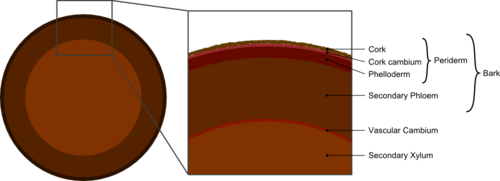
The periderm is a secondary protective covering composed of the cork, cork cambium, and phelloderm. It replaces the epidermis and acts as a shield against desiccation and pathogen attacks. Because the periderm is largely impermeable to gases, the plant develops lenticels—small pores with numerous intercellular spaces that allow the living cells within the cambium to exchange gases with the atmosphere.
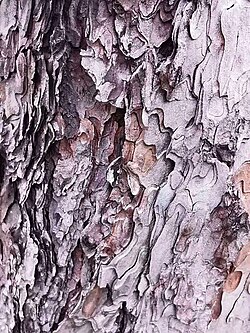
The Rhytidome
The rhytidome is the most visible part of the bark. It consists mostly of dead cells and is formed by multiple layers of periderm, cortical tissue, and phloem. This layer is most prominent on the bole (the trunk area from the ground to the first main branches) and is particularly thick in older trees. In shrubs, the rhytidome is often exfoliated more quickly.
Chemical Composition and Protection
Bark is a powerhouse of biopolymers, including polysaccharides, tannins, suberin, and lignin. Lignin is especially important, as it crosslinks with polysaccharides like cellulose to provide structural integrity. Up to 40% of bark tissue is lignin.
To defend itself, the tree utilizes condensed tannins, which are found in high concentrations in the bark and are believed to inhibit decomposition. Additionally, the suberin in the cork layer acts as a chemical and physical barrier against microbial degradation. Research on the white-rot fungus Lentinula edodes (Shiitake mushroom) suggests that the specific type of lignin in bark—containing more Guaiacyl units than Syringyl units—makes it more resistant to fungal decay than the interior wood.
| Component | Type | Primary Function |
|---|---|---|
| Suberin | Waxy Substance | Prevents water loss and blocks insects/bacteria |
| Lignin | Biopolymer | Provides structural support and decay resistance |
| Phloem | Living Tissue | Transports photosynthetic nutrients |
| Lenticels | Pores | Facilitates gas exchange for metabolism |
| Tannins | Chemical Compound | Inhibits decomposition and fungal growth |
Damage, Repair, and Ecosystems
Bark is subject to various forms of damage. Environmental stressors can cause sun scald or frost cracks, while biological factors include attacks from boring beetles and woodpeckers. Some animals, such as male deer (Cervidae), damage bark by rubbing their antlers against trunks during the rutting season to remove velvet.
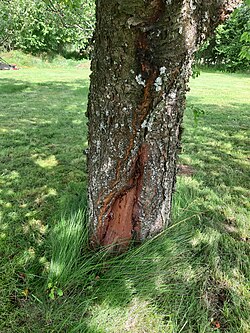
Physical constraints, such as wrapping a tree in wire or binding it to stakes, can also cause significant harm. If the phloem is destroyed in a complete circle around the stem, the plant cannot transport nutrients and will die—a process known as girdling.
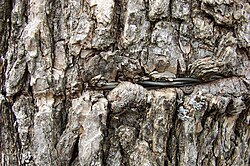
The ability to repair this damage varies by species. Some trees produce a callus, a mass of cells that heals the wound but leaves a visible scar. Others may produce sap to seal the area against insects and disease. Bark also serves as a habitat for various organisms, including mosses, algae, fungi, and insects, some of which maintain symbiotic relationships with the tree.
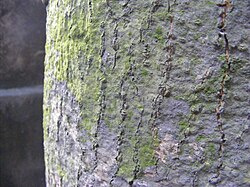
Human Uses of Bark
Throughout history, humans have utilized bark for food, medicine, and construction. The inner bark (phloem) is edible and has been used as a survival food during famines. In Scandinavia, the toasted and ground inner bark of birch or scots pine is used to make bark bread. The Sami people of northern Europe traditionally harvest Pinus sylvestris bark in the spring as a staple food resource.
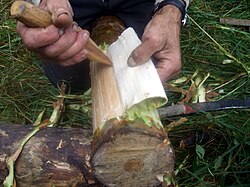
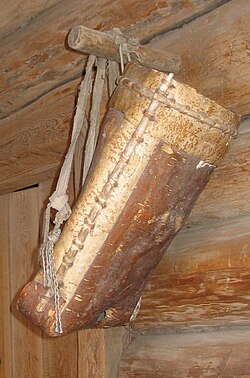
Bark's physical properties make it an excellent construction material. Birch bark, which can be removed in long, cohesive sheets, has been used to create canoes, shoes, and backpacks.
In settler colonial societies, such as in Australia, bark was used for roofing and exterior wall cladding. Australian Aboriginal cultures have used eucalypt bark for thousands of years to create shields, coolamons, and canoes, as well as for painting (such as the Yirrkala bark petitions).
![A 1922 bark-clad schoolhouse in Queensland, Australia[33]](/images/b3/77/b377636c5fe457ca1212697e73d5bf395e29ea8fbb7813e7a0ea67b82bcfb16b.jpg)
Commercial and industrial applications of bark are diverse:
- Medicine: Quinine is derived from Cinchona bark, and aspirin originates from willow bark.
- Industry: Oak bark (Quercus robur) provides tannic acid for tanning leather.
- Products: Cork is harvested from the Quercus suber without killing the tree.
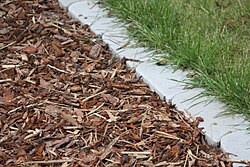
- Horticulture: Bark chips are used as landscape mulch and as a growing medium for epiphytes.
- Chemistry: Pyrolyzed wood bark yields bio-oil rich in phenol derivatives, used in resins for plywood and oriented strand board (OSB).
Frequently Asked Questions
What is the difference between bark and cork?
While often used interchangeably in casual conversation, they are different. Bark is the general term for all tissues outside the vascular cambium. Cork (phellem) is specifically the outermost layer of the periderm, produced by the cork cambium.
What happens to a tree during girdling?
Girdling occurs when a strip of bark, including the phloem, is removed from the entire circumference of the stem. Because the phloem is responsible for transporting photosynthetic products (nutrients) from the leaves to the roots, the roots are starved, and the plant typically dies.
Why is the inner bark considered "living" while the outer bark is "dead"?
The inner bark contains the phloem and the innermost periderm, which are active in transporting nutrients and cell division. The outer bark (rhytidome) consists of cells that have been pushed outward by new growth; they are cut off from water and nutrient supplies by the thickening cork layer, causing them to die.
Can all tree bark be used as food?
No. Only the inner bark (phloem) of certain species is edible. While some cultures have used pine or birch bark during famines, many barks contain toxins or chemicals that make them inedible or poisonous.
How do trees "breathe" through their bark?
Since the corky layers of the bark are impermeable to gases, trees use lenticels. These are small, porous openings in the periderm that allow for the exchange of oxygen and carbon dioxide between the internal living tissues and the atmosphere.